My First Cup of Excellence Coffee

I just wanted to introduce you, to those of us who do not know to the Cup of Excellence group. Scanning through their website on www.cupofexcellence.org the idea began 1999 when a group of coffee connoisseurs believed that Brazil had some really special coffees that kept on being unnoticed or disregarded, probably because although Brazil grows the most coffee in the World, their coffees are primarily used for instant coffee or if of good quality, blended with other coffees.

In any case this group got together “cuppers” (expert coffee tasters) and they went through a few coffees and the best ones were selected, giving the Cup of Excellence stamp and auctioned through the internet. This practice continues today and now has 9 country programmes, mainly from Central and South America but with one exception, Rwanda in Africa. The coffees are very special, each with their own distinctive flavours, aromas, etc and are practically handcrafted by their grower and eventually auctioned off through the internet.

The Cup of Excellence is now what may be known as the Oscars of the Coffee World. The coffees are bought by coffee connoisseurs all over the World, roasted by top specialists who want to give their customers the best highest quality coffee. Furthermore, the people who really benefit from this scheme are the growers themselves, who are recognised and financially rewarded, enabling them to plough back the profits into their business, leading to better education for their loved ones and impacting positively on their communities – Well done !

So, naturally, you can imagine that I was very excited when I got my hand on a Cup of Excellence Bag of coffee from the Costa Rica Libano coffee farm, roasted by a specialist in Austria.

CoE Label 

I checked out the coffee on the Cup of Excellence website, where it was described by the professional cuppers as “bright, honey, syrupy and dry fruit”. I was advised to use it for espresso, which I found sweetish, reminding me of the espresso I had at Flat White, Soho (London). It had a nice golden colour too, having not been dark roasted.

Cup of Excellence Espresso 

However, as far as I am concerned Central American coffees are excellent for espresso based milk drinks and I as soon as I used this coffee for a double espresso macchiato, it was  FANTASTICO – Heavenly, Wow ! What a feeling. Naturally ! I only drank this wonderful coffee in the mornings when I tend to drink milk based espresso drinks such as Cappuccinos or Lattes. I think the price I paid, about 7 Euros for a 250g bag of beans was worth it, considering that I have spent more and it hasn’t been a Cup of Excellence coffee. So, next time you visit your specialist roaster, try and ask if they can get you a Cup of Excellence coffee, but not one that will break the bank.

Latte Love – My Latte Art Heart

I just wanted to share another one of my favourite pics with you, taken in a LOVE coffee mug bought by my wife pour moi.

 Latte Love

As you can see, I’ve been practising my “latte art” and although I haven’t progressed to rosettas and big hearts, this is my second success with a little heart, so wish me luck every mornings when I practise my latte art and end up rushing to work and getting in just in time. Wishing you a latte love morning, ciao.

Another Visit to Origins Coffee Roasting, Cape Town

This is another long overdue post, as I was in Cape Town in February 2008. Again, any visit there has to include a trip to my favourite coffee shop in the Southern Hemisphere, Origins Coffee Roasting, 28 Hudson Street, de Waterkant, Cape Town. Origins Shop FrontIt’s one of those places that when I visit, it feels like home, as the staff now recognise me as that keen coffee drinker with a camera always talking about coffee machines and coffee beans. I was glad to see that Origins have expanded their horizons and are taking their self-imposed goal of educating South Africa about quality coffee seriously. For one, they now have a barista school at the back of their shop, where I was able to witness upcoming baristi (plural for barista in Italian) practising their latte art. I also met briefly again with Joel Singer, co-owner of Origins. Secondly, Origins now organise roadshows and they planned to have one in Johannesburg in late February. They now sell their blends to other cafes (Manna Epicure – see post on Cape Town Coffee Scene of 2008 below) and are now beginning to get a reputation. When I first discovered the place, I used to go around Cape Town mentioning Origins and everyone used to look at me like, “what and where is that ?”, but on this visit, they were like “yes, I’ve heard of it….” . In addition, one of their baristi won the South African National Barista Championships – the second year in a  row that one of Origins home grown has won.

Origins Inside 

So, I’m glad that Origins reputation is spreading as the “Artisan Roasters of Africa” in SA.

In the shop, they’ve changed their main coffee grinder to the Spanish made Compak, which is fast becoming the expert choice of the baristi world as Compak coffee grinders are now used at the World Barista Championships.  In any case, I went for my double espresso and was tempted to try 2 Portugese custard tarts or pasties de nata and shot a video of a two heart latte art, which you can view on my YouTube page ( http://www.youtube.com/Lameen71) They still serve their coffees using a naked filter on their Synesso espresso coffee machine, which I was determined not to miss. This gives their espresso and edge.

Origins naked filter 

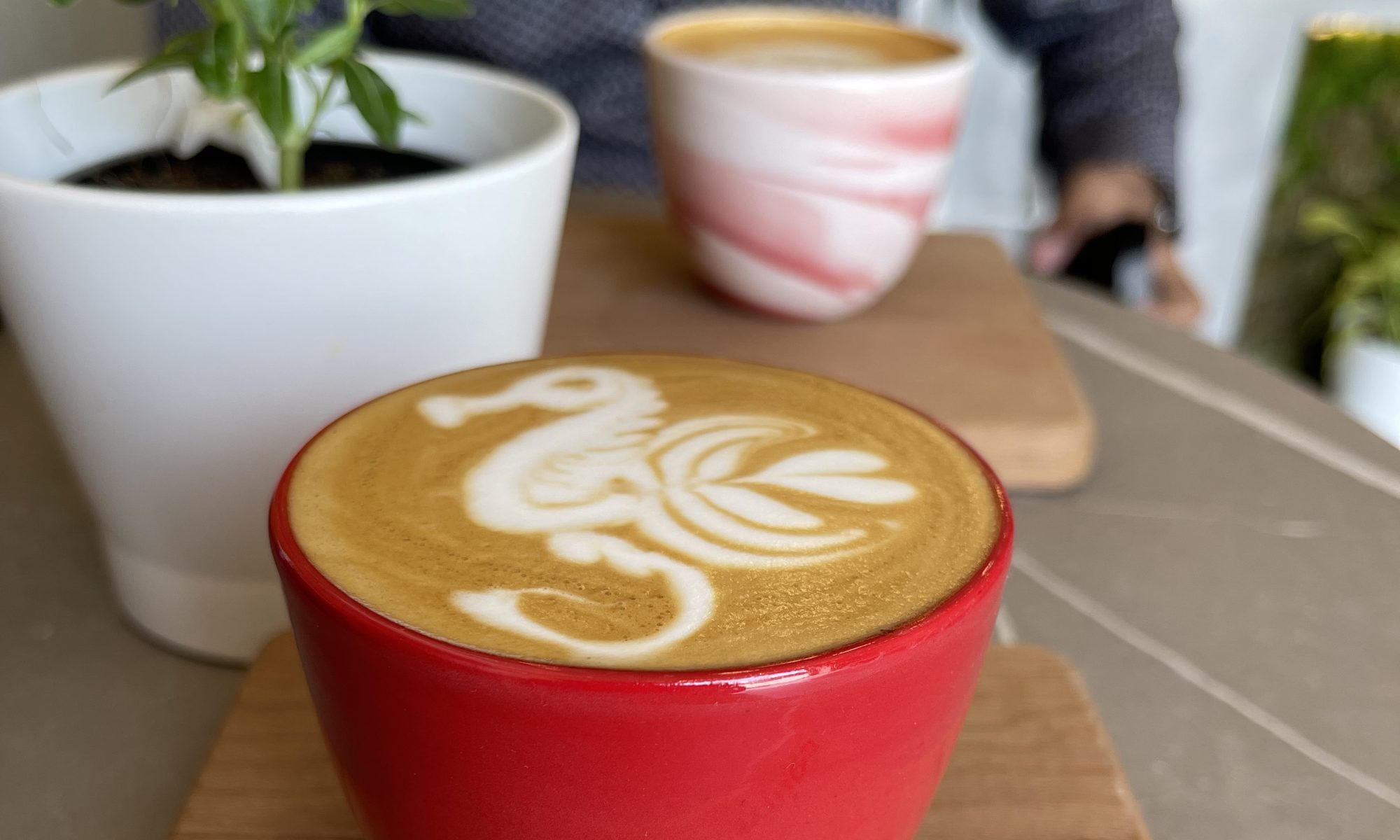
I also got to snap this unusual latte art piece – dragonfly of heart ?

Origins Dragonfly 

I bought some freshly roasted coffee and was glad to see other people in the queue enquiring and splashing out (an English slang for spending lots of money) on coffee.

Origins Coffee Display 

I continue to wish Origins the best of luck in their ventures and if you go to Cape Town, please do yourself a favour and visit – your taste buds would love the experience. Check out their website on http://www.originroasting.co.za/

I’ve Been Drinking… lots of Coffee

Bags of Coffee 

I’ve been a bit lazy with this category, where I share my latest coffee bean experience with you – so I’m going to give you a snapshot of what I’ve been drinking over the last 2 months and promise to keep you up to date with my latest taste adventures.

First up is a Rwandan Musasa, which I bought from Origins Coffee Roasting, Cape Town, back in February 2008.

Rwandan Musasa 

It was quite nice as an espresso, rich, dark and …. handsome (to the taste buds that is). I found it earthy/chocolatey and a smell of it, reminded me of Africa. So it was quite true to its name. I also got on that trip an Ethiopian Yirgacheffe as they didn’t have my favourite Ethiopian Sidamo. The Yirgacheffe was what I call typical African – bold and earthy, nice for Cafetiere and I couldn’t resist the temptation to make a portion in my bodum Cafetiere and shoot it in a newly bought “African” coffee cup, which I bought in Zimbabwe.

African Coffee

On my way back from that trip to Africa, I got to stop over in London and rushed on over to my favourite roaster, HR Higgins, where sadly enough they didn’t have Indian Malabar Monsooned but I was tempted to try their Brazilian Bourbon, which I can tell you has been added to my favourite list for espresso. Delightful ! It’s quite smooth as an espresso and has that Italian feel – I seem to recall reading somewhere that Italians use a lot of Brazilian arabica coffee beans in their espresso blends. As I usually drink espresso at night and wasn’t able to get a good shot of a rich and smooth espresso due to bad lighting, I can only share with you, a snapshot of the coffee bag below.

HR Brazilian Bourbon 

In any case that basically summarizes the main highlights of my taste adventures for now. Of course I’ve also been drinking lots of other coffee but I just wanted to focus on the main discoveries.

My Coffee Videos on You Tube

My First Video, shot at Origins Coffee Roasting, Cape Town, where the barista poured two hearts into a latte. Check it out; Two Hearts Latte Art.mov   

Or if your browser doesn’t like this, click below for more videos;

http://www.youtube.com/Lameen71 

From Russia With Love

No ! I didn’t misspell the title of this blog. I’m not sure about you but since my childhood (not trying to give away my age), I’ve always been a keen James Bond fan – slight inspiration for my website and blog name. I’m now in the process of trying to keep up with technology and buy my favourite James Bond films on DVD. So the other night, I finally sat down to watch the DVD re-mastered version of one of my all time favourites – From Russia With Love, starring Sean Connery as James Bond.

From Russia With Love 

I noticed that of all the James Bond films I can remember, this is the only one where James Bond actually ordered a cup of coffee and not his usual shaken not stirred cocktail. Perhaps, the author, Ian Fleming, thought that for that scene in Turkey – home of the first coffee culture phenomenon – James Bond should order coffee and not an alcoholic drink. I also found out that Ian Fleming had a house in Jamaica, where he wrote some of his novels and that one of his favourite drinks was coffee, the highly renowned and most expensive coffee, Jamaica Blue Mountain coffee naturally, which incidentally is supposed to be James Bond’s favourite coffee bean. What a coincidence – just thought that I’d share.

A Special Request @ Flat White

“Can I have a triple espresso flat white made on a bottomless filter please ?” You what ? OK ! let me decipher. Usually, you can get a single or a double espresso in your milk based drink, mainly because the portafilter (where the coffee is ground into and placed into the espresso machine) can take a minimum of a single espresso and a maximum of a double espresso. However, I learnt that at Flat White, Berwick Street, Soho, London they had a special triple espresso portafilter, which means you can order a triple espresso shot. A Flat White (from which the shop is named) is an Australian Version of a Latte, but with less frothed milk. I also learnt that they sometimes use a bottomless filter, which means that the portafilter does not have a base under the coffee basket – Am I loosing you in this jargon ? Making espresso in a bottomless filter means that the coffee is extracted straight from the machine into your coffee cup, without touching any metal. So in essence, you are getting quite a pure pour and the taste should be sublime. So, on a recent visit to Flat White coffee shop, I made this order and watched the event. The top barista and co-owner, Cameron, was really helpful. Here is the beginning of the pour for the latte art;

rosetta cometh 

And here is the final version – almost too good to drink, but lovely as a picture.

Rosetta @ Flat White London 

They also use bottomeless portafilters at my other favourite coffee shop in Cape Town, Origins Coffee Roasting, which I have a picture of and will share with you some other time God willing !

So ! if you get a chance to be brave and show off to your friends, forget that stuff about skinny soya latte, etc and order a triple shot espresso latte or flat white. 

Drinking Coffee in London @ Fernandez & Wells

Fernandez & Wells 

Another one of favourite coffee shops in London has to be Fernandez & Wells, which actually has two shops in Soho – fast reclaiming back its status as the place to eat, drink and be seen in London. The first shop on 43 Lexington Street is described as a Food & Wine Bar “a European Market Stall in an English Setting”, where you can buy meat, cheese, sandwiches, etc. However just around the corner on 73 Beak Street is their Coffee Shop, where I’ve been before (see https://fromcoffeewithlove.com/pages/enjoy_culture-beanthere.html).

For a little background, their coffee is from the famous Monmouth Coffee Company and they now have a Synesso Cyncra Espresso Machine (they used to have a La Marzocco) – I’ve only seen 2 Synesso machines, one in Cape town and one now in London. For more info about this wonderful machine see www.synesso.com If my dream of having a coffee shop one day came true, then this machine is first on my list. Anyway back to the shop – they have a simple clean layout, where all the goodies are displayed

Cakes at F&W 

Now ! doesn’t that look inviting ? As I had just had breakfast, I could only stomach a Pasties de Nata a Portuguese custard tart, which I had only had previosuly at Origins Coffee Roasting in Cape Town – now that I am writing this, there seems to be come kind of connection, same custard tarts and same coffee machine, hmmmm ! They also have bread from the famous French bakery, Poilâne. I decided to try a Piccolo, which I had wanted to try on my return. A Piccolo is like a smallish latte, served in a double espresso cup and I found out that the barista and another shop assistant were previously from Monmouth Coffee Company – so they got the coffee and the staff from the pros – well done ! Anyway, as you can see below, my piccolo was served with latte art in this tiny cup – impressive as Im still struggling to do latte art in a big cup.

Piccolo from F&W 

The coffee was nice and smooth and the staff were friendly and on my next visit, I pray that I’ll have the chance to pop in and have that Sicilian Lemon Cheesecake that I didn’t have space in my tummy for.

For more, visit http://www.fernandezandwells.com/beak.php

How Can You Tell if Your Beans are FRESH ?

I’m not sure about you, but sometimes when you go to a cafe or speciality coffee shop to buy coffee, when you ask, “Are your coffee beans fresh ?”, you will always get an answer of “Yes ! of course”. However, as most of us are not expert coffee sniffers – those who can see or smell a handful of coffee beans and know instantly whether it is fresh, not to mention that in most places, the beans are already packed neatly in a bag, so there’s no way for you to even see or smell the beans, then you just have to trust the retailer until you get home – and this is where I can share some advice with you. As a first test, look at the pictures below – can you guess which ones are fresh and which ones are not ?

Old to Fresh

 fresh to old

OK ! the colour in these pictures may give you a clue, but to save you from agony, the prominent beans in the first picture are actually very old – like over a year – ideal for taking pictures but not to drink. The prominent beans in the second picture are fresher. However, in some cases this might not be the best way to judge the freshness of your bean, because as you know by now (I am assuming you have been reading my website and blog) – some coffee beans are roasted darker than others. OK ! for the next test. From what I’ve read, as soon as you freshly grind your coffee beans and prepare it in the manner that you prefer, you will see some obvious signs of freshness. For espresso, it can be quite obvious – fresh coffee beans, just roasted and prepared properly and extracted will show coffee coming out like it is full of crema, like the picture below.

 Extracting Fresh

So if you watch your espresso being prepared, it should not fall into your cup looking like dark coffee, but like crema/light brown. It obviously changes when it hits the cup and mixes with the air. There’s a lot of science to do with this, but as I’ve been through the agony of reading literally tons of pages on this, I will just simplfy it for you “fresh coffee should come out like crema when extracting for espresso”. For other types of coffee, like cafetiere, when you pour it into the beaker and stir, there should be a bubbly dark cloud on top – I promise to get a picture of this for you but my camera is currently broken, so for next time God willing !

For some very aromatic coffees like the Indian Malabar Moonsooned or Central American coffees, you will obviously be able to judge by the wonderful aroma too. In any case, if you get home and don’t see these signs not just for the first time, but over the course of the week of drinking that particular coffee, then chances are the coffee isn’t very fresh at all. Good luck !