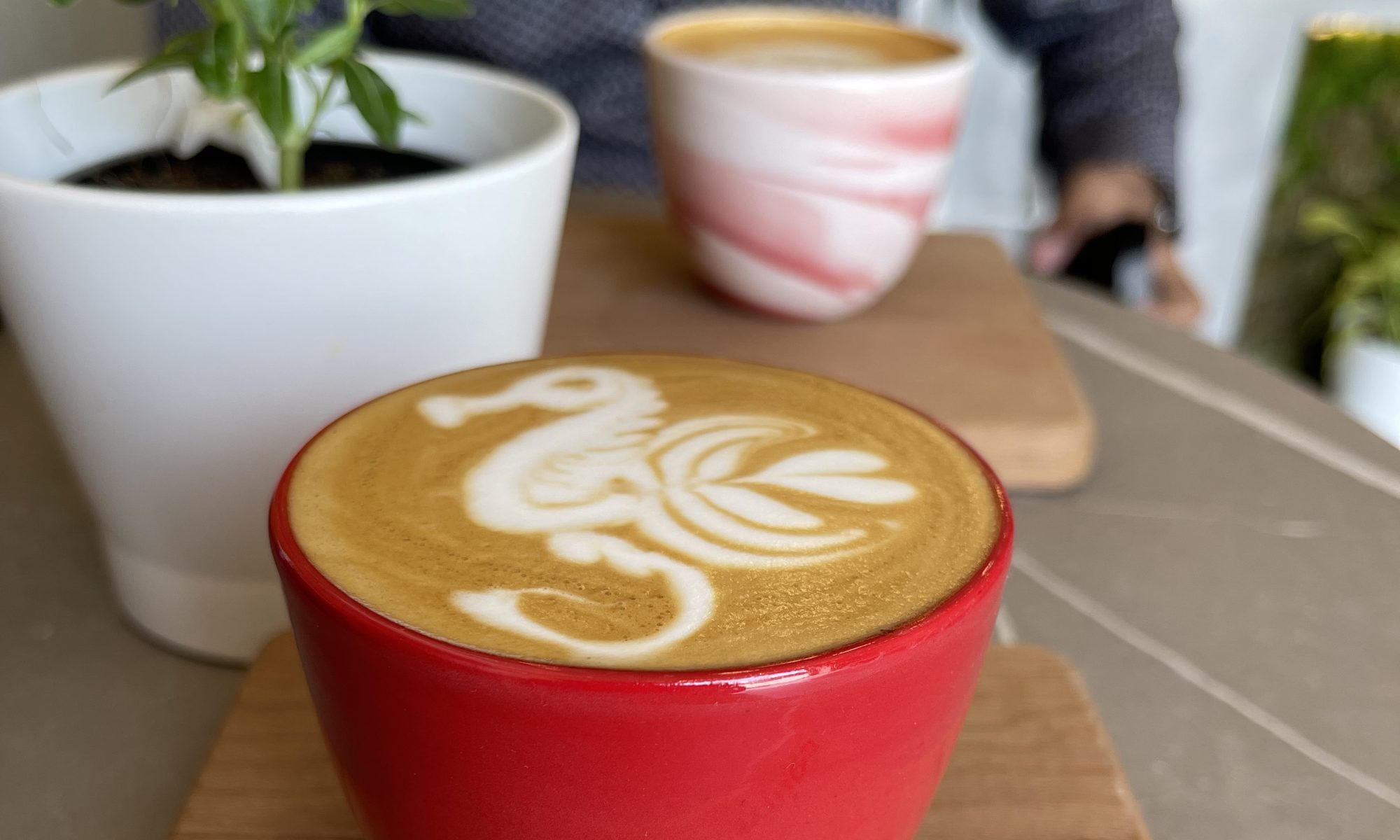
Wow ! it’s already been a month since my last post, which is way over my target of a weekly post but my excuse, if I can get away with one, is that it was family holiday season and we went again to Dubai – the kids and wife insisted.

Last year I wrote a summary on drinking coffee in Dubai, which was really like a summary of drinking coffee in one mall. This time, I tried to broaden my horizons by visiting a few more malls but still failed to visit some cafes outside the mall perimeter – next time God willing. Following on from some advise given by a coffee pro – “don’t bother tasting espresso style coffee from coffee chains because it is always going to be badly prepared”, I initially only ordered what could be called Americanos and just “normal” filter coffee. For a while it satisfied my caffeine thirst, but then I thought, it’s been over one week without espresso and decided to risk it.
A few pointers before telling you about my experience. Firstly, I only visited cafes with semi-automatic machines and not pure automatic ones (witness Starbucks), where the barista just pushes a button and hopes for the best. Secondly, and I was called a snub for this by my wife – insist that the barista cleans the machine before making your coffee. Usually, old coffee is left in the portafilter, emptied and without cleaning the old dried stale coffee, what is supposed to be fresh coffee is ground and placed into the portafilter before placing into the group head without cleaning the machine – Yuk! On this occasion, I insisted every time that the barista empty the old coffee, flush it out with hot water and also clean the group head with hot water. Finally, I insisted that they tamp the ground beans. You would think that with these key pointers, some sort of espresso will come out, but sadly this was not the case – why ? I think it falls under the best known two classical mistakes – serving non-fresh coffee with an inaccurate grind setting. From the taste of the majority of the coffee I had, freshness was compromised by far, because, even if the coffee is fresh and the grind setting is inaccurate, you will smell the aroma and the coffee, although bitter in taste, will still have some sort of fresh taste. I didn’t even go there with milk based drinks because badly frothed milk is usually burnt and gives me indigestion – Snubbish ? No ! I’m just trying to get what I paid for and not mess up my stomach.
Anyway to the shops. One thing I noticed now is that some more of the cafes have now started trying to tamp. At the Tea Merchants, Burjuman Mall, I noticed a La Marzocco machine and an expensive Mahl Konig Grind-on-Demand coffee grinder, but sadly, as you can see from the picture, after insisting on cleaning the machine, etc the crema was still very thing and lasted about a minute but the taste told me more – not very fresh.

The baristas, however, were very amused by my tips on cleaning the machine and tamping the coffee.
Having looked down on coffee chains and there are everywhere, I decided to try a popular one in Dubai, who boasted about the “Italian taste”, so I went to the aptly named Barista – which is actually an Indian coffee chain. At their shop in the Dubai Festival City (nice shops and water way) I was impressed by their preparation techniques and most of all by the taste – it did have an “Italian taste” after all, as they proudly displayed that their coffee is roasted in Milan.

In all, I told them that their espresso was the best I had tasted in Dubai. I also caught, surprisingly of all, one of the baristi having a go at latte art… hmmmm !
One more success story was the espresso I had on my last day at the Dubai International Financial Centre in the Testa Rossa Caffe. I decided not to fuss about how the coffee would be made – I was too hungry to run over to the bar. However, perhaps my reputation had preceded me as I watched the barista, clean the machine, flush out the group head, grind the coffee and tamp. I was impressed and although the coffee had some crema, the taste was not as sharp as the one I had at Barista.

I’m still looking for real crema and that authentic espresso taste in Dubai – land of the malls, flashy cars, famous hotels and indoor ski slope, but that will have to be on another occasion God willing if I return. I’ve just got to leave you with one incident – On another occasion on this trip, I decided to try an espresso at a Dubai based coffee chain and after warning the barista that I write on coffee, he boasted that his colleague could make really good espresso, so I thought why not. In chatting to him, I went a step further, “so ! what sort of coffee do you use in your blend and where is your coffee from ?” “Canada” was the reply and I thought “Oh no it doesn’t, they don’t grow coffee in Canada” but I decided to keep that embarrassing revelation to myself and just smiled – I then knew I was in for a surprise. Needless to say my suspicions were confirmed and that is why I have a story and not a picture of what was advertised as an espresso. I think they need really good coffee in Dubai to match their plans to become one of the top destinations in the World…. still looking.
 It is near the Hofburg Palace, situated on Kohlmarkt, which now resembles Saks Fifth Avenue (New York) or New Bond Street (London, UK), next to shops like Armani, Chanel, Louis Vitton and Tiffanys. Cafe Demel is famous because it was often visited by royalty and in keeping with tradition, even today, whenever dignitaries visit Vienna, a lot of them get taken to Demel to have a coffee or at least to buy a famous Viennese cake. For example, when the former United Nations Secretary General, Kofi Annan visited, Cafe Demel made a cake that looked just like him, at least from shoulder up.As you enter the shop, there’s a display of souvenir cakes on your left and on the right and in front of you, an impressive display of very traditional Viennese cakes and pastries. As you make your way to the back, the traditional atrium has been converted into an open display area, separating you from pastry chefs decorating cakes – you are allowed to take pictures as long as he flash is off. I made my way upstairs as the lunchtime crowd had already taken up all the best seats downstairs. The interior looks like it hasn’t been touched since the turn of the last century, but that adds to the character. The regular customers I spotted in there were all into the typical Viennese tradition of ordering a coffee and reading a newspaper. as you know, if you have been through my website under “did you know”, you will know that cafes in Vienna were the first ones to introduce newspapers on sticks.Anyway Cafe Demel is now a must-stop on the Vienna tourist trail, so I was not surprised to hear lots of American and British accents. I am also happy to report that the waitresses spoke English and more importantly, where very polite, contrary to the infamous Viennese reputation of unpleasant waitresses. I had a very traditional Viennese coffee, called an Einspanner, which s basically like an Austrian version of an espresso topped with lots of thickly whipped cream.
 To accompany my very Viennese Coffee House experience, I ordered another traditional Viennese dessert, a cherry and apple strudel. All in all it was a good experience, something to be done at least once if and when you visit Vienna and I must confess, this is my first visit to a traditional Viennese coffee shop since I moved to Vienna almost 6 years ago.
  It’s one of those places that when I visit, it feels like home, as the staff now recognise me as that keen coffee drinker with a camera always talking about coffee machines and coffee beans. I was glad to see that Origins have expanded their horizons and are taking their self-imposed goal of educating South Africa about quality coffee seriously. For one, they now have a barista school at the back of their shop, where I was able to witness upcoming baristi (plural for barista in Italian) practising their latte art. I also met briefly again with Joel Singer, co-owner of Origins. Secondly, Origins now organise roadshows and they planned to have one in Johannesburg in late February. They now sell their blends to other cafes (Manna Epicure – see post on Cape Town Coffee Scene of 2008 below) and are now beginning to get a reputation. When I first discovered the place, I used to go around Cape Town mentioning Origins and everyone used to look at me like, “what and where is that ?”, but on this visit, they were like “yes, I’ve heard of it….” . In addition, one of their baristi won the South African National Barista Championships – the second year in a row that one of Origins home grown has won.


 Needless to say, by the time I got there I was starving, having turned down the free breakfast at my hotel. The restaurant is a bit small and to be quite honest, I think it was converted from a bungalow. It has an all white decor inside, including white tables, chairs, floorboards and displays and a chandelier. There’s an outside bit, where I sat, which is like a balcony. To eat, I had their signature dish, scrambled eggs on coconut bread (delicious) and of course, I ordered a cappuccino. Turned out that they get their coffee from Origin Coffee Roasting Cafe (more of that to come later) – Anyway the coffee wasn’t bad, but I think it was more like a caffe latte than a cappuccino – I promptly got my camera out and took a few snaps – of course I got some weird looks, but hey ! you’ve got to seize the moment and what a lovely picture it is, below.

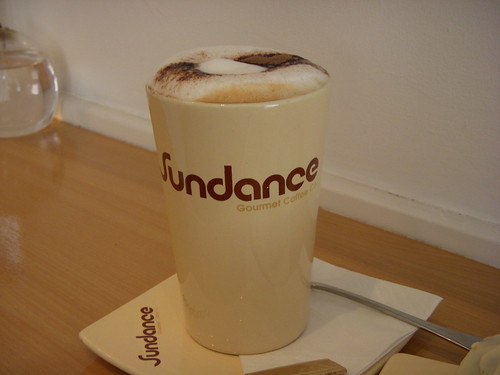

 On the website, I wrote a glowing report about my experience, so I wont’ go into similar details here. In any case, Origin is in keeping with their name – the Artisan Coffee Roasters of Africa. They now have a barista training school and are providing coffees to restaurants and other cafes (like Manna Epicure on Kloof Street), needless to say their coffee is of course superb, having won the 2007 and 2008 South Africa Barista Championships but I’ll say more on them in a future post – after all, they should get a special post as they are my favourite and this post is already getting quite long. Cape Town Coffee Scene – highly recommended !
 It doesn’t look too exciting when you walk in, but on your left there’s a massive Probat Coffee Roasting machine, which was roasting green coffee at the rate of 12 kilogrammes per 12-15 minutes. During my visit around lunchtime, the machine stopped and all this lovely freshly roasted coffee poured out and the air was awash with freshly roasted coffee beans, ahhh !!!!
  Back to the shop, coffee beans are displayed in metal-like boxes, offering a choice of 19 different types of coffees, mainly house blends but for the eco-friendly and trade conscious amongst us, there’s also a selection of 6 fairtrade and bio/organic single estate coffees. There’s also a small place to drink coffee round the back and up some stairs, where your coffee can be made on a La Spaziale espresso machine.
  At the shop front, they also sell some minor coffee equipment like French presses, moka pots and drinking glasses as well as fancy chocolate and something unusual, used green coffee bags, which are more like sacks, and can be used for decoration. Now for the real stuff, I tried an espresso, which they can offer you in 3 strengths as mild, medium or Italian strong – well, I had to try the strong stuff naturally. I checked the techniques, and although a tamper was used, my crema wasn’t dark reddish and caramel like and didn’t last minutes before disappearing – I therefore think their strength is in selling coffee beans. Now ! time to buy coffee. As a bit of a purist, I headed straight for their organic Fairtrade Papua New Guinea coffee for my dosage of afternoon coffee. I tend to drink cafetiere (French press) coffee in the afternoon and so favour either bold African coffees or flavoursome Central American coffee. However, on this occasion I decided to try something from the Pacific Ocean – just in case you are wondering where Papua New Guinea is – right above Australia. I still wanted something different for my daily espresso and cappuccino fixes and was persuaded to try their Scarlatti blend, advertised as ideal for an Italian espresso, consisting of 85% arabica and 15% robusta beans – I am a bit fussy about finding the source of things and tend to shy away from blends that do not offer the full listing and percentages of the origins of the coffee beans used in a blend, but again on this occasion I decided to bend my rules. On first impressions, the Scarlatti blend has a bitter and woody taste and does look like an Italian espresso. The Papua New Guinea coffee is just what I expected, a bit light, but flavoursome nevertheless. Alt Wien roast their coffee weekly and so promise freshly roasted coffee beans and their prices are quite reasonable, where the average 250g bag cost less than 5 Euros ($7). They have also opened another cafe on 32 Josefstadter Strasse, A-1080, Vienna.
 From Coffee With Love