The Diary of a Moka Pot: The Essence of Italian Caffe Culture

Making Moka Coffee 3 by Lameen
Making Moka Coffee 3 a photo by Lameen on Flickr.

It’s almost 7 years from the day when we first touched down in Rome for a family holiday. Hearing that I liked coffee, my cousin’s Italian husband handed me a Bialetti moka pot and some ground Lavazza coffee, with a short explanation on how to use it. A little skeptical, I tried it on the first morning and was amazed at the taste (Yes ! back then, I only drank expensive instant coffee and/or French Press coffee). For the first few days inside our rented holiday apartment, I only had coffee in the morning, but after the 3rd day, I got used to having it at least twice a day. On departure from Rome, I thanked my cousin’s husband for introducing me to the moka pot.

On arrival back home in Vienna, the craze began – I needed a moka pot and fast. Back then, believe it or not, even in Vienna, Austria, it wasn’t easy to find one and I was kicking myself for having not bought one in Italy before we left. I found out later that Italians never leave Italy without one and I should have followed that concept. In any case, I goggled Bialetti, found their website and was glad to see that they had an on-line sales option. BUT, alas it wasn’t that easy – being frustrated with trying to buy a moka pot on-line, I decided to call them and guess what, their English voice-mail said they were on holiday for August – how can a company go on holiday for August ? In any case, after many lunch hours spent up and down the city of Wien (Vienna in German), I eventually found a 6 cup one. Afternoons at work were not going to be the same, with colleagues popping their head into the mini-kitchen, drawn in by the smell of Italian style coffee (the aroma of making coffee on a moka pot is amazing), wondering what Lameen was doing. Those brave enough, joined me, after all it was six cup moka pot. On that, six cups in Italy, really means six espresso style cups.

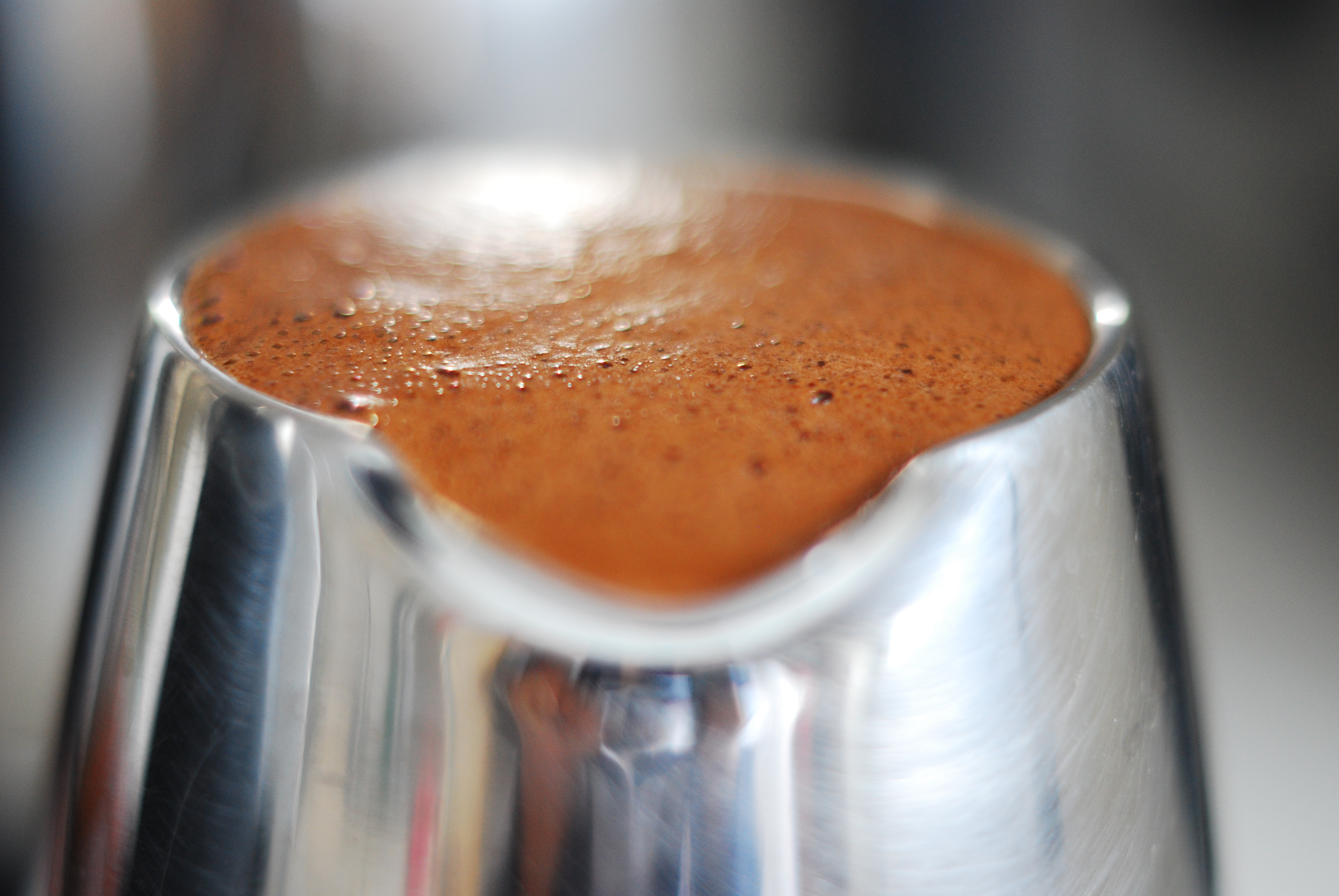
AND that folks is the beginning of “From Coffee with Love“. I am a bit puzzled that I haven’t related this story here, because from then on, I went full-on into coffee. I began with a Bialetti Brikka (pictured above), which is a moka pot that produces crema and then I went on to espresso machines and now I have a caffe, Escape Caffe, as you all know.

So, here’s a quick step on using a Moka Pot, my way of course.

Assume you have grinder, good beans and scales (optional in this case) and of course a Moka Pot.

1. Unscrew your moka pot and pour enough cold water into the lower cavity (about 100ml for a 3 cup) until it us just below the steam release device – this is easy – there’s a hole for the outlet inside the bottom of the moka pot.

2. Place the portafilter on top of the cavity containing the water.

3. Grind your coffee on a grind coarser than espresso but not as much as for a French Press. So, for example if you have a grinder that ranges from 1 – 10 with espresso at 2 and French Press at 9/10, grind on 4.

4. Place the ground coffee into the filter holder till it fills it and lightly tamp with your fingers (see below). This is the reason why scales are not essential for this method, because you should not put too little and not too much, just enough to fill the filter. I’m guessing for a 3 cup, about 13 grammes.
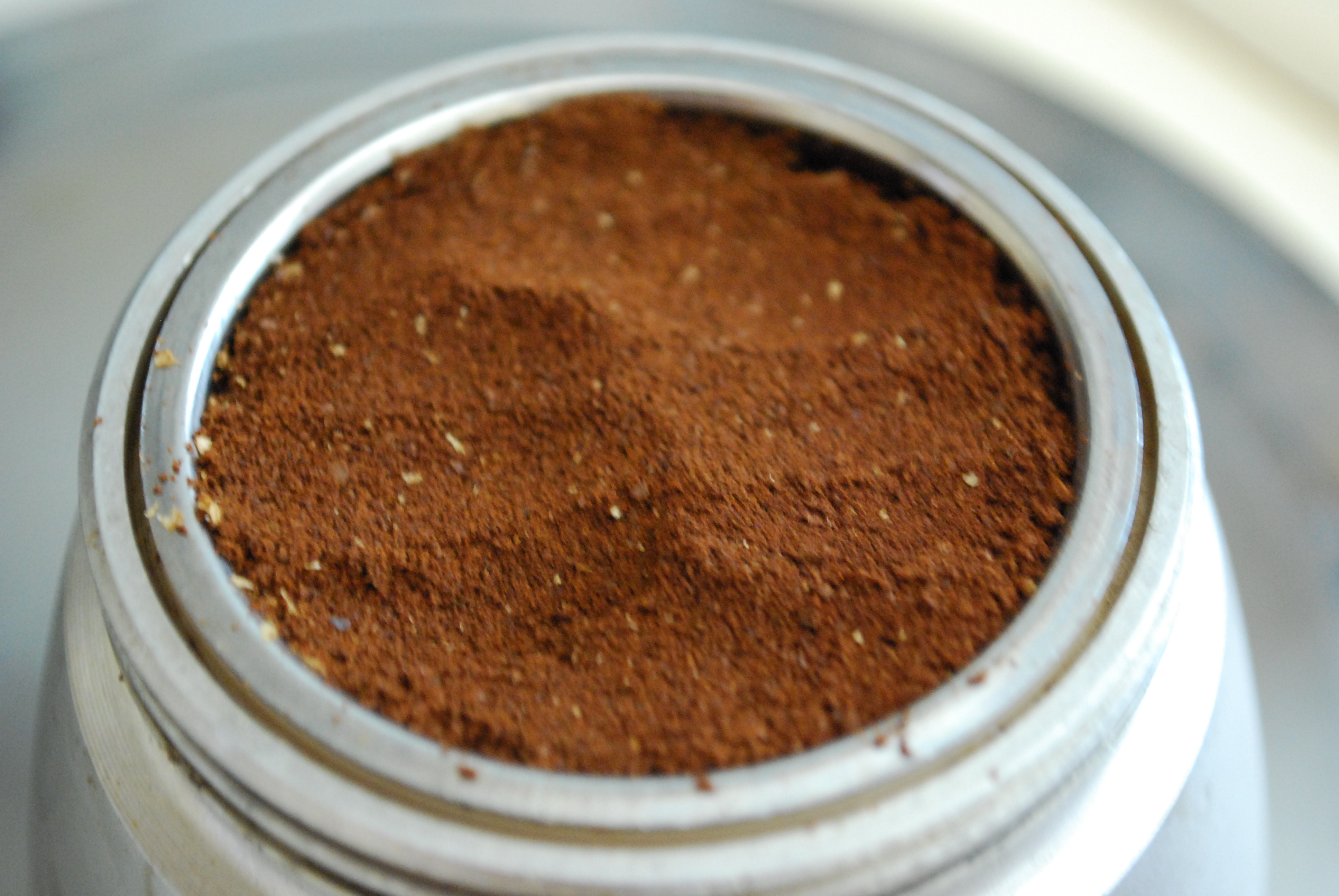
5. Screw the top on gently and place onto a hob turned to full, because you want it to boil. A note, Bialetti Moka Pots are made with aluminum because it is the fastest heat conductor – i.e. it takes on more heat than any other metal that we know off so far. This means that the moka pot heats up very quickly. Nowadays, stainless steel ones are made, with a heavy price tag, but good old aluminum is best.

6. First Light – Signs that you did the right thing – a little coffee escaping.
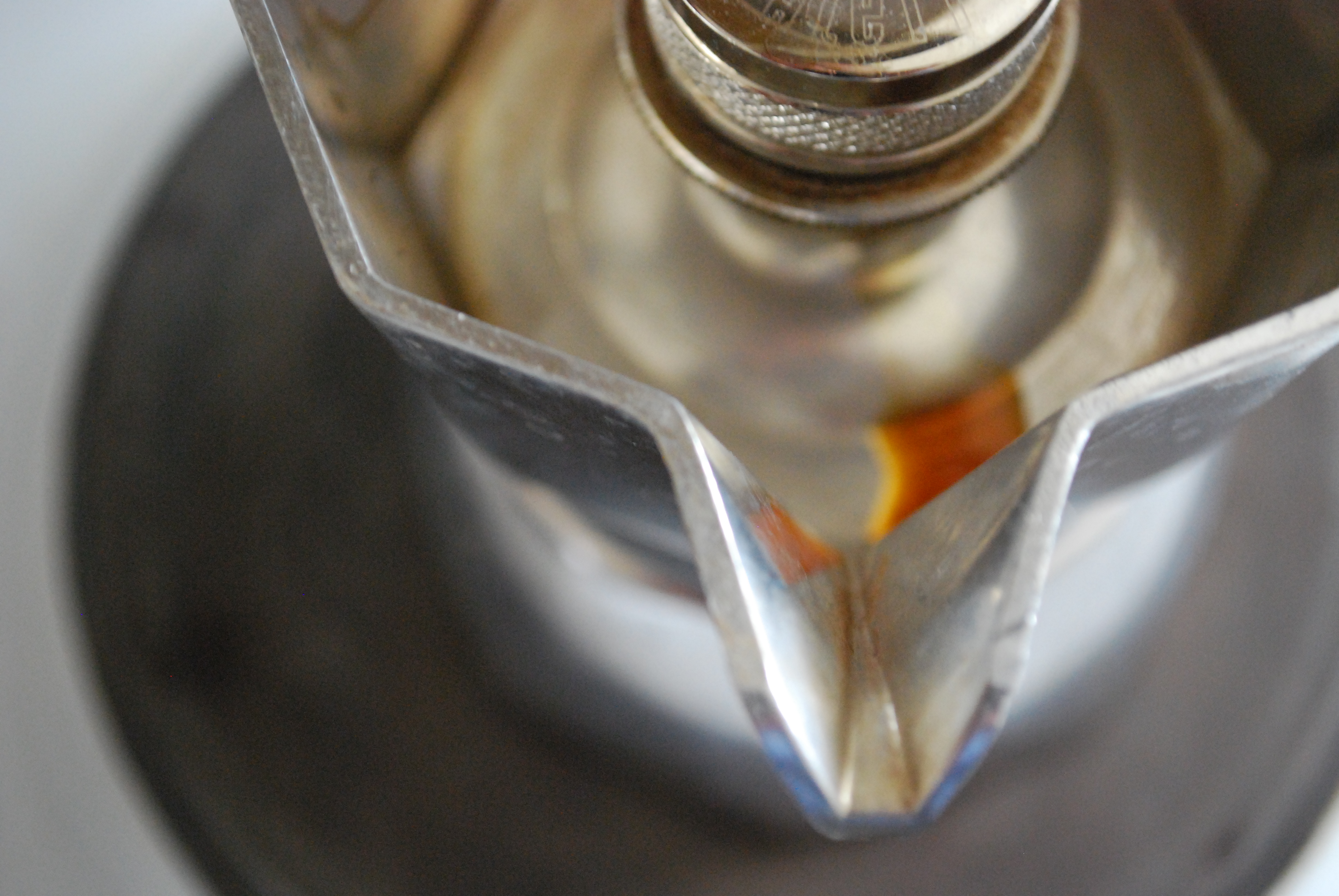
7. It’s coming – yes, the excessive heat and steam building up inside the bottom part of the moka pot, pushes the coffee through the sieve an into the top cavity – the wonders of a simple but effective creation.

8. Whoooshhhhh ! is what you hear and this is what you see when its finished.
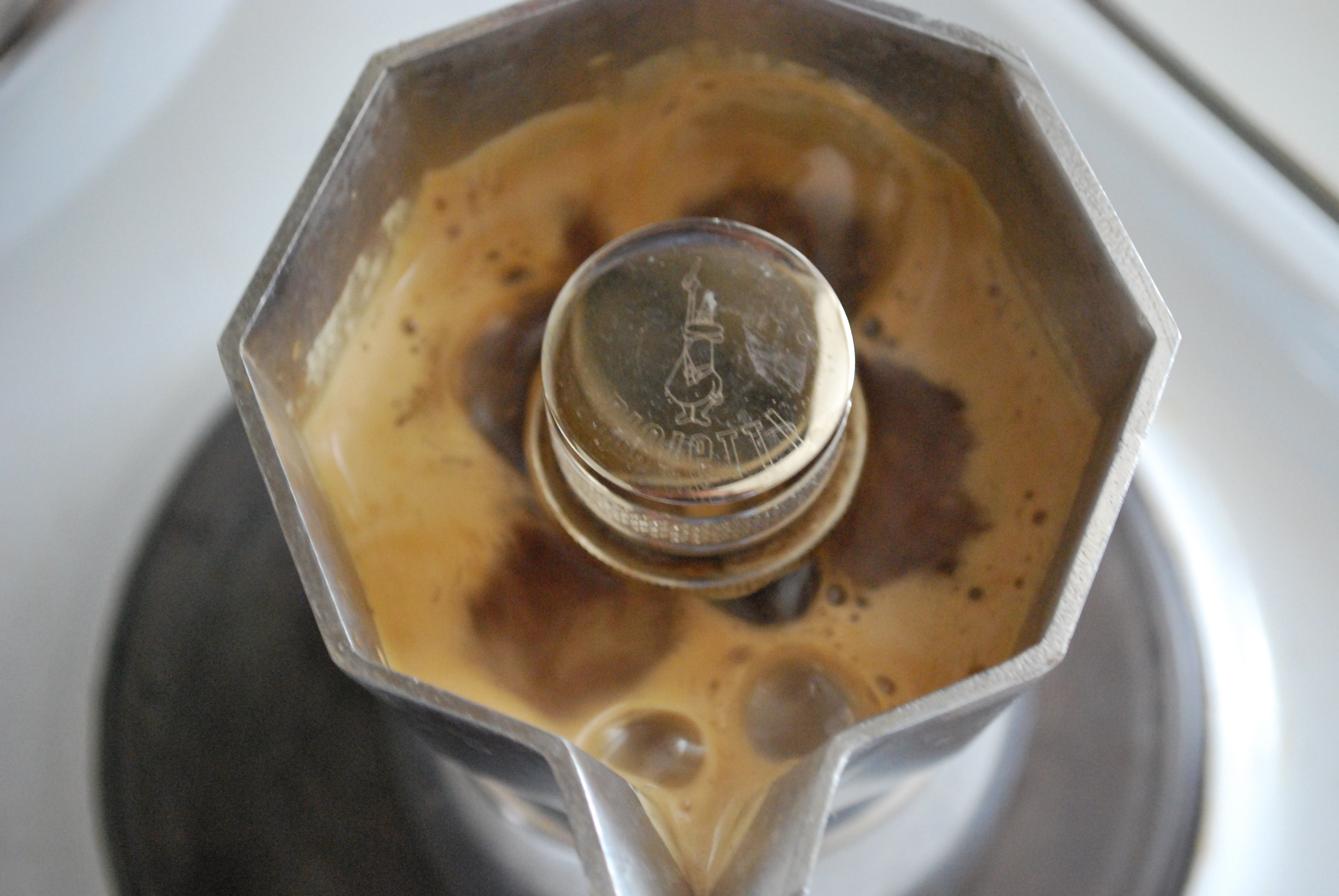
You can enjoy black with a little sugar ( I recommend a little for this method) or with cream, yum.

Caution: Don’t place the moka pot anywhere after it has finished, except on a hot plate, as the pot is still very hot. Let it cool down before you wash it by emptying the puck (used coffee) and rinsing out the base and top parts.

The Moka Pot is really simple and when I introduced it to my staff at Escape Caffe, they were amazed by the taste and wanted more. We plan to start selling them soon.

Ciao e buon giorno

The Two Minute Scoop

The 2 Minute Scoop by Lameen
The 2 Minute Scoop a photo by Lameen on Flickr.

What does that mean ? In short, how I make coffee using the French Press/Plunger/bodum Method. After all, it is Bastille Day (French Independence Day) So, I’ll try and keep this to a two-minute read.

1. Get your beans ready, weigh them, 20g and place in your grinder (Yes ! you should freshly grind before each cup for maximum enjoyment)
2. Boil your water and as soon as it is boiled, measure out 260ml.
3. Grind your beans on a coarse setting. If using a Solis Maestro (comme moi) or good quality shop bought one (don’t expect to pay anything less than $100/£70)
4. As soon as your coffee is ground, place into your French Press pot. For my Bodum Columbia, it doesn’t need to be warmed up, as it is double walled, but if you have a glass one place boiling water inside for a minute and rinse it out before placing the ground beans inside.
5. Pour 260ml of the boiling water into the French Press.
6. DON’T TOUCH IT, DON’T STIR IT, JUST LEAVE IT, BUT POUR IN A CIRCULAR MOTION. See the bloom below.

7. Put your timer on for 2 minutes.
8. At the end of 2 minutes, SCOOP the froth or the “French Press Crema” off – Hence the 2 minute scoop”.
9. Place the French Press top on and plunge.
10. Pour out a little and pour into your cup to enjoy.
Ciao, deux minute !

Me & My Aeropress

Sometimes, I’m quick to pick up on things and sometimes, I’m not, like when the CD player came out in the 1980’s. Back then and well into the 1990s, I was really into music and even contemplated becoming a DJ (hard to believe for those who know me, but true – i even had a stage name) but I was an ardent vinyl collector and loved the vinyl sound, so, I refused to succumb and buy a CD player, but eventually I gave in. So, I confess being the victim of my own snobbishness, when I first read about the Aerobie AeroPress on coffeegeek.com years back. But on this occasion, I have 2 excuses – the labeling on the original aeropress package advertising it as an espresso maker and the not very favourable review of the aeropress on coffeegeek.com. Of course I was confused, after reading all that stuff about what espresso is and isn’t and then, out comes this plastic looking contraption trying to change the rules. Fast forward, and hey presto, the aeropress is big news the world of coffee over. Hmm ! should I give it another chance ? But, of course, if all the people I respect in coffee are going on and on about it, so I did.

First up, I’m happy that they don’t advertise the aeropress as an espresso maker, but they do have the other claim “the best coffee maker you’ll ever own” (not on the UK packaging, which has pics of James Hoffman and Gwilym Davies). That leads to my second point, “REALLY !!!” the best coffee maker you’ll ever own ?” – well ! that’s if you don’t own a La Marzocco, a Synesso, a Slayer – you get my point. BUT I do have to confess, using the aeropress in my way was a taste opener.

I was really excited when I got my first aeropress, but I have to confess, when I prepared coffee following the instructions in the leaflet, I thought “is that it?”. So, over the last few months, I’ve developed my own way of preparing it, which I find quite delicious, especially for my last cup of coffee of the day. So, how do I do it…

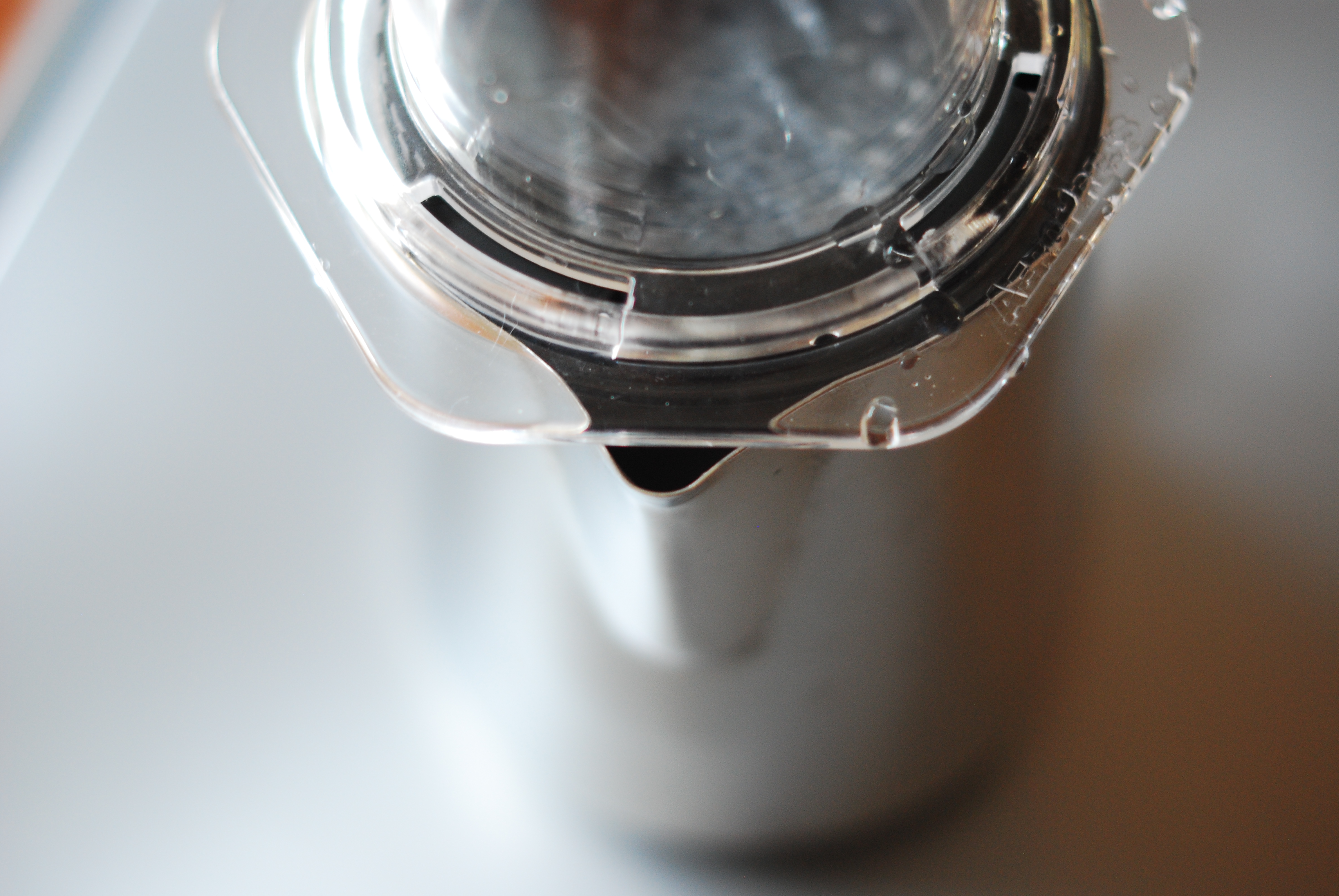
FIRST – Boil the kettle. After which, place the micro filter into the chamber & twist into place and place about 100ml of cold water and let it drip through into a container – I find a 600ml milk frothing jug the best.

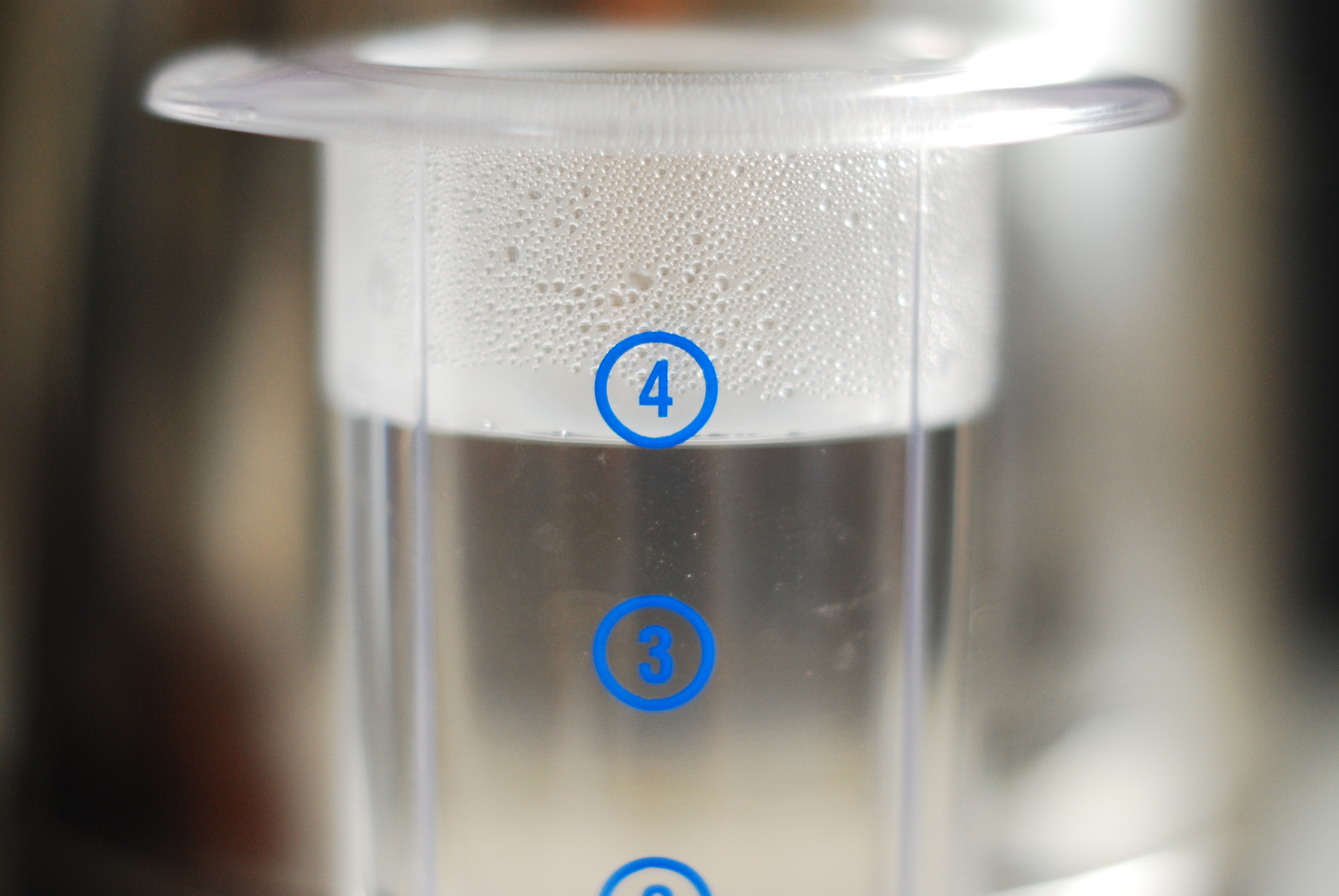
SECOND – As soon as the water has boiled, pour up to “4” on the plunger. Let it rest for about 2-3 minutes. You don’t want to use boiling water, but just off the boil. You can check the temperature if you want, but between 85C to 90C is ideal.

THIRD – Measure 20g of coffee and pour into your grinder.

FOURTH – Discard the water that went through your micro filter in STEP 1 above.

FIFTH – Grind your coffee and place into the chamber. I grind slightly finer than for a French Press and not the recommended “espresso grind” on the instructions.

SIXTH – Pour your hottish water into the chamber in a circular motion so that the hot water touches all the freshly ground coffee. You will see a bloom coming to the top (see pic above). COUNT TO 10 SECONDS and press the plunger through the chamber with coffee and hot water gently BUT firmly.

SEVENTH – Enjoy, either with half a spoon of demerara/brown sugar or alone.

WHAT’S DIFFERENT ? I didn’t stir the coffee with the paddle and I didn’t take more than 20 seconds to brew.

WHAT’S THE GENERAL TASTE PROFILE ? a light aroma and taste, clear with medium to low acidity detected on your tongue, natural sweetness, usually with soft citrus and light caramel taste – I’ve just finished one as I write this.

OK! I hear some coffee connoisseurs screaming “how can the brew method alter the acidity ?” Well ! It does, is the simple answer. To test this, I confess that I usually brew using Espresso Lab (Cape Town’s top roaster) beans, where they source top arabica beans (Serra do Bone is Intelligentsia Black Cat Organic) and they roast more to bring out the fruitiness in coffee, as opposed to dark. Fine, but when I went to Prufrock, Gwilym gave me Square Mile Coffee Roaster’s Tanzanian Blackburn Estate coffee and the Bolivian Colonia San Juan 8 Estrellas. On the latter, it was still a light taste, but with the Blackburn Estate (great for a morning cuppa as it was heavier) although it was bolder, it still had that refreshing lightish taste.

I’ve tried the invert process (basically, do it upside down, and place the filter at the end to press through, see below), favoured by Mark Prince of Coffeegeek, but I wasn’t impressed with the taste profile, I got, so I’m still stuck to my way.

BRAG OF THE POST: I was pleasantly surprised to be asked by Gwilym how I prepared my aeropress coffee and after summarizing the above method, I was pleased to learn that we share the same method, yipee.

One more confession from the aeropress is that I find it still brings out a reasonable taste from old beans (i.e. roasted longer than 4 weeks ago). I know this, because although there’s tons of coffee at my caffe (escape caffe), I find myself scouting around my home for coffee and I’ve got to have that aeropress at night, and finding something roasted over month ago, still works in the aeropress for me.

Enjoy !

My New Toy: The Hario V60

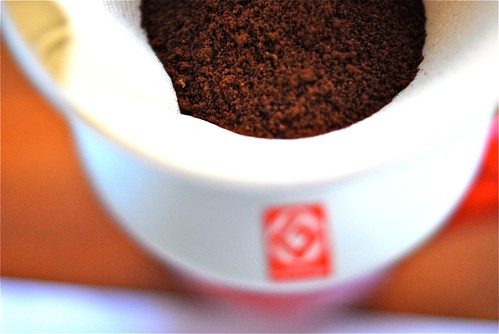
From the title, it sounds like I bought some sort of fast car or psychedelic machine, but as this is a blog about coffee, the Hario V60 is a piece of art but relates to coffee. It’s developed by a Japanese company and is a different form of coffee brewing. I’ve actually seen many similar devices before but did not really know what it was for, but after skimming through many websites, of which square mile coffee roasters (London), was one, there’s been a lot of buzz about the Hario version, with a cool name, the V60. In summary, it’s a simple brew method, but the Hario V60 design, won a Good Design award and actually does makes the coffee taste different. It’s more apt for precious coffees, which will enable you to taste the more fruity and subtle cocoa elements in well roasted coffee. So, you can imagine my delight when I walked into espresso lab in Cape Town and saw a batch of them now available. I thought about it for a week and then I was sold, and bought some Ethiopian Guji Sidamo to accompany my first experience. So, here’s a detailed account of how to brew. You need (i) scales to weigh the coffee (ii) your V60 (iii) unbleached filter paper (iv) a warm glass or carafe to let the coffee to filter into (v) a good grinder (vi) a kettle to boil the water and (vii) great coffee.

1. Whilst your water is boiling, weigh about 22g of arabica beans and pour into your grinder. Once the water is boiled, grind your beans on a setting above a moka grind setting – so not was fine as espresso and not as coarse as French Press; Pour into the filter paper, which should already be inside the V60

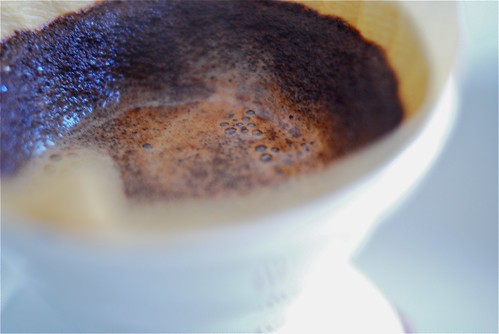
2. Measure out your hot water to about 280ml and pour in a circular motion onto the ground coffee – you should see a bloom

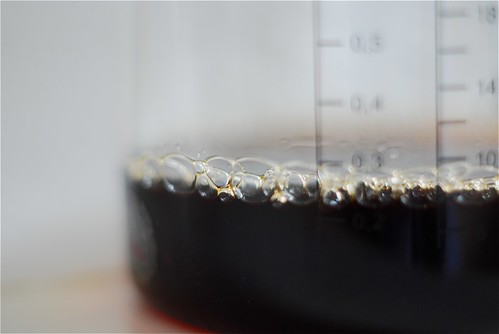
3. It should take about 2 – 3 minutes to brew through, by which time you should have about 280ml freshly brewed coffee

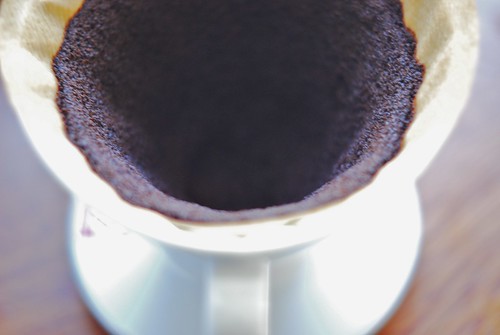
4. At the end, the V60 should look like this after the brewing process is complete

The above is just a guideline, but play around with the method if you get one. Enjoy the experience – the coffee should be light and easier to drink than a French Press. For the Ethiopian Guji I got berry and cocoa lingering tastes. I’ve just bought the organic Brazilian Sao Pedro. I’v been captivated by this method of brewing coffee and have to apologize to my lovely Bodum Columbia French Press, which hasn’t been used in about 2 weeks.

My Bodum Pavina Glasses

From my pictures on my blog and on my flickr account, you should know by now that I like different types of glasses and cups to take my coffee pictures in. After all, with just a little dark brown liquid, sometimes with a dash of milk to take a picture off, you have to make the best of its surroundings and by this I usually focus on the container, the cup. So on my trip to Bodum’s first shop in Vienna, located on 2 Marc-Aurel Strasse, 1010 Vienna, in freezing -6 C temperature, I was shown Bodum’s Pavina glasses. I thought for about a few seconds how these double wall glasses would look like with espresso or cappuccino in them and being someone who usually knows what they want and tempted by very good customer services, I bought a set of 2 glasses – the 12oz version, just right for your classic cappuccino. The next day, I couldn’t contain myself and used the glasses straight away for my morning dose of cappuccino and of course poured a heart;

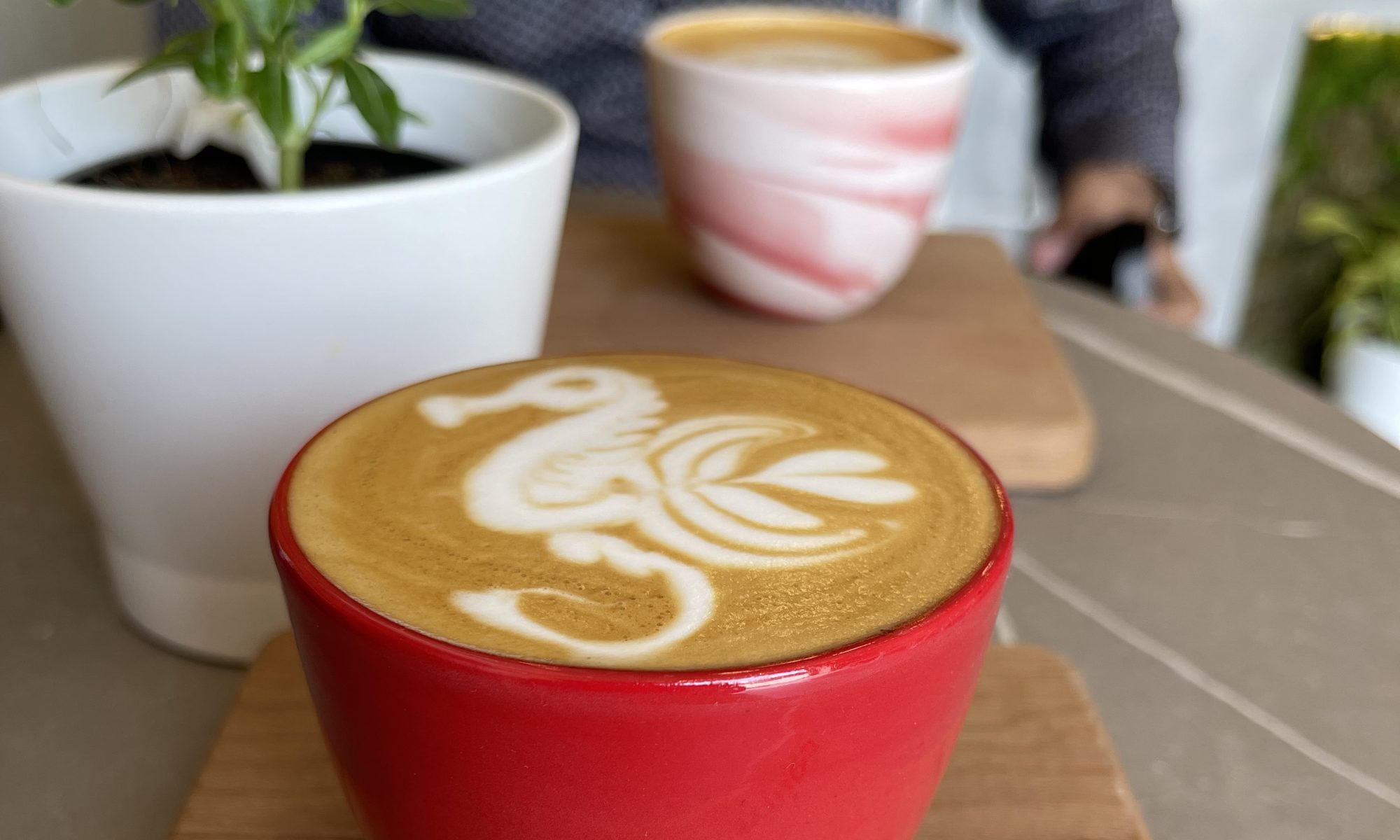
I just liked the way you can see how the frothed milk blends in with the espresso and you can see the foamy part just sitting on top. The added bonuses of this glass is that because it is double walled and mouth blown, you cannot feel the heat from the coffee when you hold the glass in your hand and it keeps the coffee hot for longer, plus of course it looks great, doesn’t it, especially when you pour latte art, with different shades of milk and espresso milk combinations ?

If you want to impress your friends and love cooking and baking, then you can make a hot dessert in these glasses provided that the oven temperature doesn’t go over 180C and alternatively you can make cold desserts in them. From the coffee side, the glass is just the right size for a double shot espresso Cappuccino or Caffe Latte. So, if you’ve got about €20 to spare during these tough economic times, then buy a set of two.

The Naked Portafilter

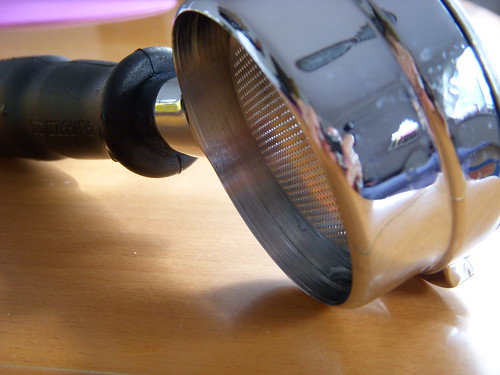
I just can’t go out like this and I’m ashamed to say that it is almost the last day of 2008 – my first full calendar year of blogging – and I have not posted a blog on my number one discovery of the year, the Naked or Bottomless Portafilter holder, You what ? You may say, but take a look below and don’t be shy to ask, if you are a novice of course, what is this ?


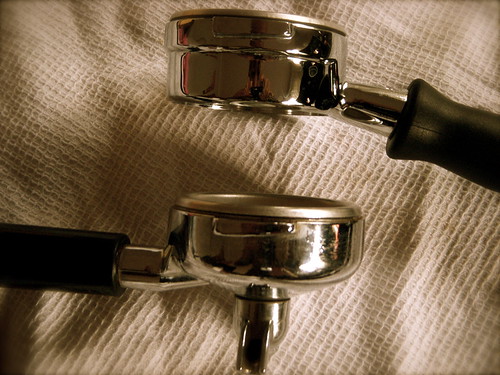
OK ! I’m going to make this quick and as exciting as possible because although this looks straight forward, it can be quite complicated explaining what this tool of tools is. Luckily for you, I’ve ploughed through a few articles, blogs and discussions to try and summarize what this little invention is all about. Traditionally, you have the normal portafilter holder, with two spouts (for making 2 espressos at once) or one spout (for making one espresso at a time). Anyway one day, someone wanted to know, what goes on if there are no spouts and you can see right through, hence the terminology, “naked” or if you go with the more simplistic terminology, bottomless. In this way, you can see how the coffee begins to come out through the little spore holes in the filter and approximately how many seconds the coffee beings to emerge at what bar/pressure level to make the exact quantity – Are you still with me ? I hope so, because I cannot make it more simple than that. In any case, the next step was to cut off the spouts, so that you have two types of portafilters like below.

The traditional one is below and the bottomless one is above. You will be glad to know that to make your portafilter “naked” or bottomless, you don’t have to get your chainsaw out or find a local mechanic who will really think you are crazy but who will nevertheless take your money – you can order one form the best, La Marzocco, of course. OK ! it might not be that cheap, mine cost about 60 Euros ($75 now), but it will be cheaper in the States and you can get one for about $60, made by another company like Rancillo.

From an academic view point, if we want to scare you off even more and bring in words that remind you of school, like the word “academic”, the bottomless filter is a good training tool. For example, if you can see what is happening from a “naked/exposed” view point, you can correct your mistake and improve your espresso shots. I can’t get away with this, but I’m going to have to go into “Lesson” mode for this tool, so that you really appreciate what I’m trying to share with you, so here goes. 

Assumptions:You are an espresso freak and you know the essentials about making an espresso using a really good grinder and good heavy brass espresso machine (upwards of $500). So you know that you buy relatively fresh beans, grind and then tamp them with 30 pounds of pressure, so that the 30 ml of crema top espresso coffee comes out in about 23-27 seconds. OK ! so you are a coffee geek or coffee snub, that’s settled.

Lesson 1: If you don’t tamp properly or use too little coffee, assuming you are using the correct grind, then some of the coffee will be under less pressure and your espresso cup will fill up more quickly, violating the 23-27 second pour rule for approximately 30ml of coffee. In short, if using the naked portafilter, you will see a blondish type cone pouring into your cup, which will be flowing with bad tasting coffee. Furthermore, the coffee will be spitting from the outside all over the cup and your coffee machine, making a right mess. It’s like the coffee is saying, if you can’t handle me right, then I’m going to spit on you. In any case, the spitting occurs, because the coffee has not been tamped well or is too little in a particluar area of the portafilter and hence the pressure pushes it out with a lot of force. I don’t have a picture of this for you, but trust me, it has happended to me, when I used less than the recommended 14-15 grammes of freshly ground coffee for a double espresso – I was in a rush to get the kids to school. Also, in this spitting scenario, if you attempt to take a picture, you might get coffee all over your lenses.

Lesson 2: If you tamp properly but the grind is too fine, your coffee will take ages to come out and will taste sour/burnt. In this case, using the naked portafilter, you will see that when you get to 18 seconds, drops of honey like espresso begin to pour out – it may look good, but it isn’t going to taste good, trust me and of course you are not going to get 30ml of espresso coffee into your cup between 23-27 seconds, but much less. Again this has happened to me when I got a new bag of coffee and wanted to test for the right grind. Seeing this scenario, I quickly loosened the settings on the grinder to avoid wasting anymore precious coffee.

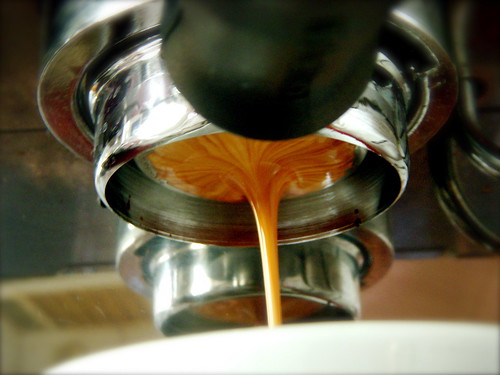
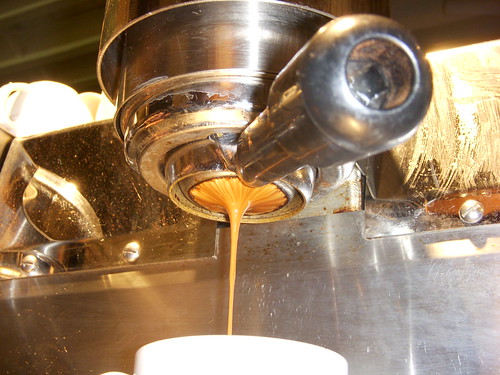
Lesson 3: If you do everything right, this is what you should see (below)

Now, doesn’t that look lovely ? You can see a few colours here. The darker ones have a higher concentrate of well extracted coffee and you will notice that the coffee seems to be flowing right, without any gushing.

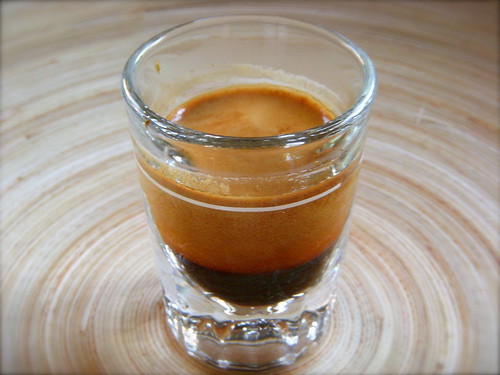
If you are feeling brave, hold a single shot espresso cup carefully over the naked portafilter, making sure you watch the extraction closely so that you don’t burn your hand with free flowing 93C degree coffee and you can also make a ristretto, with should display excellent crema as evident by the dark brown bits, which dominated this cup of ristretto (i.e half a cup of espresso).

Conclusion/Analysis: Using the naked portafilter helps you to (i) estimate very quickly if you have the right grind (ii) improve your tamping technique, especially in making it more even (iii) know very quickly if you used to much coffee or too fine a grind (thick honey drops) and (iv) look good, if you invite your friends to show them a perfect extraction, but practice beforehand.

What Else ?According to some experts, because the extracted coffee comes into less contact with metal, because it basically flows from the portafilter into your cup, you should get a more “purer” taste of coffee. If you notice, there will be very tiny bubbles in your cup.

In any case, I usually use mine when I get a new bag of coffee from a different roaster or a different type of coffee. When I got my naked portafilter, I used it for several weeks, because I just liked the way it flowed into the cup. Serious coffee shops like Origins Coffee Roastingin Cape Town have naked portafilters, like the one below, extracted on their Synesso Cyncra machine.

Also, my favourite coffee shop in London, Flat White have them, as evident by my request for a triple espresso, using a naked filter (see my post of 25 March 2008), but you will have to make a request for it.

My advice, go on experiment and enjoy, HAPPY NEW YEAR !

Light a Candle for…..


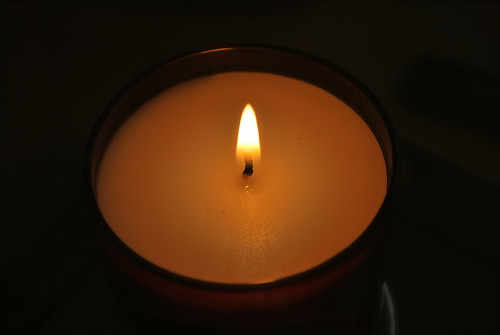
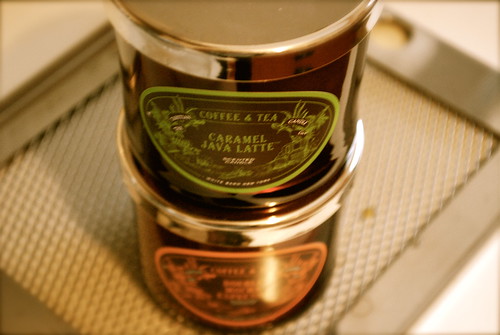
Light a candle for America… No ! Seriously, light a candle for COFFEE. These coffee candles are from America – whatever next you may ask ? but my sister sent me these from America, bought from a store called White Barn (New York), apparently famous for making lovely candles. As soon as she saw these, she thought “my bro would love these”, she bought me a whole bunch and sent them over to Austria. They’ve got lots of flavours like Caramel Java Latte, Double Mocha Espresso, Java and even Chai Latte & they smell really nice too.

So, if you are inviting people over for lunch or dinner and don’t want to waste your lovely coffee by grinding it to extract the aroma just to get the right ambience, then buy a bunch of these, light them up and hey presto, everyone get ready for coffee, after dinner of course. I haven’t seen these type of candles in Europe, but if I find anything similar, I’ll write about them too – why do we always miss out on this side of the Atlantic.

In any case, if you know of anyone popping over to America to take advantage of the relatively low dollar exchange rate, then ask them to look for these and impress your family and friends with this special find. It may also work in cafes, where you may want to light them up to erase some of the foody smell to preserve a real sweet cafe ambience – just a thought and if you use it, tell them to check out my blog and website too – spread the love of coffee.

La Marzocco GB5

I’ve decided to add another category to my blog, aptly named “Coffee tools” in anticipation that there are some readers of my blog that just want to know about the stuff needed to make coffee. Anyway, what better tool to start with than a La Marzocco coffee machine. I’m not really going to go too technical here because I only feel comfortable sharing stuff that I really understand and as I didn’t major/study in-depth any sciences especially engineering, I’m not going to bore you with stuff that  you will need a dictionary to understand. OK ! La Marzocco espresso machines are generally what top baristas believe to be the best machines for making espresso and espresso based drinks. Their machines are used at the World Barista Championships to determine who is the best barista in the World. Of course, there are many good espresso machines like the Synesso Cyncra, which coincidentally is designed by a former La Marzocco engineer. There are other machines and of course many opinions but, the consensus is on La Marzocco.

In any case, I had the opportunity to meet with La Marzocco’s main rep in Austria, based in Vienna. It is run by Mr Reinhold Fliedl who supplies coffee machines and other stuff under the name Espresso Solutions. I had already met Reinhold when I bought a La Marzocco bottomless filter-holder and so this was our second meeting. His company was on the other side of Vienna and I took the opportunity to get a half day off from work on a Monday morning – more sleep for me. Anyway Reinhold is a really nice guy and he really knows his stuff when it comes to espresso, coffee, coffee machines and coffee grinders – he owns a La Marzocco GS3 – the only espresso machine suitable for the home made by La Marzocco and costing about 4,000 Euros ($6,000). I learned a lot from him as I was also looking to buy a new coffee grinder too and he talked to me about his two-group head La Marzocco GB5 (one of the best machines made by La Marzocco), which looks really nice.

 LM GB5

I snapped away and also got a really great shot of him pouring some latte art in his Alessi milk jug, after he had showed me briefly how to froth milk on the GB5. Actually, this is one of my best shots yet, judged by the number of the views on my flickr account

 Great Shot Pour

He did a few practice runs on different types of coffee for espresso.

 GB5 Espressos

A couple of cappuccinos later and an espresso, I was coffeed-up for a few hours and we got talking about beans, roasting and grinders, as well as the poor state of affairs in Vienna with regards to getting really good espresso and espresso based drinks. Reinhold was so serious about this that when we met in mid-June, he was planning a trip to the World Barista Championships in Copenhagen to register through examinations to become an Speciality Coffee Association of Europe (SCAE) trainer. I can gladly report that he passed and he is now one of only three in Austria. A coffee school is planned, which I hope to attend God willing if it is set up very soon.

Despite my intro about technical stuff, I cannot end this post just with pictures – I’ve got to delve into some of the tekky stuff and so here goes. I was shown the inside of the GB5, which displays La Marzocco’s unique dual boiler mechanism, which means, and I quote from La Marzocco ” the GB/5 ensures maximum temperature stability for coffee brewing, with electronic monitoring of all the machine functions” –  in simple language, this means that the temperature for preparing coffee is always maintained at the ideal levels of between 90-93 C for extracting espresso. This is what I understand the now famous Proportional Integrative Derivative (PID) system is, which monitors temperature to all group heads. So for example, as we know, temperature is key in coffee preparation and a 1-2 C variation in temperature can affect the taste of an espresso, where you can loose out on high citrus tones for example in a type of coffee. Also, in lesser technology machines, the more you extract coffee, the less the temperature gets, whereby you begin extracting espresso at 87C, which could mean that the coffee will be a bit bitter on all group heads. However, with the technology on the GB5, the temperature is automatically adjusted for each group head and maintained at the desired level – now isn’t that cool. There’s also one other bonus – there’s a light under the main control unit, which means that if you have one of those dark looking interior cafes, the machine lights up to show where all the action is, just above the brewing heads. Of course, this type of machine is for those serious about their coffee and serving the best, but I believe it’s worth it whatever the price. Of course, all the other variables have to be right too, like the right grind, the type of grinder, the quality of the bean, in summary the 5 Ms – (Mescla (coffee type or blend), Machina (the type of coffee machine), Machinadosatore (the grinder that grinds the coffee), Mesura (the grammes of coffee used per espresso shot) and Mano (the hand of the barista) – now make sure you learn these as I might test you on it next time…. hmmmm !. In any case it was a pleasant trip and I learned so much. Perhaps next time I can try the machine out. If you live in Austria or Germany check out Reinhold’s website/e-shop on www.espressolutions.at