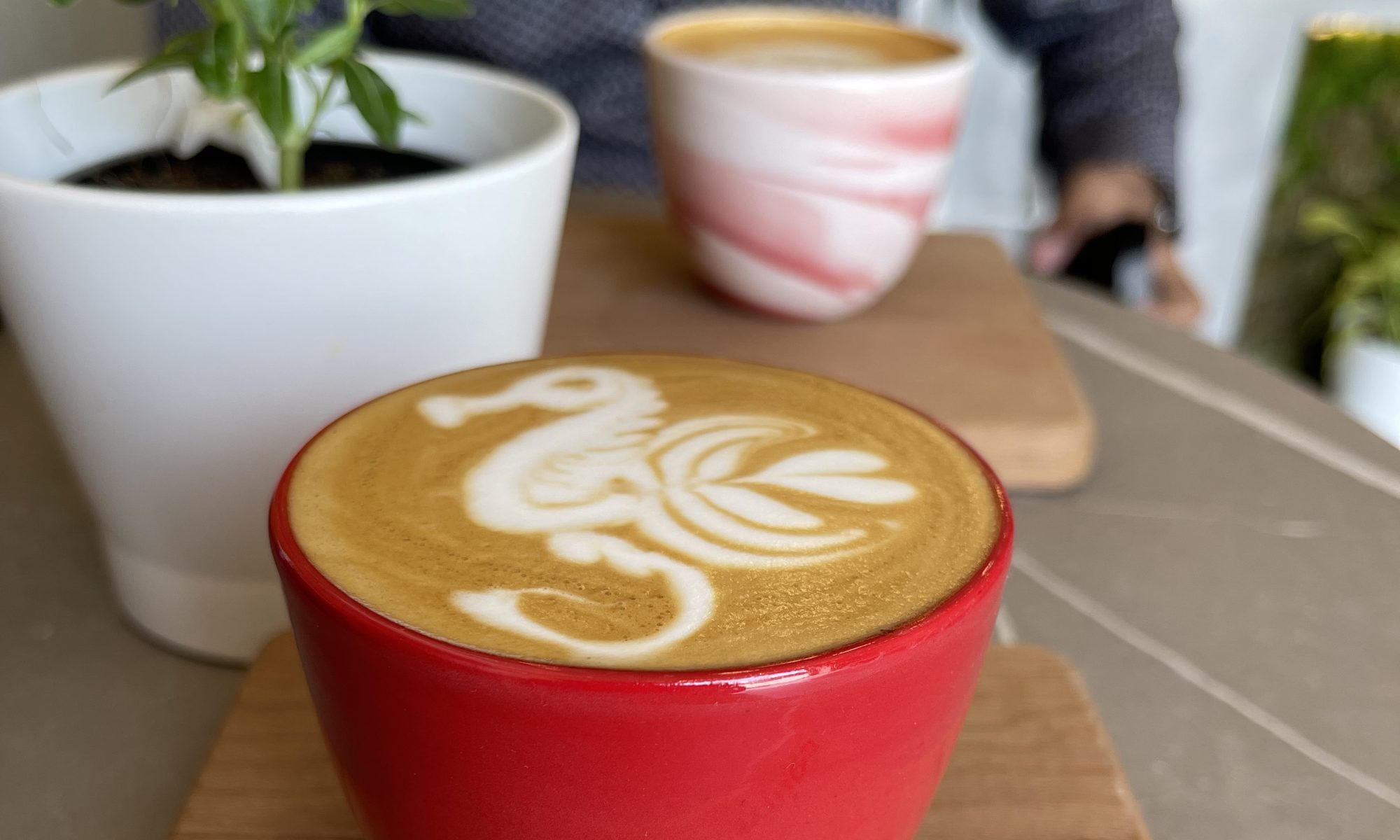
So, this is the final part of my series on my fave coffee spots in Dubai and I finish with a bang @typica.uae run by @coffee_limitless (aka Michaela) two times #uaebaristachampion (2018 and just last week 2021) not to mention she got into the semi finals of the recently held @specialtycoffeeassociation #wbc2021 in Milan 👍🏽 Sure, you can be served great #coffee sourced from very special farms across the world 🌍 and I usually opt for a special filter brew but if there’s one drink I’ll recommend, 😌 it’s the champion 🏆 aptly named as the winning drink Michaela served when she won the uae barista trophy in 2018. If you scroll to the second page of this post, one of her barista @hartgomezatienza explains the drink in detail but in short it’s a whirl of flavors in your mouth from pronounced orange to watermelon and a hint of coffee cream, literally a party 💃🏽 in my mouth.
If that’s not enough, as I was about to leave @jason_galinea . told me that they still have some of the beans (Mandela) used by Michaela at the WBC & I was like wow, 😮 I’m away but I pray upon my return Inshallah I’ll taste it before it runs 🏃🏾 out. My only competition are the Dubai based coffee geeks like @sanaveed90 reading this.
Thanks to the team for another wonderful experience. . .
Part 2? You may be wondering what was Part 1. Well, part 1 was when I had my coffee shop, ESCAPE CAFFE in Cape Town from September 2010 until February 2012. That’s when I moved my whole family to another part of the world to set yup my ideal coffee shop.
Fast forward ⏩ to 2021 and….
Well, I believe that when you pursue your dreams, God puts people in your life to help you complete the journey.
So, when I first met Shehzeen and MD of @sippybeans, Dubai in October 2020 and she asked how can we collaborate after talking coffee for about one hour, I said “why don’t we release a coffee line together” and she said “why not” 🕺🏽 now, who said dreams don’t come true. 🎉
I recall when I was growing up and how my mum instilled in us the concept of never throwing food away.
Fast forward to 30+ years later and I’m a coffee geek. So when I get to the end of a coffee, do I throw it away or just mix it in with the new?
Hands up for this who guessed right – yes, I still can’t throw food items away, especially coffee – after all when you source great coffee weekly and can’t wait to brew it and enjoy it, how can I be so careless to throw some good beans away – I can’t
So, when I was thinking about the Filter version of my coffee, it was natural for me to think of a Filter Blend. Even the roaster asked me, “but why?” and I was like “why not?” – too scared to tell him my childhood fear, 🤷🏽♂️ Ha! I was also aware that square mile coffee have also recently started a filter blend for filter coffee.
So, here we are, the FILTER BLEND …. coming soon to your fave UAE based coffee platform, SIPPY and my partners and as a homage to Africa, it’s comprised of two special African coffees naturally.
It’s almost here…. The FILTER BLEND of my coffee line in collaboration with @sippybeans . We did the tasting two weeks ago and I presented it at an exclusive event recently.
The blend combines the bold flavours of berries, fruit and medium acidity with an unforgettable aroma that I search for when I prepare coffee daily using @hariov60 ..😋 I can’t wait to share it with you so that you can tell me what you think but it’ll soon be in the market.
Truly exciting I must say this coffee dream of mine. Dream big and be bold 😉
Sometimes we get so serious about what’s around us in the world BUT sometimes we need to escape into our pleasant thoughts.
For me looking back at precious moments from my childhood warms my heart ❤️ and I thank God for my parents and for growing up in Nigeria with my siblings, lots of family and friends.
I recall my favourite movies 🎥 as a child and if you can relate, you may be able to guess what movie inspired me to name my coffee blog FROM COFFEE WITH LOVE.
Try not to get distracted by my singing 🎤as my #coffee skills are much better.
What loving fun thoughts from your childhood still resonate with your journey through life at the moment?
The experience was even more exhilarating as I had my #dailycortado using #kenyancoffee
In honour of International coffee day on 1 October 2020, I decided to treat myself at one of Dubai’s iconic specialty coffee shops, The Espresso Lab, located at Dubai Design District. In fact this was my second visit, as I had visited them at the previous location in 2016, read here.
As you enter, you are greeted with a brew bar, featuring a Synesso espresso machine and many filter brew options ranging from cold drip, Hario V60, khalifa wave, etc and more, see pic below.
Brew bar at espresso lab
What was unusual for me, was the number of staff present. Let me explain; following the pandemic , I’ve noticed that most food and beverage establishments have cut down considerably on staff. I’ve always been in two minds about this because I always believe that this compromises on service delivery. Can you really provide the same level of quality customer experience ( I prefer this to service) with less people? Well, I don’t think so.
So, back to espresso lab. For me, with this amount of staff, it gave the impression that they were very focused on the customer and that each staff had clear guidelines on their job, so well done espresso lab.
Now, to the coffee. I love that they don’t serve espresso to go and don’t offer sugar, yay!
Coffee menu
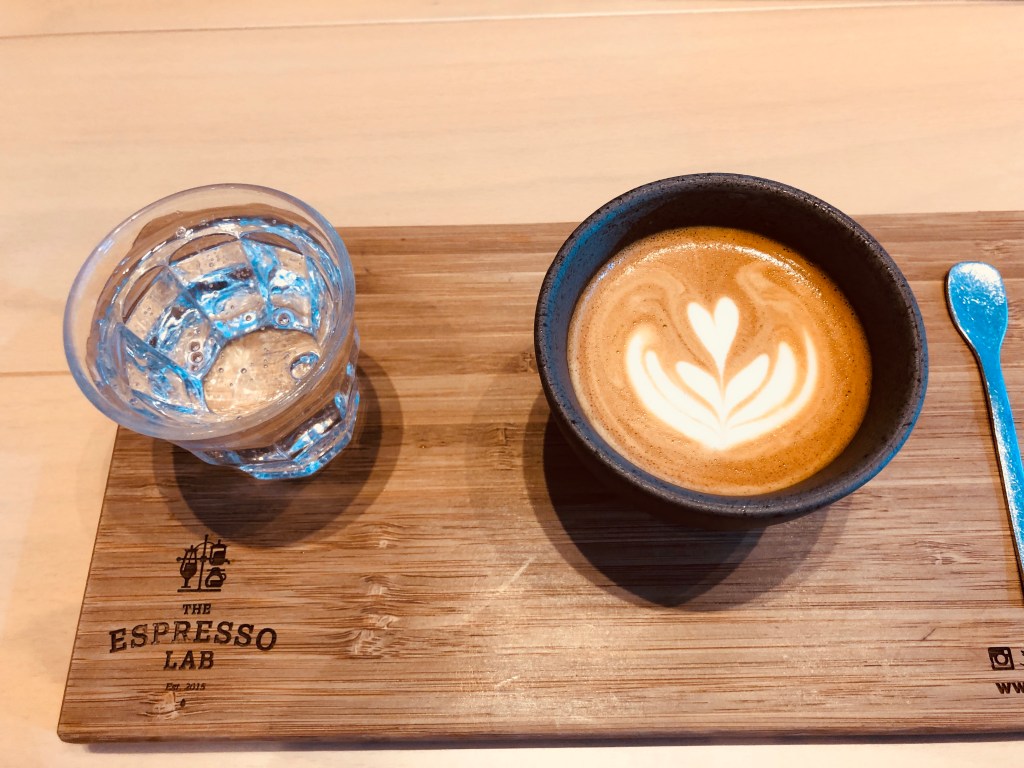
I knew I was craving espresso based coffee as I had to leave my espresso machine in Vienna until it is air freighted. On offer were 3 single origins; India, Yemen and Kenya. Now, if you know a bit about coffee origins and taste profiles, you’ll know that these choices are very unusual, especially for espresso. In case you are wondering, it’s very rare to brew Kenyan coffee on an espresso machine mainly because of the typical profile of bold, berry and citrus flavours. Although very uncommon at the moment, I must say since I’ve moved to Dubai, I’ve had close contact with Yemeni coffee, so, I decided to try the Kenya coffee. Check out the latte art pour by barista Wael below.
Pouring my cortado
And wow! I wasn’t disappointed, as this was for me, one of the best milk based espresso drinks of 2020, a true treat, praise God. Well done to the barista Wael, who I quizzed endlessly before I placed my order. I salute his patience.
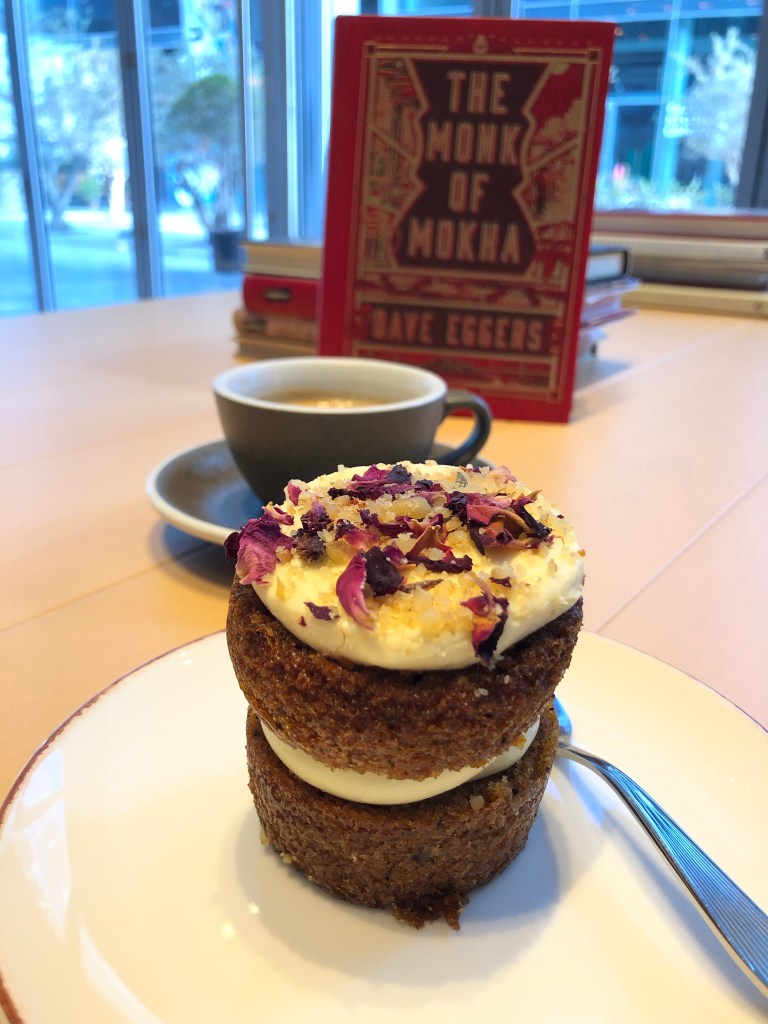
After that delightful experience, I knew I needed something sweet, so here comes the mini double layer carrot cake, topped with rose petals, another delicious treat. To compliment this experience I had a short black, americano with less water and discovered a book, “the monk of mokha“, which a friend mentioned to me a few years back, that I would like to buy and read.
Cute Carrot cake
Their menu is different and I plan to visit their newly opened roastery with another coffee nerd soon in order to learn more.
Coffee galore
So, when in Dubai, I highly recommend a visit to espresso lab, located in building 7, Dubai Design District.
About 10 years ago, I packed up from Europe and headed to Cape Town, South Africa to set up a cafe, one of my dreams. There are many lessons I learnt on that journey but here I wanted to share with you in a short video the 3 lessons I learnt, which can be applicable for all you aspiring entrepreneurs.
If you blink, you might miss it, but the taste will last longer than a few minutes. So, this weeks coffee features, Caravan Coffee’s Special Bru filter coffee released to celebrate their 10 year anniversary – in my previous post I gave an extensive background on caravan and how I first heard of them and still admire them till today. Now, the coffee.
Coffee at home
So, I’m using the Hario V60 for this video, but I’ve adjusted the recipe somewhat. Typically, I would use about 15g of freshly ground coffee with about 240ml of 95C boilng hot water, but I found that when I used this recipe I wasn’t getting the punchy fruity notes I desired, so I increased the amount of coffee by 2g, to 17C for both the aeropress and Hario V60 filter brewing methods and wow! I got them. However, it was on the Hario V60 that I had the slightly more pleasant experience, with berry and citrus undertones and a taste of delicate milk chocolate. The perfect way to end the day (as I’m fasting there’s not daytime video).
To summarise;
17g freshly ground coffee 95C 245ml hot water Hario V60 Hario V60 filter wet with hot water Makes about 235ml delicious coffee
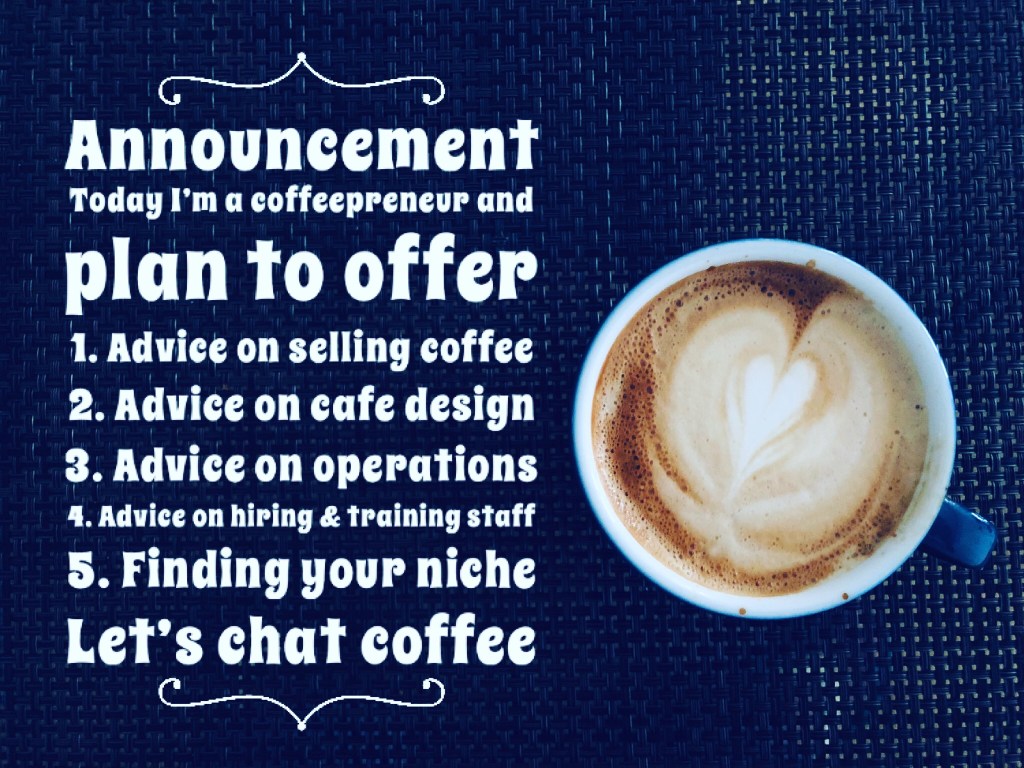
I just wanted to let you know that in the spirit of following my passion I’ve decided to take the step to launch my coffee career.
I’ll be offering services as a coffeepreneur ( I love this word) and will offer;
Advice on how to set up a quality focused coffee business
Advice on coffee shop operation including a competency based Human Resources management plan.
Advice on how to find your niche based on your personality and goals
Participating in events to speak about the coffee chain and economics ( I studied economics, have an MBA and want to help coffee farmers get access to more fair markets)
It’s March 2020 and my burning desire for many years has been to work one way or another with coffee.
Please Share this news with anyone that wants to get into the #coffeebusiness and talk coffee (for a fee as advised by my wife 😊). We only have one life and I encourage you to #liveafulfillinglife








 From Coffee With Love