I’m Drinking… Verve Coffees

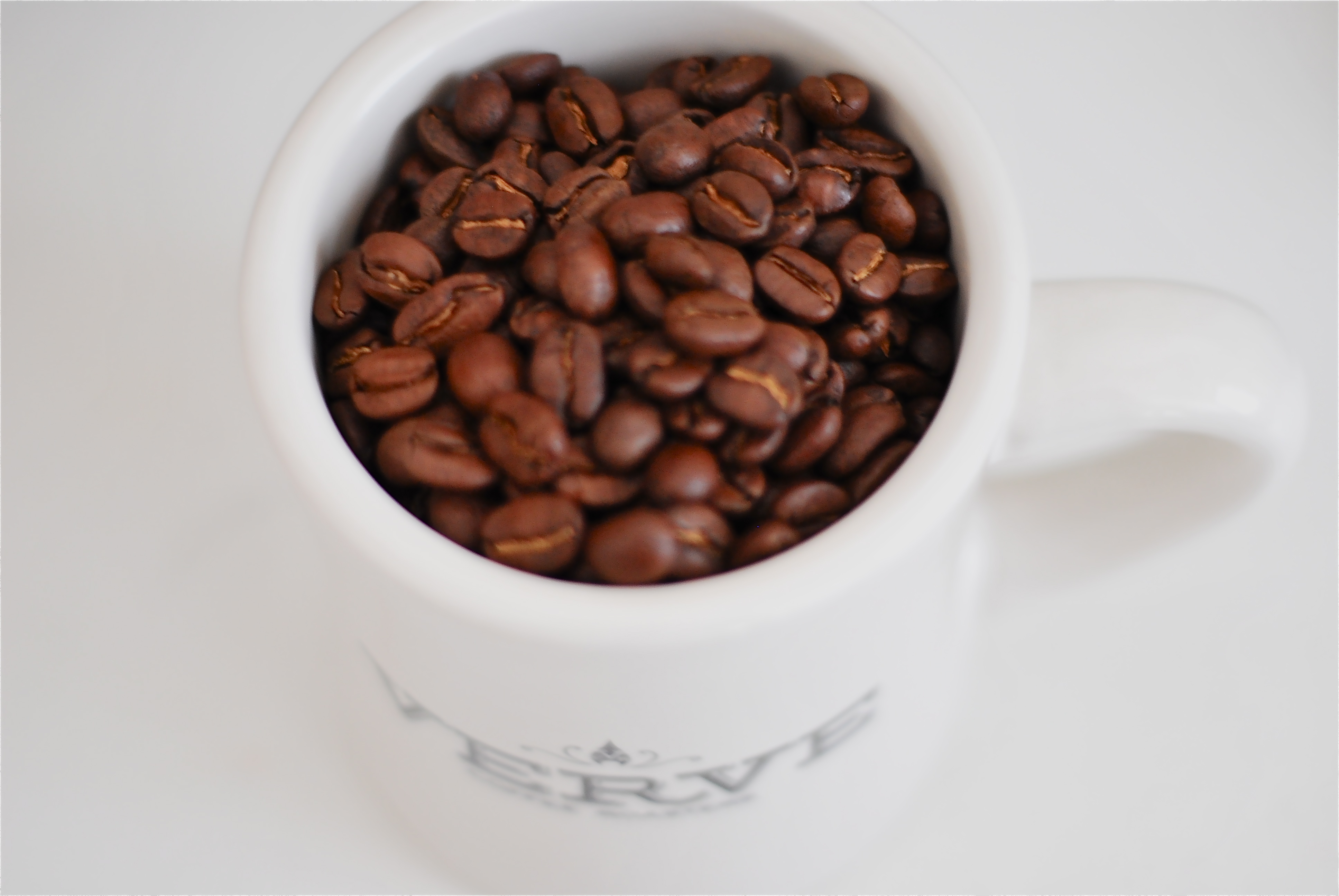
Lucky me, I must say. I first heard about Verve Coffee Roasters in early 2010 when I was researching ideas for the logo for my cafe, skimping through countless logo and typeset books. when I came across the one for Verve, it stopped me in my tracks. IOt was obvious that this company had taken their logo and branding very seriously, employing the services of a top firm to do so. As soon as I got home, I searched for them on the internet, reviewed the concept behind the logo and was also impressed that their commitment to their branding was backed up by their serious commitment to speciality coffee. So, you can imagine how excited I was when following them on twitter and reading abot their new coffees, I hinted it would be good to taste their coffees one of these days – and in came the reply, “sure! send us you address and we’ll send you some”. I tried to contain my excitement, having beforehand  tried to buy some of their coffees on-line, but shied away at the astronomical postage costs from Los Angeles all the way to Cape Town –  so I replied “that would be great, but I live in Cape Town, South Africa”. Jon from Verve didn’t seem to mind and voila, roasted on 29 September 2011, my coffees arrived by mid-October – well in the zone, as I prefer drinking coffee not before 7-10 days after the roast date. And my, what a package it was:

3kg of their single estate espresso from Costa Rica, 250g bags each of Kenyan and Ethiopian coffees, a wonderful coffee mug and some brewing tips – talk about spoilt for choice and very lucky me. I was so excited that everyone in my family now admires Verve Coffee Roasters (kids and wife). So, what was the drinking experience like:

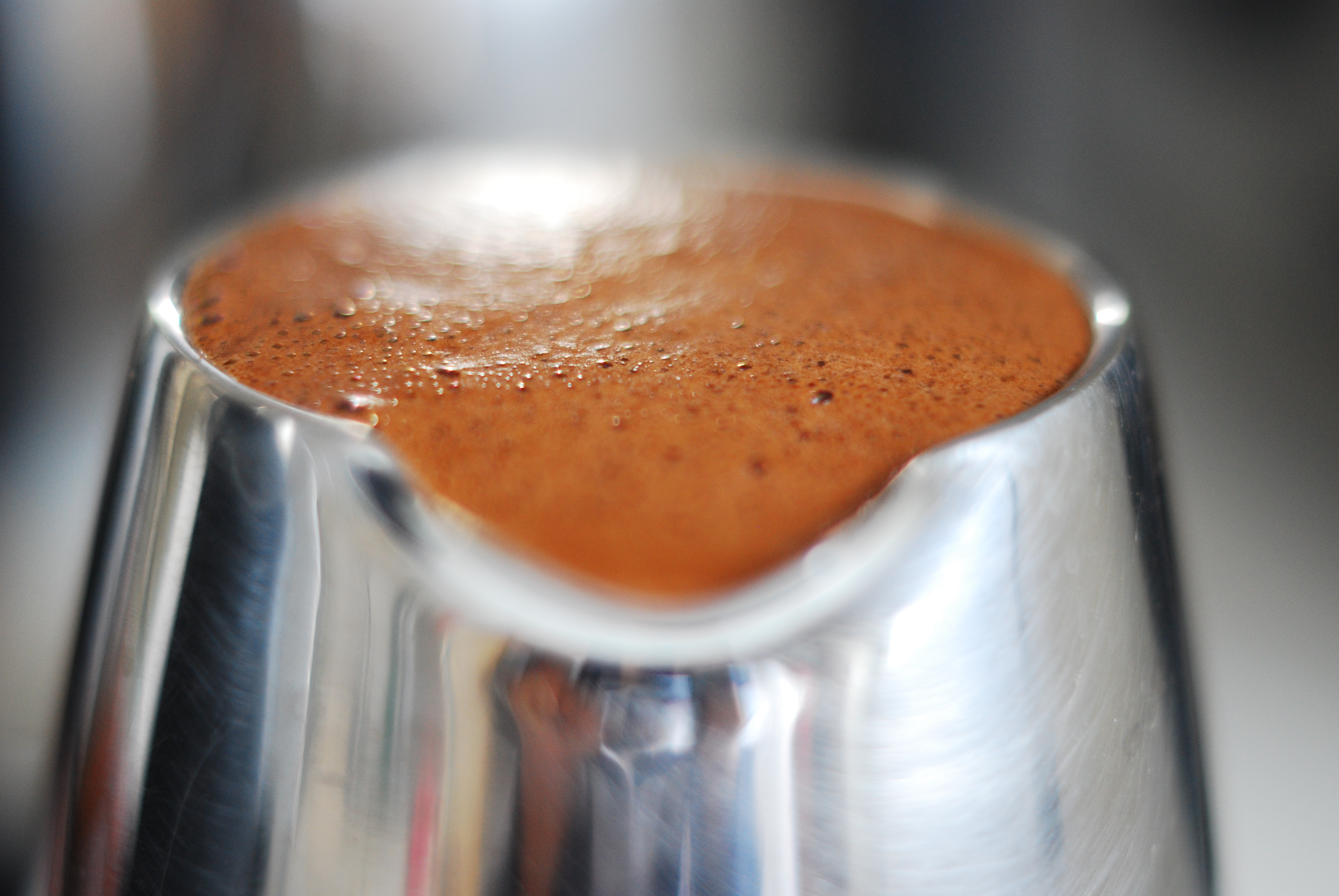
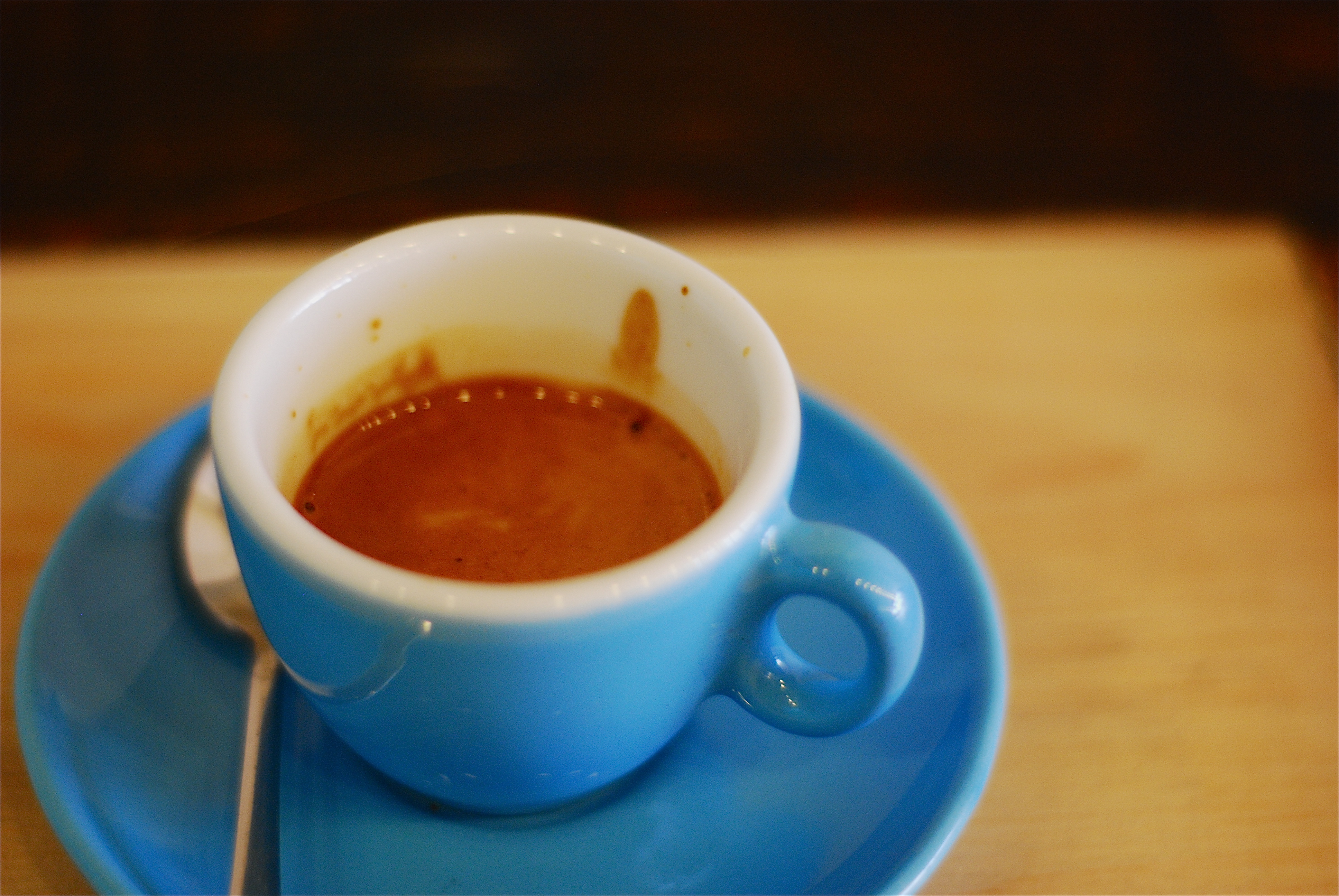
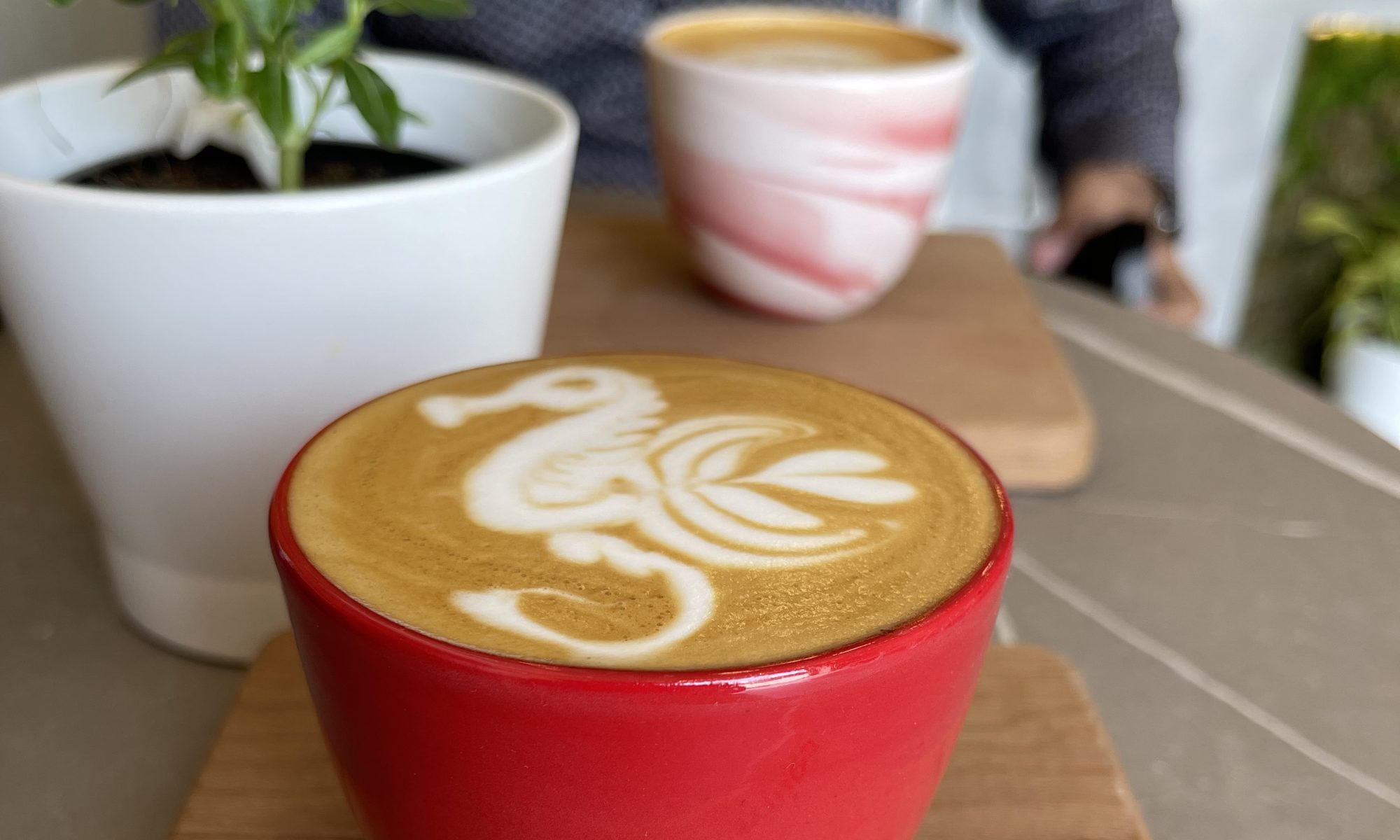
For the Single Estate Espresso, it was as they said it was on the packet “Sparkling”, which is what you would expect from a high-prized coffee from Costa Rica Helsar: C. Alpizar, from Los Naranjos Region roasted medium – high in acidity with honey like colours, making a volcano with your taste buds. I tested them out as single shots (one of my fave pics below)

And sure, it was sparkling – enough to wake both you and your taste buds up in the morning. I however, preferred this coffee when mixed with well frothed milk for a cappuccino or macchiatone (Italian version of a Cortado) – for this method, I got “soft” caramel, with hints of milk chocolate.

However, the real prize in the package were the Ethiopian (my favourite of the bunch) and the Kenyan coffees, which I thought  were “exceptional”. For the Kenyan, Ndimaini, being your typical bold and berry-ful coffee, I extracted it using the French Press and Hario V60 methods and this coffee made me fall in love again with the V60 method. It was like the Kenyan coffee was roasted only for a pour-over – very delightful to drink, complex flavours, full in your mouth with dark berries and a mild hint of dark chocolate. I should add that I adhered to Verve’s coffee tips (a bit simlar to mine, 20g of freshly ground coarse coffee with about 200ml of off-the-boil hot water) when brewing their non-espresso coffees. Not only was this another discovery, but it made me think, “these guys really know their coffee and how to get the best out of it” so they must have spent a lot of time on their brewing methods vis-a-vis the roast profile of each coffee.

OK! the Ethiopian, Biloya. Naturally, I used the aeropress method for this – why ? Usually, when I sense a coffee is really special, aroma, look and feel, I think it should be treated gently, which is how I relate to the aeropress – the most gentle way of getting the best out of your coffee. Again, I followed Verve Coffee guidelines and the taste profile was as they described (which I tweeted about), raspberry and wrap around your outer tongue, citrus.

However, following my tweet about my experience, I got some feedback from DearCoffeeILove You (aka DCILY) about Verve Coffee. After a brief interaction on twitter, he (sorry, I don’t know his real name) pointed me to his post about his aeropress method, which you can read in detail here. In summary, his method got him into the top 4 of the World Aeropress Championships in October 2011 (Yes! there is such a competition) and involves reducing the dosage to 16g with 92C 215 water, using a slightly finer grind than what I use, and with more steeping time (1 minute to 1.5 minutes). So, off I went and immediately tried his method, bringing out my scales, measuring jug, etc and wow! my efforts were not wasted  – the taste profile changed dramatically – It reminded me of my fig and orange honey cake – so we are talking about dried sweet fruits, with honey completed with a citrus linger.

Since then, I have been using this method for extracting coffee, the aeropress way. A bit of a digression, BUT I had to share this wonderful revelation.

Back to Verve – I just found out that they are now 4 years old and that they have just opened (23 November 2011) their third store in LA and from the pics, it looks amazing. So happy for the residents and future customers of their 1540 Pacific Avenue store. Read more about them on their website HERE.

Thanks a lot Verve Coffee Roasters and keep up the good work.


I’m Blending….

I'm Blending: The Beans by Lameen
I’m Blending: The Beans a photo by Lameen on Flickr.

I’m blending, yipee ! But what exactly does that mean ? In summary, it means that I’ve got my experimental hat on again. Having changed my coffee bean roaster at my caffe, Escape Caffe, I’ve started sourcing beans from another roaster but this time I’m sourcing single estate coffees from different regions of the World. I’m experimenting because part of my character loves change and getting to understand things from the bottom right up. Have I lost you ? It means that I want to understand what makes a good espresso blend. So, I’ve been trying to build up on my basic knowledge of taste profiles.

In general, and I wish to emphasize, GENERAL, most coffee roasters have a formula for blending coffee for espresso preparation, which goes as follows:

A Brazilian for BODY,

a Central American for ACIDITY and an

Ethiopian for natural SWEETNESS.

One of your main goals in blending should always be to get a BALANCE, as you don’t want one coffee taste to dominate. In principle, very high quality or distinctive coffees (lots of black fruit juiciness, acidity and boldness/heaviness) are seldom used in blending for espresso. WHY ? Because they will dominate the blend. Think of it like making a soup/stew – if you cook – you don’t want to put lots of chillies in with subtle tastes like basil, as you will kill the basil taste with hot and fiery chilli. This is one reason why you won’t see Kenyan coffees in espresso blends. I can’t imagine blackberries tasting sweet if exposed to a harsh preparation process.

OK! what do we mean by BODY in the case of Brazilian arabica coffees ? We mean body as in the density of the liquid. IOf you taste/drink lots of good coffee, then you will know that some coffees taste light. Sure, they are both liquids, but orange juice does not have the same texture/body as apple juice.

Now, ACIDITY. I’ve spoken at this at great length before, so won’t go in to it too much, but in summary, it’s detected by the sharpness in taste when you drink coffee, resonate of citrus fruit. So, when you blend, although essential to round off the taste around your tongue, you don’t want it to dominate either, if not it could confuse your tongue with sourness. After all, orange juice and mlik (think of a cappuccino) don’t look nor taste nice together. Personally, I’m not in favour of medium to high acidity in espresso based drinks.

Finally, SWEETNESS. Very essential for coffee and to dispel the misconception that coffee is only sweet when you add sugar. However, by sweetness, we don’t mean sugary sweet, but more like natural sweetness, such as the type found predominantly in honey and sometimes elevated in dried fruit like dates, raisins and figs.

So, what are you looking for ? As the coffee roasters rule – and yes they do, as they control what you taste and more often than not, they roast the way they like coffee to taste – you are looking for a coffee that has a nut like character, with a hint of chocolate (and sometimes cocoa, because most people love the cocoa family) with natural sweetness wrapped around your tongue, well balanced and with medium acidity and a lingering finish. Wow ! what a mouthfull, quite literally.

For nuts, think almonds, hazelnuts and macadamia (if you are lucky) and more specifically BRASIL.

For hints of cocoa, toffee, subtle citrus fruitiness, think Central America, like COSTA RICA, GUATEMALA.

For honey like sweetness and sometimes hints of red berries think ETHIOPIA.

If you favour spices like vanilla (hard to get), cinnamon, etc then in general look to the East like INDONESIA, INDIA, PAPUA NEW GUINEA.

BUT, of course, coffee is a lot more complicated than this, so sometimes the basic rules above can be broken by sourcing coffee from a very high quality single estate farm, roasted by a very experienced cupping and roasting master.

I also don’t want to get into the wet-processed and naturally dried process of coffee as these too affect tastes and how you blend, but in general, a lot of top roasters seems to be ignoring naturally dried coffee when blending. Some also use just Central American coffees in their espresso blends. Personally, my ideal espresso would have hints of almonds, vanilla, caramel, buttery toffee, dried figs, medium to low acidity, balance, smoothness and lingering taste. Fussy ? Yes I am. I sometimes get this from drinking Square Mile Coffee Espresso blends and just this morning from Verve Coffee Roasters (my next post God willing).


So what did I experiment with ? First up I used a Brasilian for body, a Malawian for bursting chocolate and a Cup of Excellence Guatemalan for acidity, sweetness and for balance. The result, a bit mellow, easy to drink and favoured by most.

Next up, I tried just two coffees, the Brazilian and the Guatemalan COE. The result, bursting with energy, toffee, caramel and customers saying “Wow! what coffee is this, can you get more ?”

And so for my next experiment…….

The Diary of a Moka Pot: The Essence of Italian Caffe Culture

Making Moka Coffee 3 by Lameen
Making Moka Coffee 3 a photo by Lameen on Flickr.

It’s almost 7 years from the day when we first touched down in Rome for a family holiday. Hearing that I liked coffee, my cousin’s Italian husband handed me a Bialetti moka pot and some ground Lavazza coffee, with a short explanation on how to use it. A little skeptical, I tried it on the first morning and was amazed at the taste (Yes ! back then, I only drank expensive instant coffee and/or French Press coffee). For the first few days inside our rented holiday apartment, I only had coffee in the morning, but after the 3rd day, I got used to having it at least twice a day. On departure from Rome, I thanked my cousin’s husband for introducing me to the moka pot.

On arrival back home in Vienna, the craze began – I needed a moka pot and fast. Back then, believe it or not, even in Vienna, Austria, it wasn’t easy to find one and I was kicking myself for having not bought one in Italy before we left. I found out later that Italians never leave Italy without one and I should have followed that concept. In any case, I goggled Bialetti, found their website and was glad to see that they had an on-line sales option. BUT, alas it wasn’t that easy – being frustrated with trying to buy a moka pot on-line, I decided to call them and guess what, their English voice-mail said they were on holiday for August – how can a company go on holiday for August ? In any case, after many lunch hours spent up and down the city of Wien (Vienna in German), I eventually found a 6 cup one. Afternoons at work were not going to be the same, with colleagues popping their head into the mini-kitchen, drawn in by the smell of Italian style coffee (the aroma of making coffee on a moka pot is amazing), wondering what Lameen was doing. Those brave enough, joined me, after all it was six cup moka pot. On that, six cups in Italy, really means six espresso style cups.

AND that folks is the beginning of “From Coffee with Love“. I am a bit puzzled that I haven’t related this story here, because from then on, I went full-on into coffee. I began with a Bialetti Brikka (pictured above), which is a moka pot that produces crema and then I went on to espresso machines and now I have a caffe, Escape Caffe, as you all know.

So, here’s a quick step on using a Moka Pot, my way of course.

Assume you have grinder, good beans and scales (optional in this case) and of course a Moka Pot.

1. Unscrew your moka pot and pour enough cold water into the lower cavity (about 100ml for a 3 cup) until it us just below the steam release device – this is easy – there’s a hole for the outlet inside the bottom of the moka pot.

2. Place the portafilter on top of the cavity containing the water.

3. Grind your coffee on a grind coarser than espresso but not as much as for a French Press. So, for example if you have a grinder that ranges from 1 – 10 with espresso at 2 and French Press at 9/10, grind on 4.

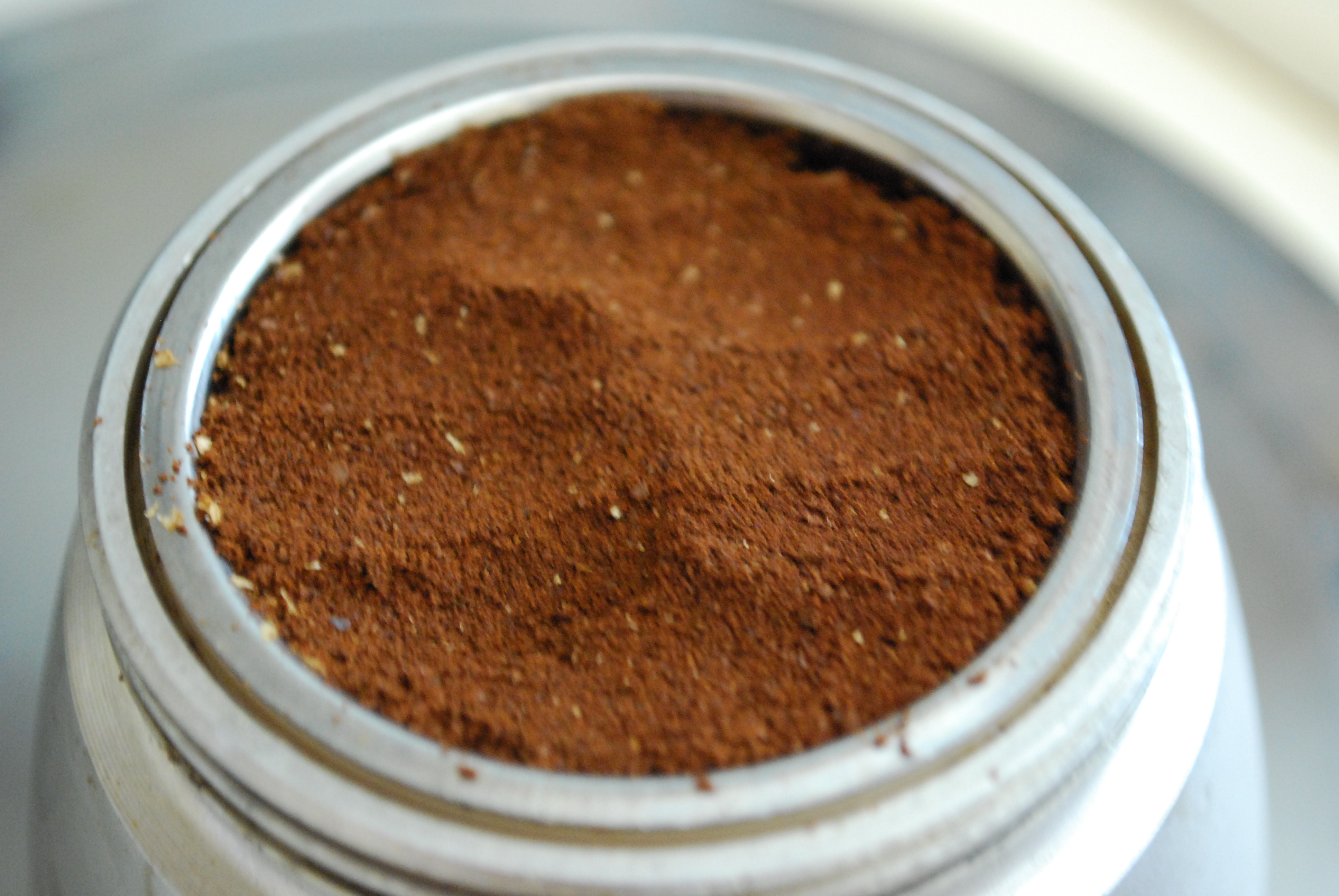
4. Place the ground coffee into the filter holder till it fills it and lightly tamp with your fingers (see below). This is the reason why scales are not essential for this method, because you should not put too little and not too much, just enough to fill the filter. I’m guessing for a 3 cup, about 13 grammes.

5. Screw the top on gently and place onto a hob turned to full, because you want it to boil. A note, Bialetti Moka Pots are made with aluminum because it is the fastest heat conductor – i.e. it takes on more heat than any other metal that we know off so far. This means that the moka pot heats up very quickly. Nowadays, stainless steel ones are made, with a heavy price tag, but good old aluminum is best.

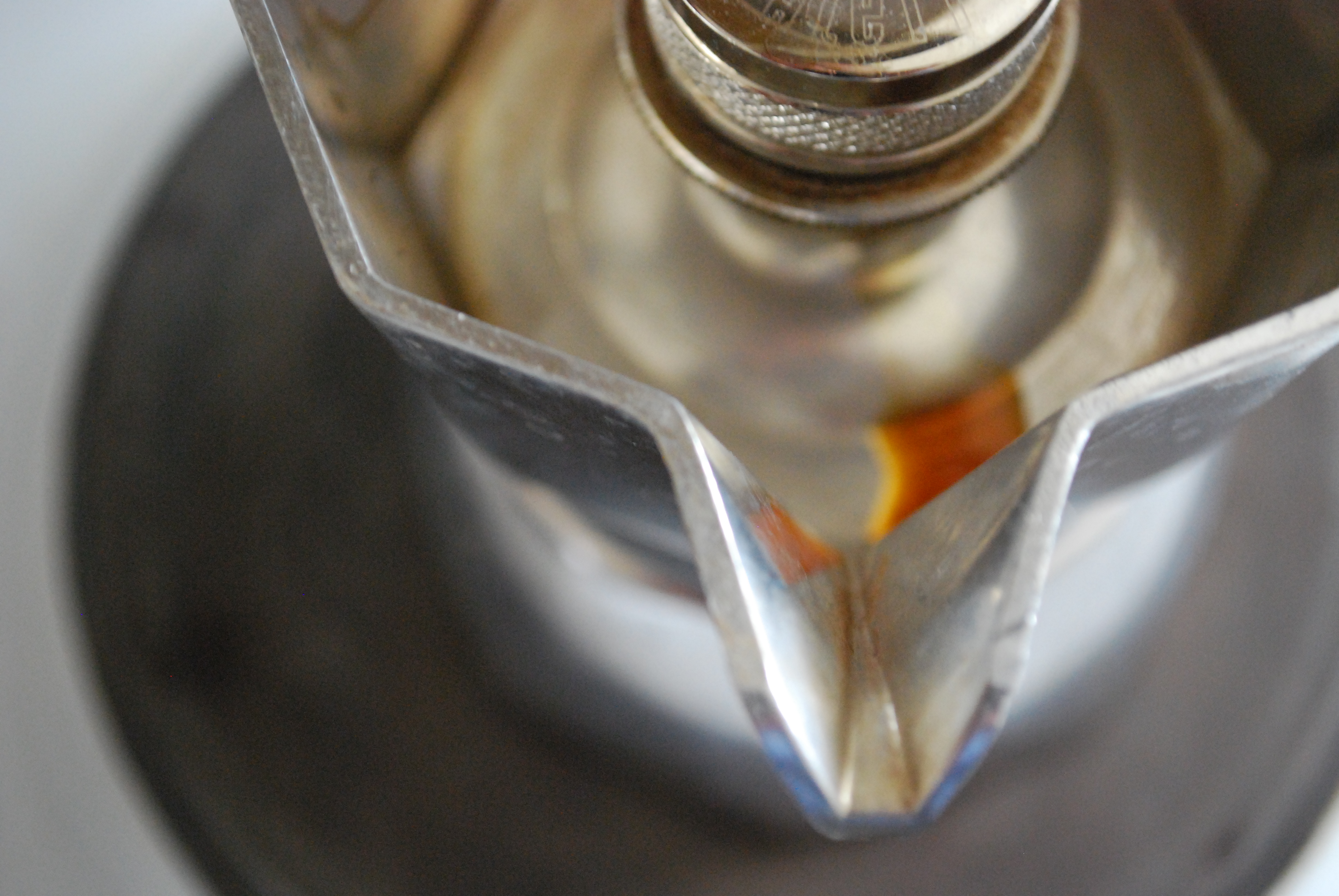
6. First Light – Signs that you did the right thing – a little coffee escaping.

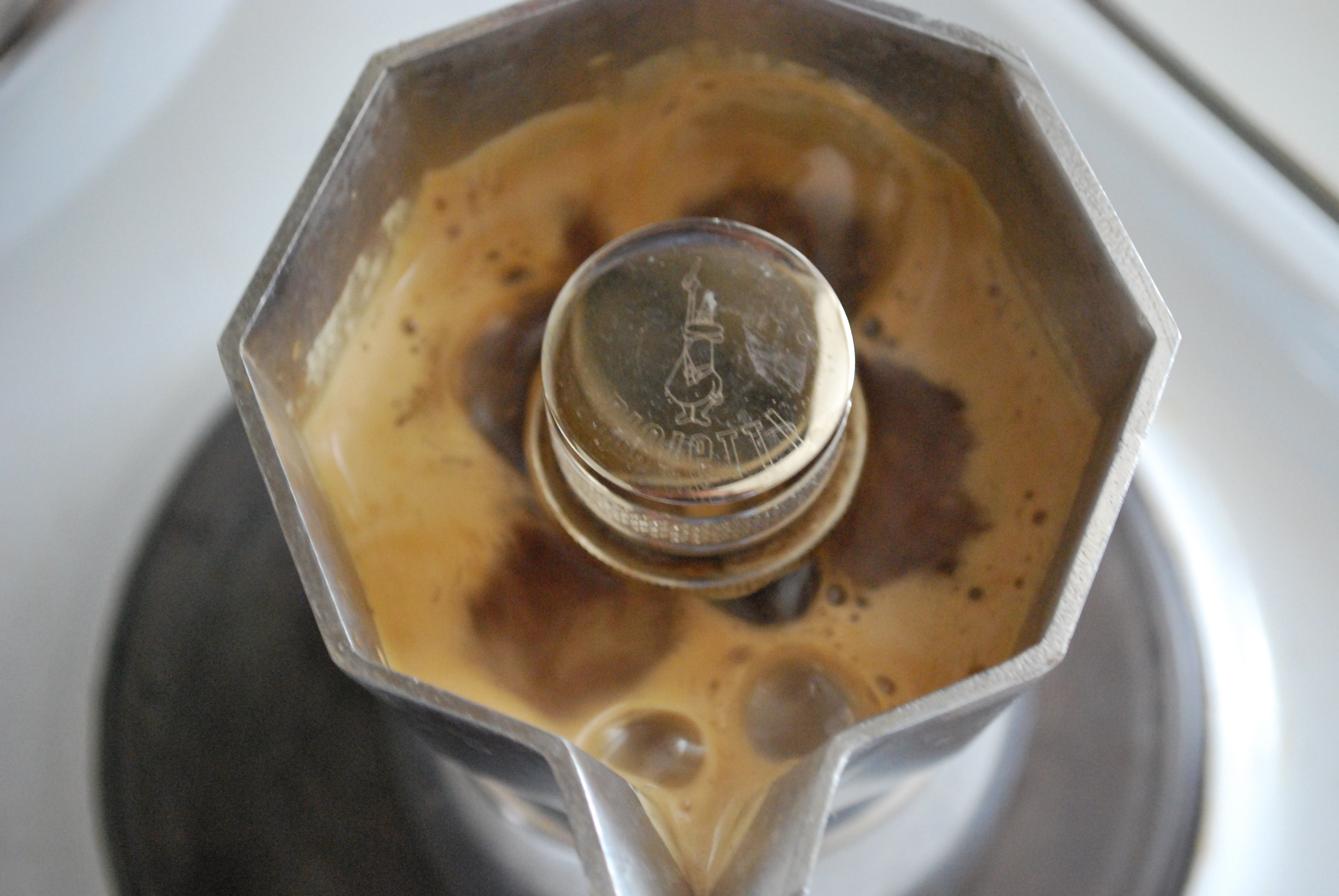
7. It’s coming – yes, the excessive heat and steam building up inside the bottom part of the moka pot, pushes the coffee through the sieve an into the top cavity – the wonders of a simple but effective creation.

8. Whoooshhhhh ! is what you hear and this is what you see when its finished.

You can enjoy black with a little sugar ( I recommend a little for this method) or with cream, yum.

Caution: Don’t place the moka pot anywhere after it has finished, except on a hot plate, as the pot is still very hot. Let it cool down before you wash it by emptying the puck (used coffee) and rinsing out the base and top parts.

The Moka Pot is really simple and when I introduced it to my staff at Escape Caffe, they were amazed by the taste and wanted more. We plan to start selling them soon.

Ciao e buon giorno

The Two Minute Scoop

The 2 Minute Scoop by Lameen
The 2 Minute Scoop a photo by Lameen on Flickr.

What does that mean ? In short, how I make coffee using the French Press/Plunger/bodum Method. After all, it is Bastille Day (French Independence Day) So, I’ll try and keep this to a two-minute read.

1. Get your beans ready, weigh them, 20g and place in your grinder (Yes ! you should freshly grind before each cup for maximum enjoyment)
2. Boil your water and as soon as it is boiled, measure out 260ml.
3. Grind your beans on a coarse setting. If using a Solis Maestro (comme moi) or good quality shop bought one (don’t expect to pay anything less than $100/£70)
4. As soon as your coffee is ground, place into your French Press pot. For my Bodum Columbia, it doesn’t need to be warmed up, as it is double walled, but if you have a glass one place boiling water inside for a minute and rinse it out before placing the ground beans inside.
5. Pour 260ml of the boiling water into the French Press.
6. DON’T TOUCH IT, DON’T STIR IT, JUST LEAVE IT, BUT POUR IN A CIRCULAR MOTION. See the bloom below.

7. Put your timer on for 2 minutes.
8. At the end of 2 minutes, SCOOP the froth or the “French Press Crema” off – Hence the 2 minute scoop”.
9. Place the French Press top on and plunge.
10. Pour out a little and pour into your cup to enjoy.
Ciao, deux minute !

Me & My Aeropress

Sometimes, I’m quick to pick up on things and sometimes, I’m not, like when the CD player came out in the 1980’s. Back then and well into the 1990s, I was really into music and even contemplated becoming a DJ (hard to believe for those who know me, but true – i even had a stage name) but I was an ardent vinyl collector and loved the vinyl sound, so, I refused to succumb and buy a CD player, but eventually I gave in. So, I confess being the victim of my own snobbishness, when I first read about the Aerobie AeroPress on coffeegeek.com years back. But on this occasion, I have 2 excuses – the labeling on the original aeropress package advertising it as an espresso maker and the not very favourable review of the aeropress on coffeegeek.com. Of course I was confused, after reading all that stuff about what espresso is and isn’t and then, out comes this plastic looking contraption trying to change the rules. Fast forward, and hey presto, the aeropress is big news the world of coffee over. Hmm ! should I give it another chance ? But, of course, if all the people I respect in coffee are going on and on about it, so I did.

First up, I’m happy that they don’t advertise the aeropress as an espresso maker, but they do have the other claim “the best coffee maker you’ll ever own” (not on the UK packaging, which has pics of James Hoffman and Gwilym Davies). That leads to my second point, “REALLY !!!” the best coffee maker you’ll ever own ?” – well ! that’s if you don’t own a La Marzocco, a Synesso, a Slayer – you get my point. BUT I do have to confess, using the aeropress in my way was a taste opener.

I was really excited when I got my first aeropress, but I have to confess, when I prepared coffee following the instructions in the leaflet, I thought “is that it?”. So, over the last few months, I’ve developed my own way of preparing it, which I find quite delicious, especially for my last cup of coffee of the day. So, how do I do it…

FIRST – Boil the kettle. After which, place the micro filter into the chamber & twist into place and place about 100ml of cold water and let it drip through into a container – I find a 600ml milk frothing jug the best.

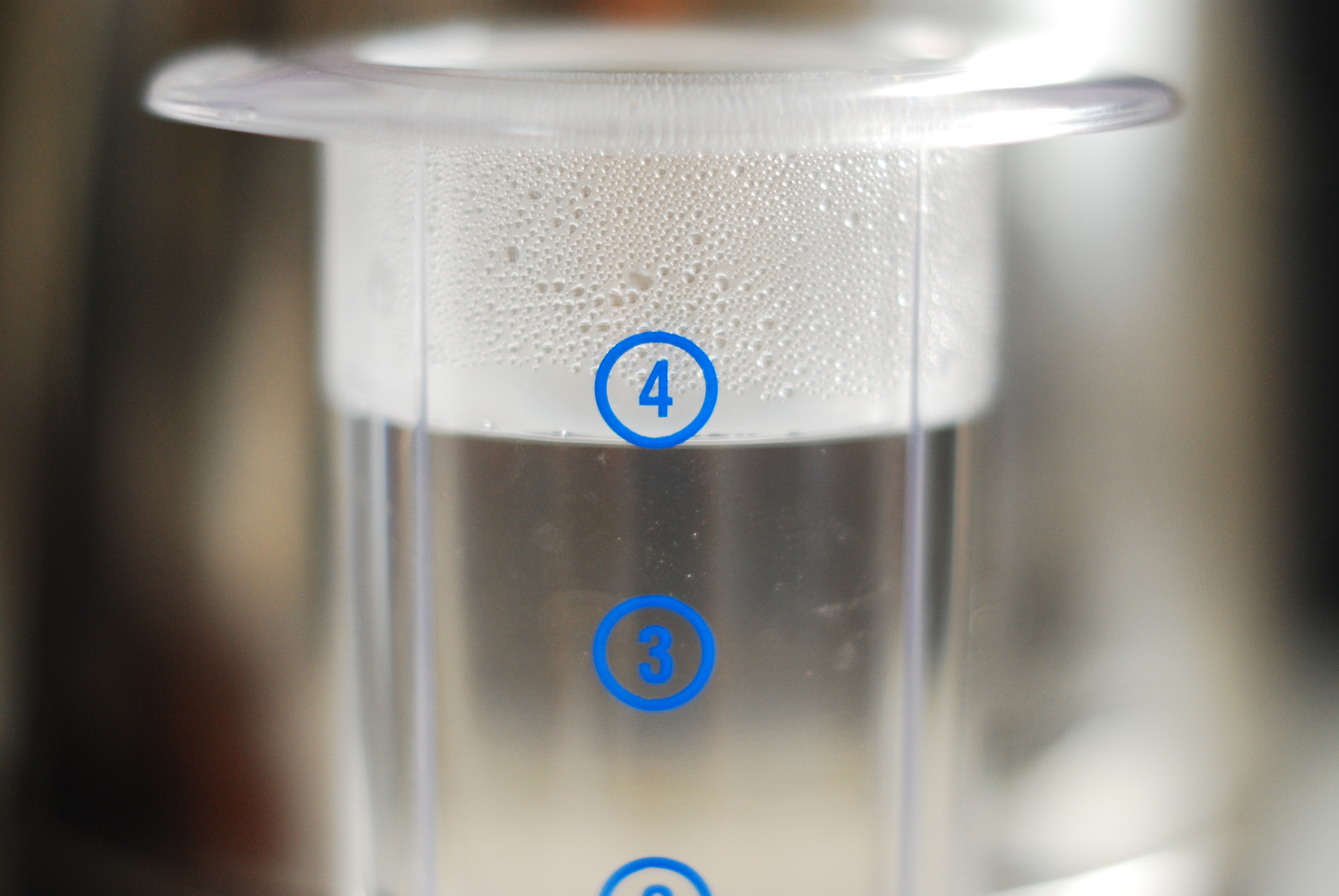
SECOND – As soon as the water has boiled, pour up to “4” on the plunger. Let it rest for about 2-3 minutes. You don’t want to use boiling water, but just off the boil. You can check the temperature if you want, but between 85C to 90C is ideal.

THIRD – Measure 20g of coffee and pour into your grinder.

FOURTH – Discard the water that went through your micro filter in STEP 1 above.

FIFTH – Grind your coffee and place into the chamber. I grind slightly finer than for a French Press and not the recommended “espresso grind” on the instructions.

SIXTH – Pour your hottish water into the chamber in a circular motion so that the hot water touches all the freshly ground coffee. You will see a bloom coming to the top (see pic above). COUNT TO 10 SECONDS and press the plunger through the chamber with coffee and hot water gently BUT firmly.

SEVENTH – Enjoy, either with half a spoon of demerara/brown sugar or alone.

WHAT’S DIFFERENT ? I didn’t stir the coffee with the paddle and I didn’t take more than 20 seconds to brew.

WHAT’S THE GENERAL TASTE PROFILE ? a light aroma and taste, clear with medium to low acidity detected on your tongue, natural sweetness, usually with soft citrus and light caramel taste – I’ve just finished one as I write this.

OK! I hear some coffee connoisseurs screaming “how can the brew method alter the acidity ?” Well ! It does, is the simple answer. To test this, I confess that I usually brew using Espresso Lab (Cape Town’s top roaster) beans, where they source top arabica beans (Serra do Bone is Intelligentsia Black Cat Organic) and they roast more to bring out the fruitiness in coffee, as opposed to dark. Fine, but when I went to Prufrock, Gwilym gave me Square Mile Coffee Roaster’s Tanzanian Blackburn Estate coffee and the Bolivian Colonia San Juan 8 Estrellas. On the latter, it was still a light taste, but with the Blackburn Estate (great for a morning cuppa as it was heavier) although it was bolder, it still had that refreshing lightish taste.

I’ve tried the invert process (basically, do it upside down, and place the filter at the end to press through, see below), favoured by Mark Prince of Coffeegeek, but I wasn’t impressed with the taste profile, I got, so I’m still stuck to my way.

BRAG OF THE POST: I was pleasantly surprised to be asked by Gwilym how I prepared my aeropress coffee and after summarizing the above method, I was pleased to learn that we share the same method, yipee.

One more confession from the aeropress is that I find it still brings out a reasonable taste from old beans (i.e. roasted longer than 4 weeks ago). I know this, because although there’s tons of coffee at my caffe (escape caffe), I find myself scouting around my home for coffee and I’ve got to have that aeropress at night, and finding something roasted over month ago, still works in the aeropress for me.

Enjoy !

Prufrock Coffee: The Standard

Well ! I promised a followed up post on just Prufrock alone and here it is. Dare I say it, but I think this is probably the best coffee destination in London. I have been tracking the success of Gwilym Davies since he won the WBC in 2009 and after tweeting back and forth that I was coming over, literally off the plane and after freshened up in the BA Lounge (that’s another story), I headed straight for Prufrock Coffee on Leather Lane. It seemed like a lifetime getting there because Prufrock is located in the legal district of London and more specifically on a market street and as it was a public holiday, the streets were dead. I was even beginning to wonder if they were open, but of course they were – serious coffee drinkers never sleep.

On the outside, there’s this:

Not sure what it is, but in the window display, there’s a bike and some exclusive looking coffee gadgetry – you have arrived.

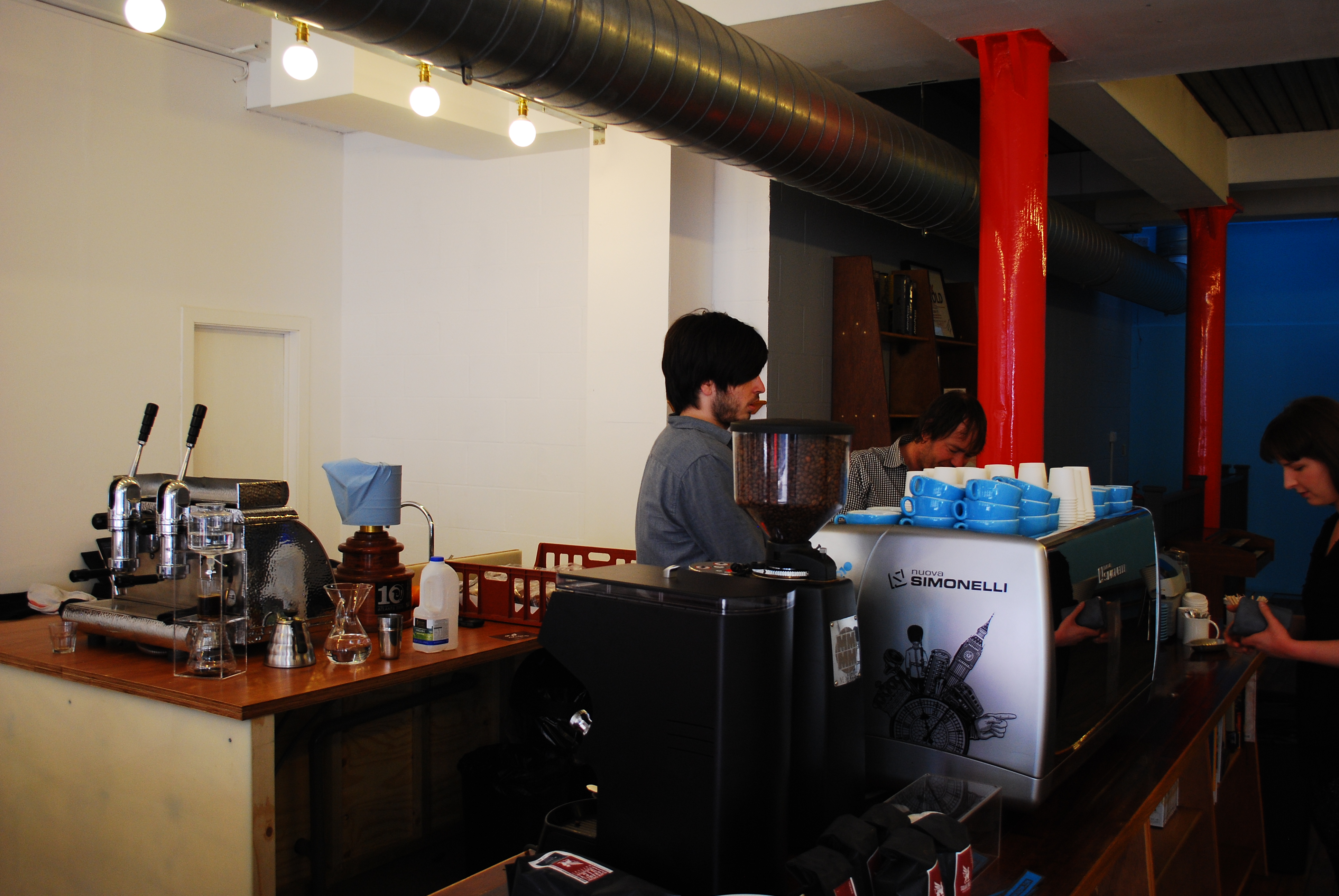
Walking inside, it comes across as a bit bare, there are some stairs leading downstairs on your right (more on that later), some chairs and an old paino, but as you get further in and glance to your left, there it is, the “the brew bar” – loaded with a 3 group Nuova Simonelli Aurelia (courtesy of WBC 2010), Robur E, a prototype grinder, hario V60, aeropress, a slow brew gadget (see below)

 a chemex, a woodneck, an Uber Bolier, the WBC award, a manual espresso machine and I’m sure I’ve missed something. There’s also a wooden retail shelf, stocked with Square Mile Coffees.

Now, we are talking coffee. In short, there’s almost every gadget known to coffee geeks, to make good quality coffee at Prufrock and if you think they are there for show, take a sit and let them educate you, but make sure you have the time and a clean palate to take your taste buds on a twirl.

So, what did I do ? Well, of course as a WBC champion to make me an espresso. After that, I had a piccolo from another barista. On my second visit – I had to go at least twice in 4 days – I asked Jeremy to make me an espresso, using the exclusive to Prufrock (roasted by Square Mile Coffee Roasters) Pomorroso – Single Estate Colombian Arabica. I have to say, this was probably one of the best espresso I’ve ever tasted – creamy, wrap around your lips, nutty, fruity and soothing to the tummy (stomach for non-Brits).

So, on the stairs leading downstairs, Gwilym showed me their future barista training academy, equipped already with a nice looking La Marzocco Linea 3 group, the Penny University Brew Bench and other bits – would love to train there one day.

They are just beginning to find their feet, but I think the idea is to grow into the space. This is pure coffee nirvana, so don’t expect anything to eat, even though they tend to have the occasional delivery of cakes. They’ve also got some books – I bought the latest London Coffee Guide book and some coffee equipment to buy. I think they may roll out more stuff later, but pay them a visit on Leather Lane, if you love coffee and if you are curious, walk in, learn and drink.

London Coffee Scene 2011: Summary, PART II

 The West End (Covent Garden, Soho, Fitzrovia)

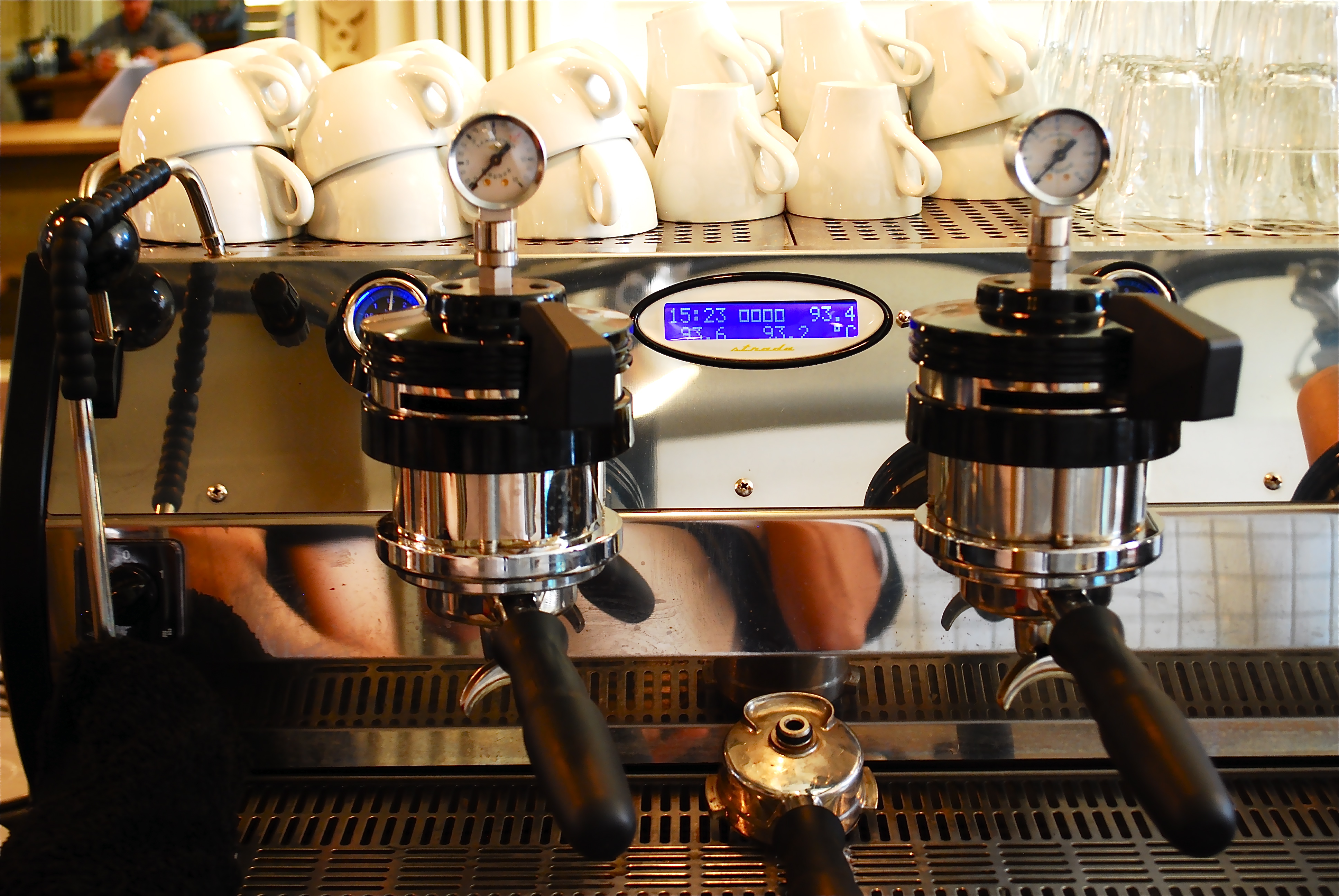
And we start with the place with the best gadget, Yep ! the La Marzocco Strada OR Notes Music & Coffee, located at 31 St Martin’s Lane, Covent Garden, almost opposite Trafalgar Square from the Charing Cross End (Londoners will know where I mean). I’d heard that there was a cafe which had been first off the mark to buy and install the most up to date and probably most expensive espresso machine in the World when reading through my tweeter feeds, so a mental note was made to head down here for coffee. Not being a totally mad gadget man in general, but when it comes to coffee, I’m a victim, so after having being treated to lunch on a sunny day at Jamie Oliver’s Italian Restaurant in Covent Garden by my brother, we headed down the road to Notes Music & Coffee. From the outside, you are tempted by the lovely array of sandwiches and cakes, BUT I knew that I was here for one thing, an espresso on a Strada machine. Doesn’t it look beautiful…

Josh, the barista, was busy and introducing myself briefly, I asked if I could take a picture of this lovely machine….. Warning ! coffee geek inside. So, I snapped away and then obviously asked for a Strada made espresso, which he made, using Square Miles’s Capao, extracted at 93 C – a bit bright for me with such a bean, which I believe is best extracted at a higher temp to highlight the nutty caramel toffee flavours. From one coffee expert to a geek, Josh kindly declined to accept payment. There ! I had had my first LM Strada coffee, yipee !

Flat White & Milk Bar, Soho

Well ! How could I not resist, another almost “must-go destination” for coffee in London, Flat White – where it all began (for me in any case). Needless to say, I had a flat white and I was very pleasantly surprised to see that Cameron, owner and barsita, was still pouring latte art, about 5 years since opening – now ! how’s that for consistency and commitment. A note to the pretenders – the major downfall of start ups, is a lack of consistency and for charming brands, the invisibility of the owner/charismatic face of the biz. Thumbs up to Cameron. Still on that consistency thing, Flat White, still serve take away flatties with a latte heart

And yes, it was still delicious and yes, Flat White are the only cafe that Sqaure Mile Coffee create a blend for.

I actually finished my London tour, hours before my flight back to Cape Town with a visit to Flat White’s sister (why don;t they say brother ?) shop, Milk Bar on Bateman Street in Soho, where I had a fantastic espresso experience. I mean, who takes 5-7 minutes to make you an espresso ? The chief barista (I forgot his name, shame on me) at Milk Bar does, especially if he sees someone come into the cafe, order espresso and then ask him how long he’s doing the pre-infusion for, whilst admiring the Robur E Mazzer Grinder (the daddy of all daddy grinders). The first shot, which he didn’t want me to drink, went right through my tongue like a rocket, with a nutty like taste and the second, kind off filled my mouth, wrapping itself around the edge of my tongue and then coming back in – wow ! No pic, as I was struggling with last minute shopping, but nevertheless, a great culinary experience.

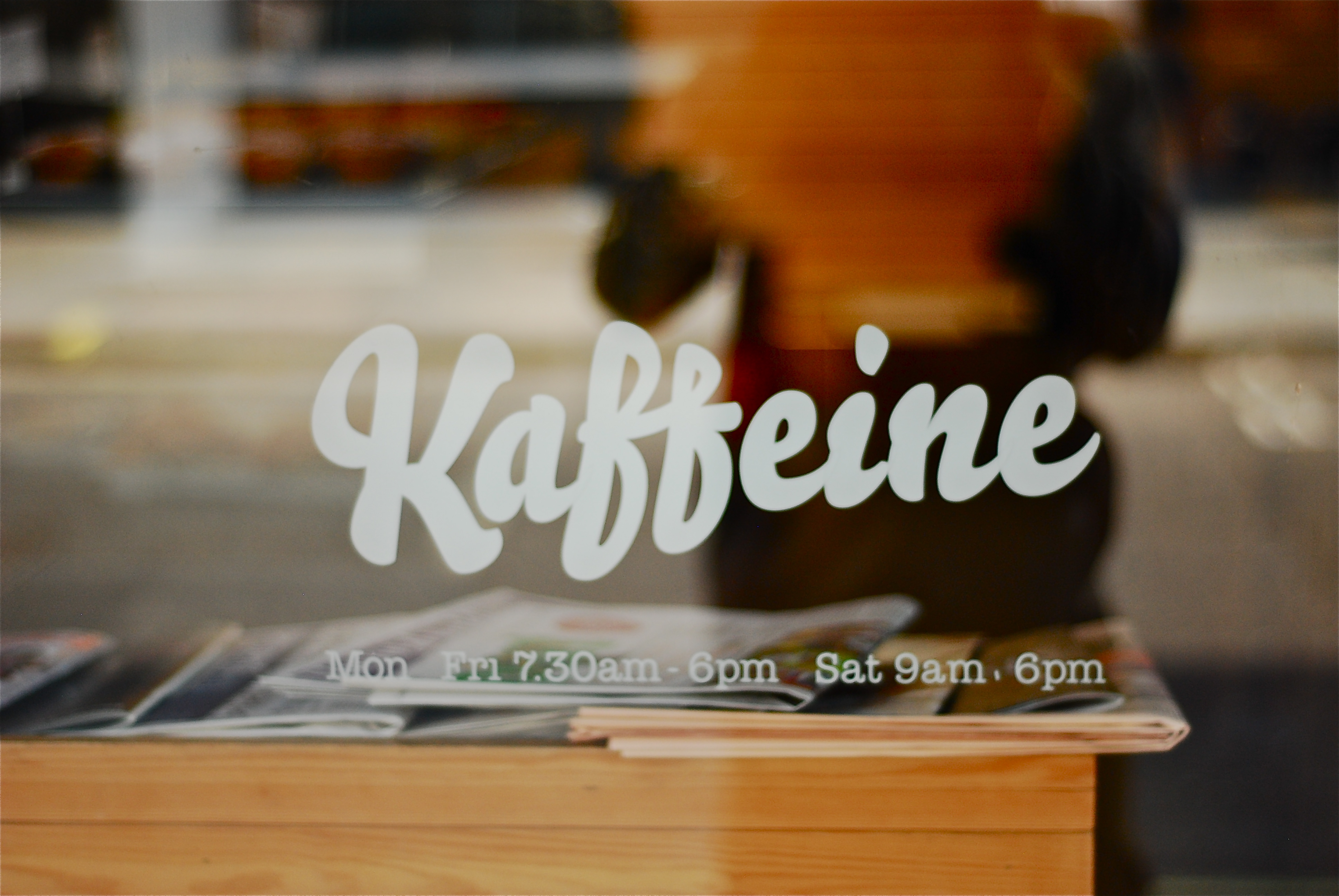
Kaffeine, 66 Great Titchfield Street, Fitzrovia

Last but not least, it was a trip I had been planning even before I packed my suitcases for my trip, a trip to Kaffeine, 66 Great Titchfield Street, London W1, winner of Europe’s best independent coffee shop and more recently, winner of Britain’s best sandwich and coffee shop.

I think I should mention this up front as it’s been on my mind but what is with Aussies and coffee and why are they ruling the London coffee scene ? I can only stand by and admire and wish they would come to Cape Town and help me out with converting the masses to a great brew, but lucky London. OK ! I digress, we are at Kaffeine, my first priority on my last leg in London, which I visited on Saturday morning in the area known in London as Fitzrovia, which means the space in between Regent’s Park and Oxford Street, parallel to Great Portland Street – a quick geography lesson for non-Londoners.

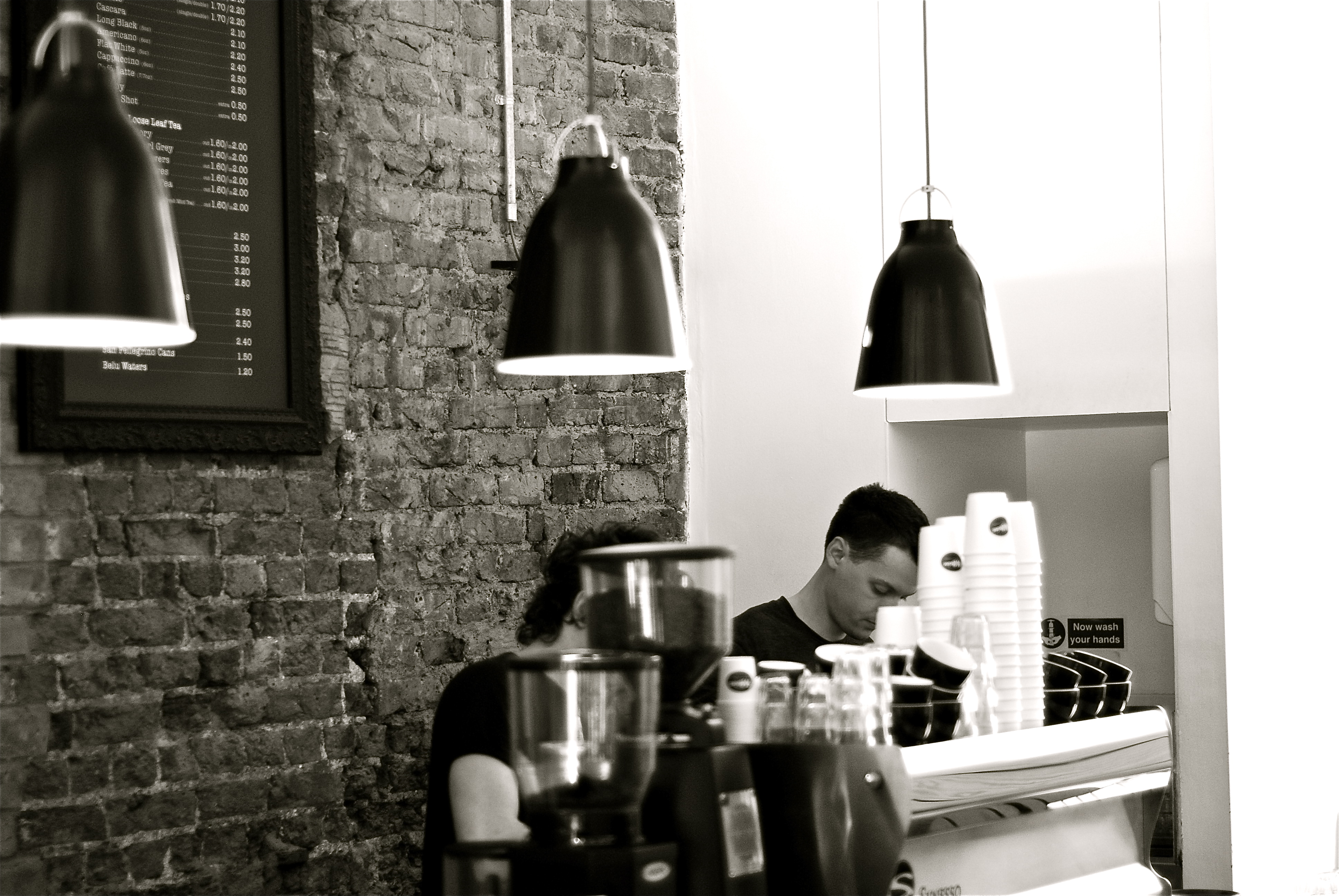
I really loved the simplicity and yet high quality finish of Kaffeine, which incidentally is small and cozy and was quiet when we arrived around 11am, but I was told on a normal day, 570 cups are the norm and on a quiet day, 200+ (Oh London ! should I have opened my cafe in you ?). As you enter Kaffeine, you are tempted by delights like strawberry friands (another great Aussie invention) and yes I was tempted and asked for one to go with my flat white.

I brought an old University friend with me and asked him to try a cappuccino – “wow ! coffee can taste like this, now I know why you are so crazy about coffee Lameen” was his reply after his first sip.

Kaffeine have a Synesso Cyncra, use a Robur E (but of course) and Square Mile Coffee and are led by top barista Cathy, who kindly gave us complimentary coffees, spotting the coffee geek in me. The staff were very attentive and one promised to visit Cape Town very soon – so watch this space if he does, as I might offer him a temp job, before he heads back to London. Go Kaffeine Go and well done on all your achievements. Can’t wait to visit again.

And there you have it….

That’s all I can say and well done London, Londoners for appreciating great coffee and I’m sorry, but I have to say this, Aussies for helping out with the quality, et al.

London Coffee Scene 2011: Summary, PART I

Wow ! Wow ! That’s what I have to say about the London Coffee Scene in 2011. A few years back, whenever I went to London, I headed straight for SOHO, and to be precise, order a flat white at Flat White on Berwick Street, and stop for an espresso at its sister shop, Milk Bar on Bateman Street, also in Soho. If I wanted a little tasty snack to accompany an espresso or a piccolo, I would go to Fernandez and Wells on Beak Street, Soho. In fact, that’s what I did when I last visited London in July 2009 – head to Soho for great coffee. BUT, in the space of just 18 months, the speciality coffee scene in London has literally mushroomed, so that on my visit in April 2011, I had to carve out London just to check out the coffee scene. First up, I wandered into unknown territory for me, East London and more specifically Clerkenwell. I had lived in London for many years but I had never been to this part of London before – OK! I knew this is where Jamie Oliver’s famous Fifteen Restaurant was located, but that was it. Now to the coffee.

Clerkenwell, East of the Centre of London, Hangout for the Legal Types, etc – Get off at Chancery Lane Tube Station

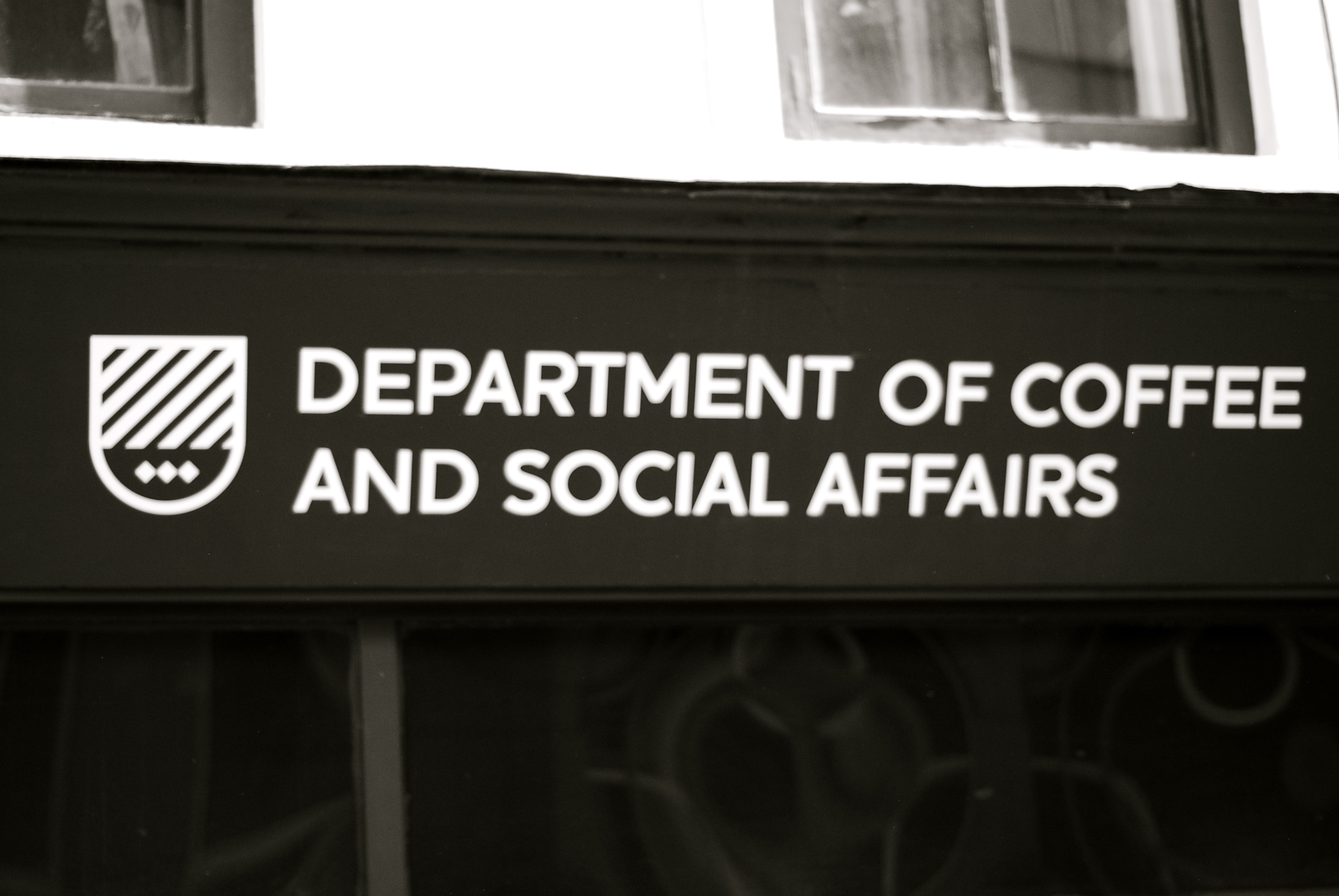
This has to be the new hot spot for coffee with three choices, Prufrock Coffee, Department of Coffee and Social Affairs (the coolest name) and St Ali UK. I headed first for Prufrock Coffee on Leather Lane, 2009 WBC Champ, Gwilym Davies, spot. This is a must for all serious coffee lovers, with a brew bar hosting almost all forms for brewing coffee (hario woodneck, hario siphon, hario V60, aeropress, espresso machines, uber boiler, prototype grinder, a slow brewer and probably more). I had an espresso and a piccolo on my first trip and on my second (yes ! I had to go twice despite the distance) I had probably one of the best espressos of my life, using Square Mile roasted Colombian Pomorroso arabica beans.

I plan to do a separate post on Prufrock, so the above is just a taster.

Almost opposite Prufrock on Leather Lane too, is Department of Coffee and Social Affairs, which only opened in December 2010.

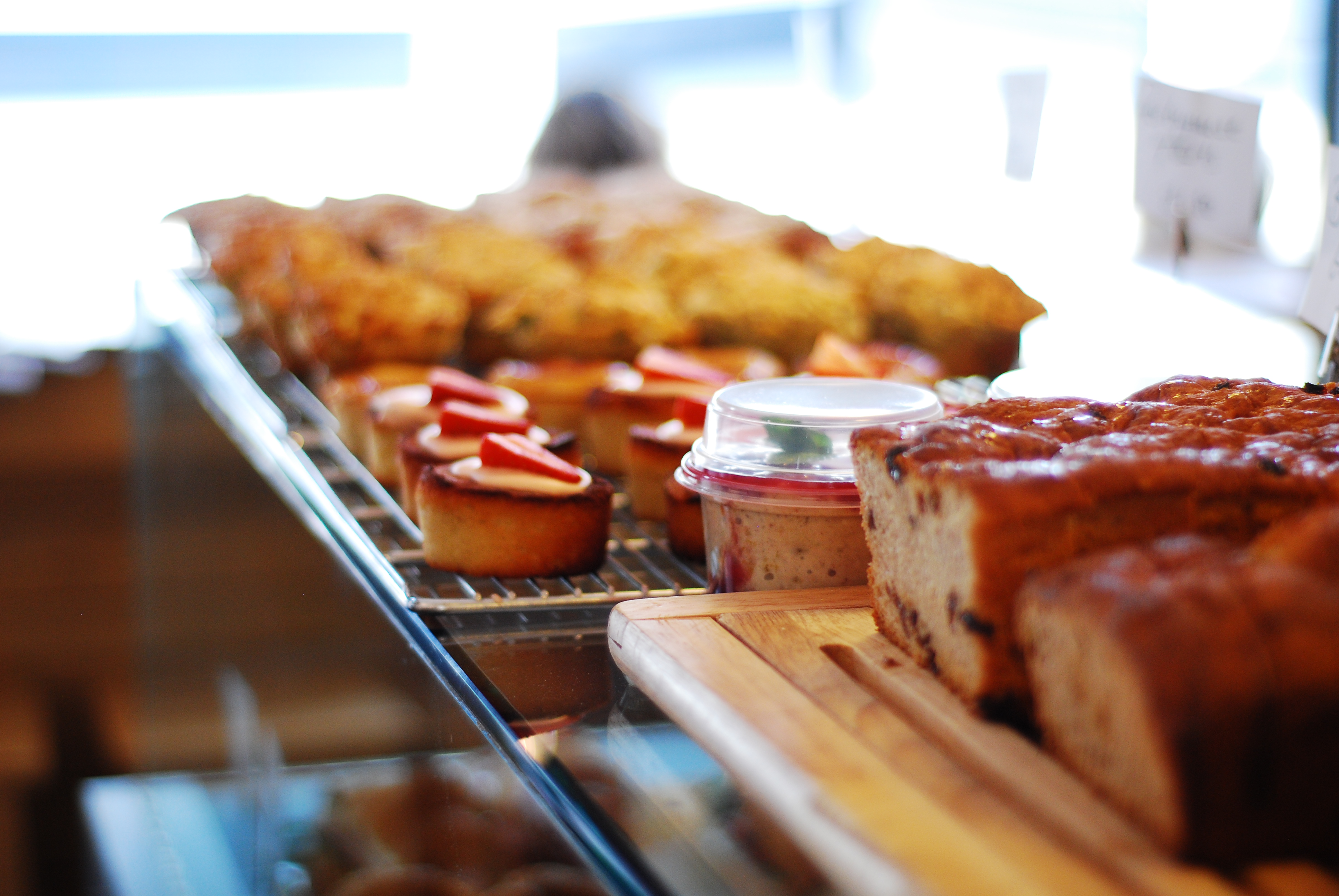
I went around lunchtime as it was rapidly getting packed with office workers looking for something tasty to eat to accompany their great cup of coffee. I was pleasantly surprised to learn that for a cafe that had only been opened for about 4 months, there were streams of people coming in and out of the Department. Hmmm ! perhaps I should have opened up my cafe in London’s East End and not Cape Town, but better weather and better cost of living in Cape Town won the day. With the lovely display of sandwiches on display, I’m not surprised that people were pouring in for lunch to fill their tummies with these tasty delights;

I met with Chris and sensing that I wasn’t just a normal customer, all the way from South Africa and with a hint of coffee knowledge, he gave me a complimentary piccolo and Spanish anise biscuit.

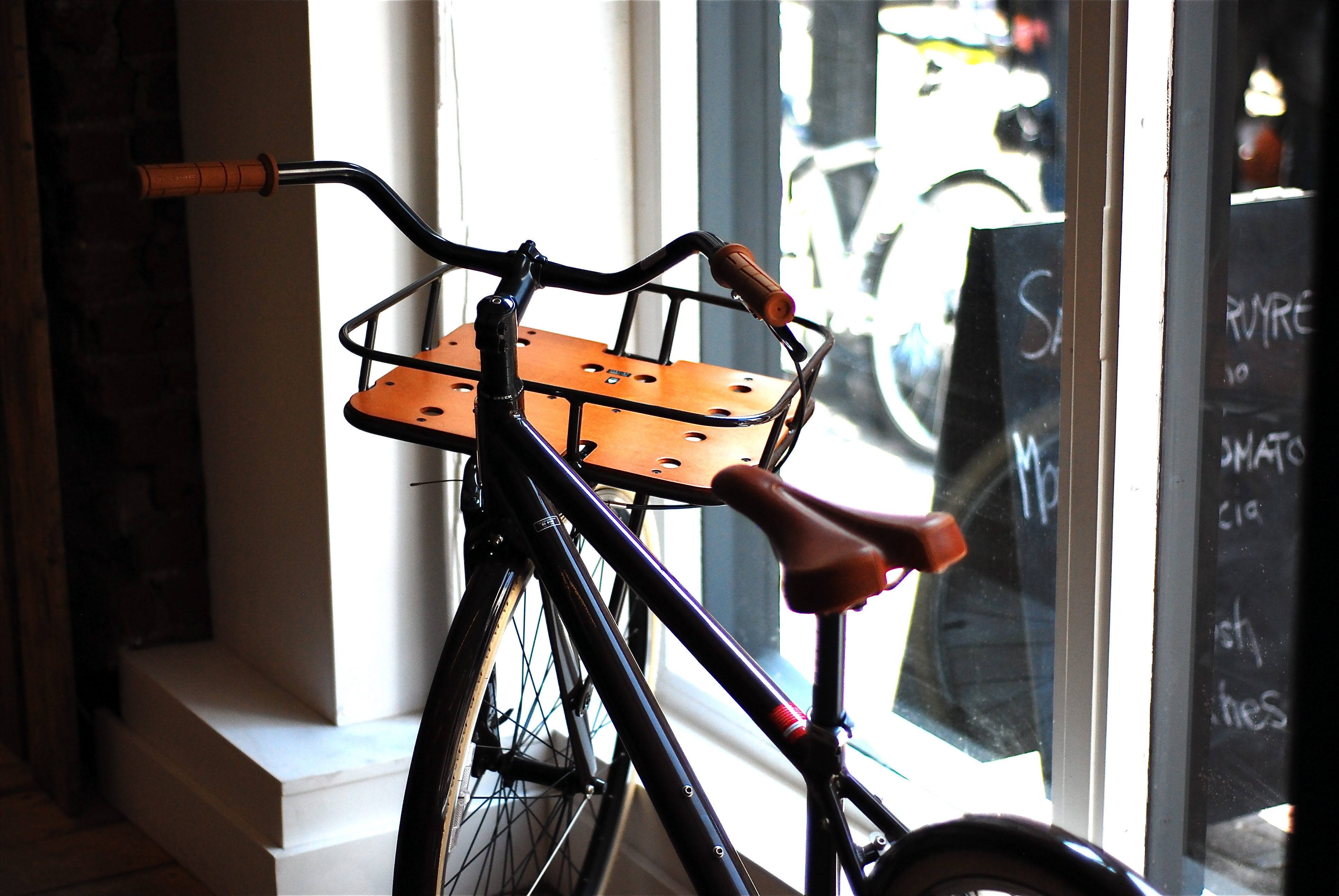
I really loved the space, which reminded me off my own (they even had the same La Marzocco 3 group linear machine I have at escape caffe), but a little more rugged and with little spaces to work. I really liked their Globe bicycle, pic below.

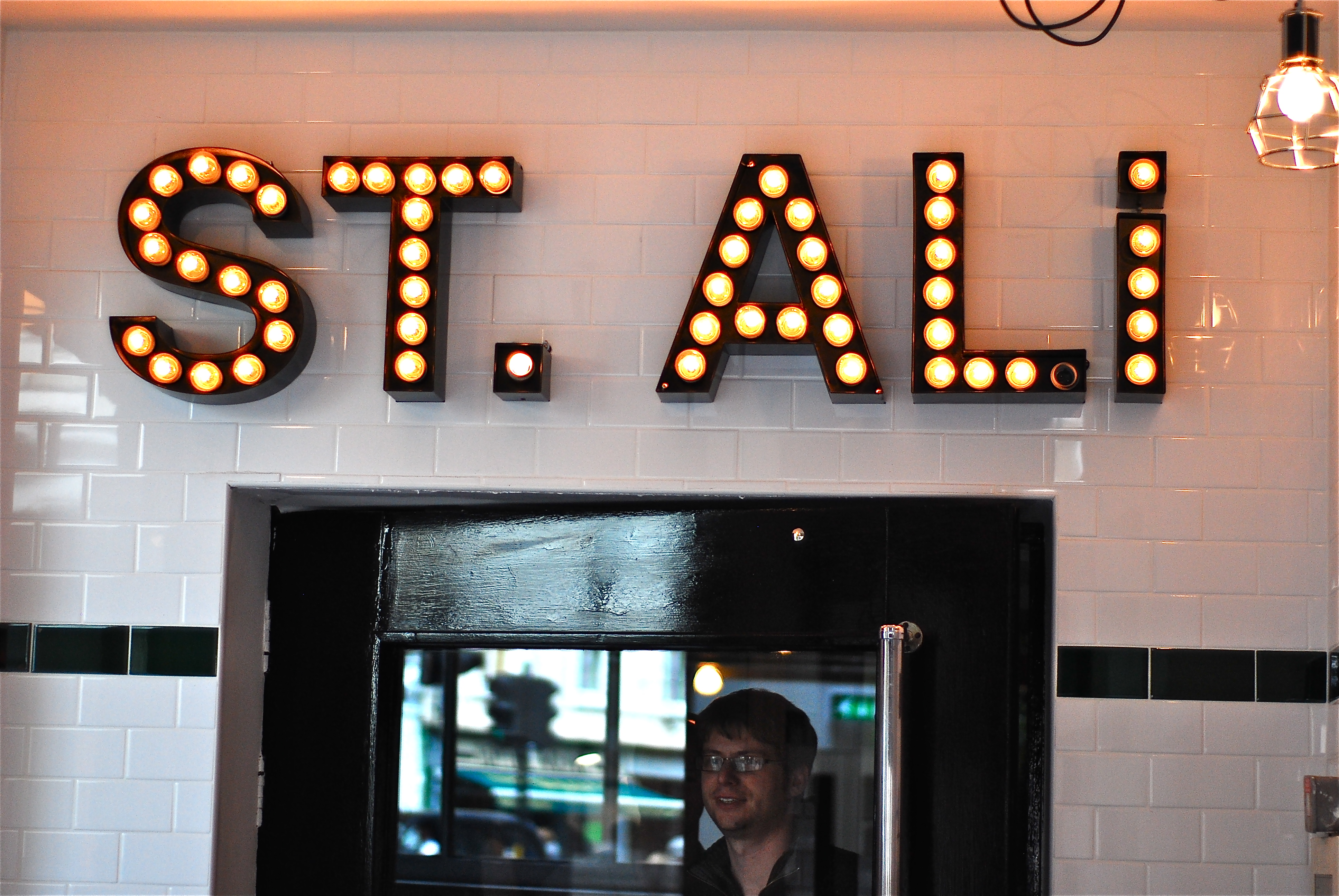
So, finally, St Ali – UK. If you are an international coffee buff, raise your hands – me, me….. okay I’ve got to keep writing this, you’ll have heard of St Ali, who are one of the most famous coffee establishments in Melbourne, Australia. They are like crazy about coffee – a destination in their own right. So, when I heard they were opening a cafe in London, I kinda went berserk, especially as they were going to be open before my trip. They are located at 27 Clerkenwell Road, almost hidden, but as you enter, there’s a coffee roaster in the window and their signage is lit up, so you’ve got no excuse in missing it.

I really loved their decors, which was a bit similar to mine at escape caffe, with exposed brick, but a bit darker and hence cozier than mine. As you enter, there it is, the famous Slayer Espresso machine (see below) greets you – sort of letting you know that although they serve food, they are serious about coffee. If that wasn’t enough, once you pass the Slayer and wander tot he back of the cafe, they have a gigantic coffee roasting machine.

Also at the back and next to the coffee roaster, there’s a green plant wall and an atrium of about three floors (I promise a pic summary of the London coffee scene later). I met with Baptiste (a French barista who worked at their Melbourne establishment, but has been relocated to London) and Tim Styles, formerly of Intelligentsia and more recently Square Mile Coffee and who has been recruited to oversee their coffee roasting operation. I had a flat white with my brother, looked around and on my second visit, bought their Cult of Done espresso blend. From what I’ve been reading, St Ali is becoming extremely popular with the London fashionista, featuring in Vogue, with queues outside on Sundays and their hiring like crazy already as they prepare to operate from 2 floors, offering both coffee and food.

In summary, head down to this part of London for a great cuppa (very English lingo) and as I observed, all cafes had a Mazzer Robur E grinder, which hints that each one is making hundreds of cups of coffee per day, so expect a queue at busy times.

For PART II, I’ll take you to central London, so watch this space.

1 more thing about Serra do Bone @ Home

Serra do Bone Naked by Lameen
Serra do Bone Naked a photo by Lameen on Flickr.

I could easily have updated my last post but decided not to. In any case, JUST ONE MORE THING ABOUT Serra do Bone @ Home, which really applies to making coffee at home. I have to confess, all those years that I was making coffee at home I never measured the weight of my coffee before putting it through the grinder and extracting espresso. There are many reasons for this, which in a nutshell can be described as, that I just assumed that as long as I ground enough to fill the double basket and as long as I got about 25ml espresso in 22-25 seconds and there were nice tasting notes at the end, Voila ! it was right. Well ! WRONG – well ! that’s a bit harsh – not exactly true is closer to the final judgement. WHY ? Here we go…

1. Too much coffee doesn’t mean a better taste: We often assume that the more coffee you get into the porta filter the stronger the coffee and hence the taste. This isn’t true. Sure you may get more coffee and perhaps more caffeine, BUT not a better taste, because we now know that the coffee can taste better with lower weights, especially milk-based espresso, i.e. cappuccinos.

2. How much coffee should we use ? There’s a sort of standard agreement that espresso is made using 7 grammes of coffee, and so a double shot, should be 14 grammes, right ? Well ! not exactly. There are many parameters that affect the taste and now, some say between 18-22 grammes. So, initially I thought that at escape caffe, we would go for 20-22 grammes of coffee, so that all that milk would not drown out the taste of the coffee. However, after about a few weeks and consulting with my roaster, we realized that by reducing the weight to just under 20 grammes, we could get a better taste profile.

3. What’s the right grind ? Higher weights of coffee can mask/hide the right grind for the coffee you are using, HOW ? If you use a lot of coffee, you have to grind coarser to make sure it goes through the portafilter, because remember, that the finer the grind, the harder it would be to get through the portafilter when extracting espresso. Still with me ? BUT, if we use less coffee, we don’t have to grind so coarse. I noticed that when we were grinding the coffee, we had lots of clumps of coffee, which meant we were grinding lots and the heat of the grinder (which are programmed) was making the coffee clump together. So when we reduced the weight of the coffee to about 19 grammes, we didn’t see so much “clumping”.

All the above arguements have been discussed at great length on twitter by experts such as James Hoffman (aka Jim Seven blog), Mark Prince (aka Coffeegeek) and Intelligentsia from which I have learnt a lot about weight profiles. So, you’ll see that people weigh the beans before grinding, weigh the actual extraction liquid, across different temperatures and times and then get a ratio. In summary, you can get different taste profiles depending on the weight, time and temperature – Complicated ? Well ! yes it is, but who said that “real” espresso was easy.

One final thing is pre-infusion – a big word, but it really means that you run water through the group head before extracting your espresso – without portafilter of course. What does this do ? Well for my home espresso machine, which doesn’t have a PID (temperature control mechanism), it will lower the temperature and should make it ready for extraction – that’s the theory at least, but it’s been working for me at home, so complaints there.

OK ! so finally, when I made serra do bone at home, what did I do ? Apart from following the rules, I kinda measured the beans before extraction (I use my eyes because of experience at the caffe), pre-infuse for 5 seconds to lower the temperature to below 94C and extract in about 23 seconds and there’s definitely a difference in taste.

The first thing is more body in the coffee, but strangely enough a good taste profile, even though the beans were roasted over 22 days ago (we don’t serve coffee using beans roasted over 21 days ago, so I bring old beans home).

Serra do Bone @ home

Serra do bone @ home by Lameen
Serra do bone @ home a photo by Lameen on Flickr.

Serra do bone @ home… why ? It’s our number one coffee at Escape Caffe, but always wanting to test parametres, I decided to take some spare beans home to use on my Isomac espresso machine and lets say, not as expensive conical grinder at home. After all, it was at home that I honed my barista skills, studying the bean and writing about different coffees and roaster profiles. At Escape Caffe, we have a La Marzocco 3 group Linea with a built in PID set at 93.6C and we use the becoming popular Anfim Super Camiano grinders – machines way superior to what I have at home, BUT nevertheless I’m thrown back to what Mark Prince (Coffeegeek extraordinaire for those who don’t know) said about preparing espresso “if you follow the rules, you can make a really good espresso at home using a great home grinder and semi-pro espresso machine” (not exact quote but along those lines). In any case, if you follow the rules, you can make better espresso based drinks at home than the vast majority of cafes in the World. I’m not going to get dragged down into the detail of the rules, but in summary they are (i) fairly freshly roasted arabica coffee beans, i.e. within 10-20 days (ii) a decent burr grinder, costing at least US$250 (iii) a semi-pro espresso machine with E61 group head, with lots of brass and heavy metal – this will cost around US$600 (iv) ability to tamp at around 30 pounds of pressure and (v) a very good idea of how to be a home barista, so that you know for example what grind to use so that you get about 25ml of espresso in 25 seconds when you extract coffee, etc, etc.

OK ! so how was Serra do Bone at home ? Pretty nice but with different taste profiles. First up, a bit about the bean – it’s an organic arabica coffee bean, winner of the Cup of Excellence in Brazil, used by Intelligentsia as their organic espresso, displaying taste profiles such as candied apple, cocoa, raspberry, cherry with a medium body and soft acidity. Secondly, don’t be misled by all the taste notes as you are unlikely to taste everything in one cup, because different brewing techniques, as well as temperature and moisture affect the eventual taste of the coffee, but that’s another blog. So in summary, was I disappointed ? NO ! because I stuck to the hard and fast rules. So, at the caffe, we kind of pick up the cherry cocoa elements and when mixed with milk, you get a chocolate berry taste with a hint of caramel, but at home I got a sweeter cocoa caramel taste, which is still very yummy. One reason for the slight difference could be environment, a hihger brewing temperature as my Isomac doesn’t have a PID, as well as the obvious, my Isomac is no La Marzocco, BUT if we follow the “rules” the main taste parameters remain the same. I would love to run a home barista course one of these days, so that people don’t get scared by the prospect of investing in a decent espresso machine and good grinder.

So Serra do Bone at home last week got me to practice my latte art skills, as well as sample a very tasty coffee, and get a good pic of my cappuccino, YUM !

Before I go, apologises for the long delay in blogging – I promise to be more frequent in 2011 – also this is officially my 100th post, yipee !