I’ve decided to add another category to my blog, aptly named “Coffee tools” in anticipation that there are some readers of my blog that just want to know about the stuff needed to make coffee. Anyway, what better tool to start with than a La Marzocco coffee machine. I’m not really going to go too technical here because I only feel comfortable sharing stuff that I really understand and as I didn’t major/study in-depth any sciences especially engineering, I’m not going to bore you with stuff that you will need a dictionary to understand. OK ! La Marzocco espresso machines are generally what top baristas believe to be the best machines for making espresso and espresso based drinks. Their machines are used at the World Barista Championships to determine who is the best barista in the World. Of course, there are many good espresso machines like the Synesso Cyncra, which coincidentally is designed by a former La Marzocco engineer. There are other machines and of course many opinions but, the consensus is on La Marzocco.
In any case, I had the opportunity to meet with La Marzocco’s main rep in Austria, based in Vienna. It is run by Mr Reinhold Fliedl who supplies coffee machines and other stuff under the name Espresso Solutions. I had already met Reinhold when I bought a La Marzocco bottomless filter-holder and so this was our second meeting. His company was on the other side of Vienna and I took the opportunity to get a half day off from work on a Monday morning – more sleep for me. Anyway Reinhold is a really nice guy and he really knows his stuff when it comes to espresso, coffee, coffee machines and coffee grinders – he owns a La Marzocco GS3 – the only espresso machine suitable for the home made by La Marzocco and costing about 4,000 Euros ($6,000). I learned a lot from him as I was also looking to buy a new coffee grinder too and he talked to me about his two-group head La Marzocco GB5 (one of the best machines made by La Marzocco), which looks really nice.

I snapped away and also got a really great shot of him pouring some latte art in his Alessi milk jug, after he had showed me briefly how to froth milk on the GB5. Actually, this is one of my best shots yet, judged by the number of the views on my flickr account

He did a few practice runs on different types of coffee for espresso.

A couple of cappuccinos later and an espresso, I was coffeed-up for a few hours and we got talking about beans, roasting and grinders, as well as the poor state of affairs in Vienna with regards to getting really good espresso and espresso based drinks. Reinhold was so serious about this that when we met in mid-June, he was planning a trip to the World Barista Championships in Copenhagen to register through examinations to become an Speciality Coffee Association of Europe (SCAE) trainer. I can gladly report that he passed and he is now one of only three in Austria. A coffee school is planned, which I hope to attend God willing if it is set up very soon.
Despite my intro about technical stuff, I cannot end this post just with pictures – I’ve got to delve into some of the tekky stuff and so here goes. I was shown the inside of the GB5, which displays La Marzocco’s unique dual boiler mechanism, which means, and I quote from La Marzocco ” the GB/5 ensures maximum temperature stability for coffee brewing, with electronic monitoring of all the machine functions” – in simple language, this means that the temperature for preparing coffee is always maintained at the ideal levels of between 90-93 C for extracting espresso. This is what I understand the now famous Proportional Integrative Derivative (PID) system is, which monitors temperature to all group heads. So for example, as we know, temperature is key in coffee preparation and a 1-2 C variation in temperature can affect the taste of an espresso, where you can loose out on high citrus tones for example in a type of coffee. Also, in lesser technology machines, the more you extract coffee, the less the temperature gets, whereby you begin extracting espresso at 87C, which could mean that the coffee will be a bit bitter on all group heads. However, with the technology on the GB5, the temperature is automatically adjusted for each group head and maintained at the desired level – now isn’t that cool. There’s also one other bonus – there’s a light under the main control unit, which means that if you have one of those dark looking interior cafes, the machine lights up to show where all the action is, just above the brewing heads. Of course, this type of machine is for those serious about their coffee and serving the best, but I believe it’s worth it whatever the price. Of course, all the other variables have to be right too, like the right grind, the type of grinder, the quality of the bean, in summary the 5 Ms – (Mescla (coffee type or blend), Machina (the type of coffee machine), Machinadosatore (the grinder that grinds the coffee), Mesura (the grammes of coffee used per espresso shot) and Mano (the hand of the barista) – now make sure you learn these as I might test you on it next time…. hmmmm !. In any case it was a pleasant trip and I learned so much. Perhaps next time I can try the machine out. If you live in Austria or Germany check out Reinhold’s website/e-shop on www.espressolutions.at
 It is near the Hofburg Palace, situated on Kohlmarkt, which now resembles Saks Fifth Avenue (New York) or New Bond Street (London, UK), next to shops like Armani, Chanel, Louis Vitton and Tiffanys. Cafe Demel is famous because it was often visited by royalty and in keeping with tradition, even today, whenever dignitaries visit Vienna, a lot of them get taken to Demel to have a coffee or at least to buy a famous Viennese cake. For example, when the former United Nations Secretary General, Kofi Annan visited, Cafe Demel made a cake that looked just like him, at least from shoulder up.As you enter the shop, there’s a display of souvenir cakes on your left and on the right and in front of you, an impressive display of very traditional Viennese cakes and pastries. As you make your way to the back, the traditional atrium has been converted into an open display area, separating you from pastry chefs decorating cakes – you are allowed to take pictures as long as he flash is off. I made my way upstairs as the lunchtime crowd had already taken up all the best seats downstairs. The interior looks like it hasn’t been touched since the turn of the last century, but that adds to the character. The regular customers I spotted in there were all into the typical Viennese tradition of ordering a coffee and reading a newspaper. as you know, if you have been through my website under “did you know”, you will know that cafes in Vienna were the first ones to introduce newspapers on sticks.Anyway Cafe Demel is now a must-stop on the Vienna tourist trail, so I was not surprised to hear lots of American and British accents. I am also happy to report that the waitresses spoke English and more importantly, where very polite, contrary to the infamous Viennese reputation of unpleasant waitresses. I had a very traditional Viennese coffee, called an Einspanner, which s basically like an Austrian version of an espresso topped with lots of thickly whipped cream.
 To accompany my very Viennese Coffee House experience, I ordered another traditional Viennese dessert, a cherry and apple strudel. All in all it was a good experience, something to be done at least once if and when you visit Vienna and I must confess, this is my first visit to a traditional Viennese coffee shop since I moved to Vienna almost 6 years ago.
 Wow ! an arena, where you will probably be served the best coffee in London and probably the UK over two days and the best part, it’s all free, as top baristi and espresso machine suppliers and coffee roasters vie against one another to try and sell you their coffee. Caffe Culture basically brings together all the major suppliers and players of the UK coffee shop scene covering all the supply chains – so if you were thinking of setting up a coffee shop, you will in summary meet everyone that can help you provide all the essentials (coffee, coffee equipment, non-coffee products, smoothie machines, tea, chocolate, cakes, biscuits, paper cups, porcelain cups, graphic design, cafe furniture, publications, software, etc) including consultants that will train your staff and teach you how to draw up a business plan. As I mentioned in my previous post announcing the event, this was my third year attending. This year, the event was even better and bigger, spreading over two floors for the first time in the Kensington Olympia Hall. The bottom floor was predominantly dominated by equipment, auxiliary items and coffee suppliers including two stages, one focusing on food preparation and the other on lectures on the coffee business. The second floor had a few other suppliers but was dominated by the Speciality Coffee Association of Europe (SCAE) events, where there were workshops and most excitingly of all, the UK Latte Art Championships and some coffee tasting sessions. Sadly, I missed some of the competitions – there was just too much going on, as I busied myself with exploring some business ideas and attending 3 lectures; (i) Why a great barista will make a difference ? (ii) planning and designing a cafe including drawing up a business plan and most excitedly of all, for me anyway (iii) Latte Art – improving your technique. For the last one, I was coached by Stephen Morrissey – Irish National Barista Champion and Soren Stiller Marcussen – Danish National Barista Champion (a favourite for the WBC 2008). In summary, there was about 30 minutes of theory and an hour of practice. Stephen guided my hand to help me pour my first rosetta (below).
  I also got to use a
  Still with
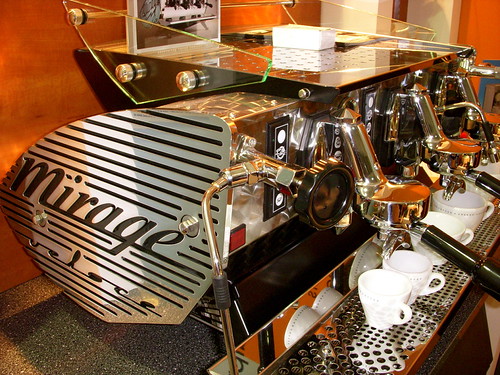
  Wandering along the foyer, I got to spot a really beautiful looking machine, the Mistral. It’s actually built by La Marzocco, but the body design is done by a designer and sold by a company called Andronicas World of Coffee who now have a coffee shop in the famous London department store, Harrods. Of course, as soon as I saw it, I stopped and took some pictures.
  For more, check
  For training and further planning, I met briefly with Gayle Reed of the London School of Coffee (
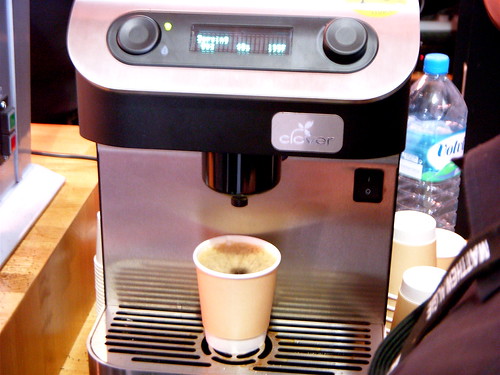 The Clover is getting quite popular in the USA, particularly with top independent cafes, where the rave is about selling coffees like wine, with $8 for a cup of coffee, sourced from a special farm. However, the Clover company has just been bought by… wait for it… Starbucks. Apparently, one of the first pioneers of Clover in America is so disgusted by the sale, that they will stop using the Clover machine. I wonder if they are willing to sell their Clover machine to me then for a few $$$. Next to the Clover, I also spotted this machine, made by Neuhaus Neotec.
  It’s a smaller roaster designed to handle small batches of green coffee and has over 200 programmes that can be pre-programmed fo
 You can view more pictures from Caffe Culture 2008 under my flickr account,


 It’s one of those places that when I visit, it feels like home, as the staff now recognise me as that keen coffee drinker with a camera always talking about coffee machines and coffee beans. I was glad to see that Origins have expanded their horizons and are taking their self-imposed goal of educating South Africa about quality coffee seriously. For one, they now have a barista school at the back of their shop, where I was able to witness upcoming baristi (plural for barista in Italian) practising their latte art. I also met briefly again with Joel Singer, co-owner of Origins. Secondly, Origins now organise roadshows and they planned to have one in Johannesburg in late February. They now sell their blends to other cafes (Manna Epicure – see post on Cape Town Coffee Scene of 2008 below) and are now beginning to get a reputation. When I first discovered the place, I used to go around Cape Town mentioning Origins and everyone used to look at me like, “what and where is that ?”, but on this visit, they were like “yes, I’ve heard of it….” . In addition, one of their baristi won the South African National Barista Championships – the second year in a row that one of Origins home grown has won.


 From Coffee With Love