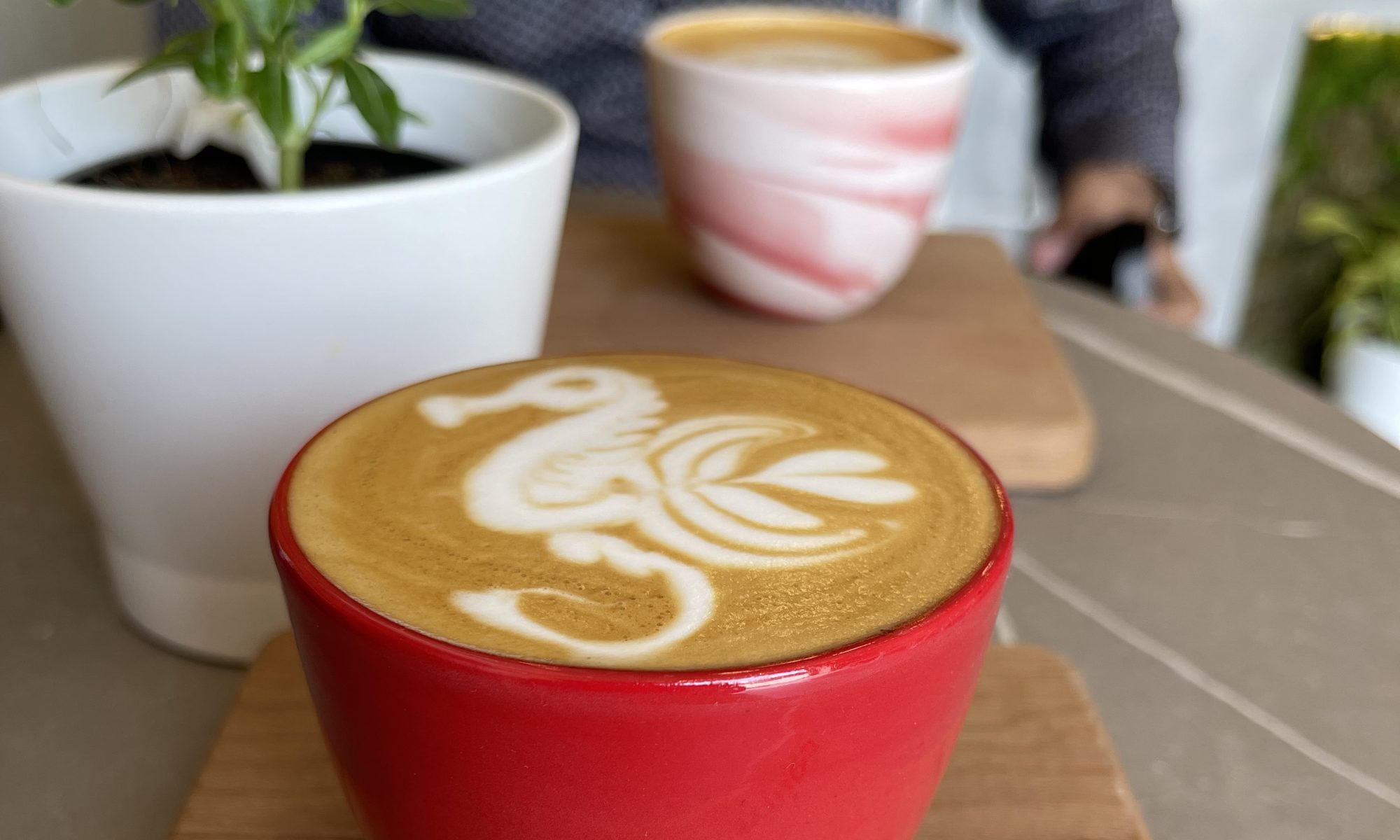
This is like a follow up to my blog post of 7 March 2008 called “how can you tell if your beans are fresh“. In summary to that previous post, I gave some pointers on what coffee looks like when it is fresh and extracted. Now, it probably seems like a contradiction when I say”how can you tell if your coffee is too fresh ?”  Again, the short answer is that you cannot just tell by looking at it – see above. You will have to wait until you get home and try and pull an espresso or use another brewing method. In any case, I recently fell victim to this scenario and really the warning bells should have been ringing when I asked the roaster at Alt Wien when the beans were roasted – his answer “a few hours ago” OK! I thought, I should really be happy about this but I recently read that very fresh beans need to “de-gas” before they are ready for drinking. In short, when you roast green beans you are changing the chemical and physical attributes of the coffee bean but the coffee bean needs time to adjust to its changed attribute after being exposed to very high temperatures. What happens is that gases that have attached themselves to the bean need to “come off” so that the bean can return to some sort of natural state – have I lost you ? Perhaps, because I think I have lost myself too. Really, I’m just trying to summarize the chemical stuff that happens to coffee beans after they have been roasted in as simple a way that I can. There’s also some problems with dark roasted coffee beans, where the oil on the bean can be “too oily” leaving oil sediments on your machine. In short, the coffee beans basically need to “de-gas” or let off some steam literally. I hinted at this to the Alt Wien Roaster and he replied “it’s OK in a domestic machine but for a commercial machine, the beans need to de-gas for at least one week” so I’m thinking, a domestic machine -Yes ! I have one of those, but my machine has some commercial parts (E61 Group head and lots of real brass, etc). I trust him and I pay the price. Sure, the beans smelt really fresh but my first problem was in trying to get the right grind for pulling a shot of espresso in 23-25 seconds. Then I was wondering as the coffee was coming out, why it was bubbly and making lots of hissing noise. So, the first sign is that the espresso shot will have many bubbles – some sort of chemical reaction (see below).
  I also noticed that once extracted, the coffee was lightish in colour despite the right time for extraction;
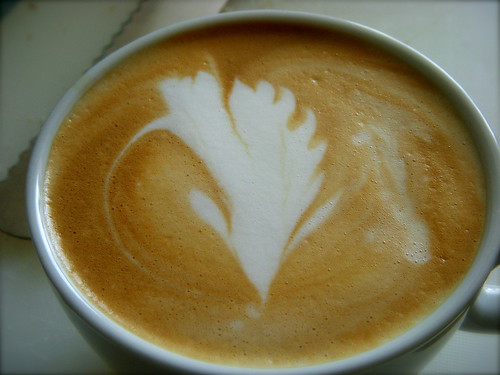
  The final straw was of course the taste test – the coffee was sour around the middle part of your tongue. Now, as you know, really fresh coffee that has been taken care of should not taste bitter or sour, so that got nme thinking – what’s wrong ? I tried stuff like leaving the beans out all night in a big metallic bowl so that they could let off steam, but that didn’t work. I tried another brewing method, French Press, but still the taste was sour. Then I thought, based on stuff that I had read, to leave the beans in their bag for about a week. I was bordering on being mad, because to compensate for my ever increasing coffee appetite, I decided to buy a 500g bag for the first time. In trying to apply my general culinary skills to the situation, I thought, if the bean could talk, perhaps it would say “hey ! I’ve just been exposed to 450 F, let me cool down a bit before you get the best out of me”. It’s almost like trying to toast freshly baked bread – it’s going to burn a lot quicker. In any case, not being a chemist, I thought there’s some sort of proper chemical explanation for this. Anyway, I’m glad to report that after leaving the beans for a week in their original bag, well sealed, with no exposure to air, there was a big difference. Firstly, although the coffee may not have smelt as nice as earlier, it was now easier to find the right grind setting for a 23-25 second pull for an espresso and the colour was back to dark reddish crema – see below;
  Also, good for latte art and impressing your friends (OK ! I’m joking about the last).
  So next time your coffee roaster tells you the coffee is really fresh, ask them how fresh. A few days can be good, say 3 days, but I have learnt that the mistake made by the roaster was putting the fresh beans into a sealed vacuum bag immediately after roasting as opposed to letting them de-gas by their own. If it is freshly roasted, it should be left alone and not bagged up. I can even say now, as I am drinking this coffee (Organic Bolivian)that after about 10 days the coffee is even better, especially for espresso – the sweetish taste is back. Ciao
A New Way to Measure Coffee
Actually ! this happened by mistake but nevertheless it was an intriguing find. I came up with an image of photographying coffee beans inside a portafilter holder and thought wow ! that looks lovely – the hard steel metal look contrasting nicely with lovely dark brown freshly roasted Indian Malabar Monsooned coffee beans, below
However, as I was just about to make coffee, surprise ! surprise ! I thought let me throw the beans from my photo shoot into the grinder and voila ! or should I link Italian to my double espresso offering and say Prego (as in ready to be served) the coffee beans were exactly the same quantity I needed to make my afternoon dose of Doppio (double espresso in English).
Take caution ! make sure that your portafilter holder, which should always sit inside the machine nice and hot for the next shot is dry, if not you will wet the beans and extract some precious locked up flavour – and also make sure you put the beans quickly into the coffee grinder as you don’t want any unnecessary heat on your coffee beans. I’m not sure if I am the first to discover this and I am probably not, but I thought wow ! what a great find, especially as if you don’t have a doser on your coffee machine that tells you how much to grind for a single or double espresso. 
This “new” method can be helpful if you are always having to guess how much to pour from bag into grinder and usually fall short or grind too much, which if you are a purist like me, will go to waste as I don’t save already ground coffee for another espresso, unless I am pulling another shot within a few seconds. Some experts say that the taste of the coffee begins to go after 12 seconds of grinding – so hurry up and try this out.
From Russia With Love
No ! I didn’t misspell the title of this blog. I’m not sure about you but since my childhood (not trying to give away my age), I’ve always been a keen James Bond fan – slight inspiration for my website and blog name. I’m now in the process of trying to keep up with technology and buy my favourite James Bond films on DVD. So the other night, I finally sat down to watch the DVD re-mastered version of one of my all time favourites – From Russia With Love, starring Sean Connery as James Bond.

I noticed that of all the James Bond films I can remember, this is the only one where James Bond actually ordered a cup of coffee and not his usual shaken not stirred cocktail. Perhaps, the author, Ian Fleming, thought that for that scene in Turkey – home of the first coffee culture phenomenon – James Bond should order coffee and not an alcoholic drink. I also found out that Ian Fleming had a house in Jamaica, where he wrote some of his novels and that one of his favourite drinks was coffee, the highly renowned and most expensive coffee, Jamaica Blue Mountain coffee naturally, which incidentally is supposed to be James Bond’s favourite coffee bean. What a coincidence – just thought that I’d share.
Thanks Conde Nast Traveller
I’m not sure about you but, since I was a kid I loved travelling to different places and now that I am grown up, it’s always exciting to see other parts of the World and meet other people from the Globe. So, whenever I get the opportunity, I try and buy the UK edition of the Conde Nast Traveller (CN Traveller for short) – Wow ! There are so many wonderful places on this earth that God gave us. Anyway to cut a long excitement note short, in the December 2007 edition, there was a piece on Cafe Culture in Vienna, Austria, where I currently live and of course I went straight to the article. I was so intrigued by what I read, that I just had to write in to CN Traveller and mildly complain about the feature on the traditional Cafes in Vienna. See below

In any case as you can see above, they were so impressed with my letter that they published it in their February 2008 Edition. I managed to get some publicity too and surprise! surpirse!, I got my most hits on this website and blog during the month of January 2008. So I just wanted to say thanks to the Editor and staff at CN Traveller.
If you’ve got the cash and want to dream about your next holiday to amazing places, I recommend you buy this fabulous magazine and I ain’t getting paid to say that, honestly !
My Travel Companion
As you know by now, I’m kind off serious about coffee and don’t believe in compromising on taste and quality just to get a coffee “fix”. So, as I cannot take my 14 KG espresso machine with me together with grinder, tamper, etc, when I travel, the second best thing for me is drinking filter coffee, with freshly roasted coffee beans of course. So you can imagine that I must have been really excited when I discovered a plastic cafetiere mug ideal for travelling with and made by Bodum – I’m not getting paid by them for this, but if you know anyone who works for them, send them a link to my website, so that they can at least think about it. In any case, here’s a picture below of this wonderful invention, taken on my last trip to Zambia in southern Africa. 
I usually take this with me when going to places where it might be difficult to get a decent cup of coffee. For Zambia, this might sound strange as their crop of arabica beans can be found easily in most European or American speciality stores (Starbucks sells them on the internet), but sadly, they tend to export all the good stuff and so it is difficult to get well roasted coffee beans in Zambia. The travel mug is a good size and it is enough for two small cups or one mug and quite light and simple to use. It cost me about 5 Euros (or $7 in today’s bad dollar exchange days). Recommended for your collection when you travel to those places where it might be difficult to get your regular dose of quality coffee to drink.
In Defense of the Bean
Thanks to my sister, I got a link to no less than CNN – yes the news channel and website – to an article (5 Foods that should have a place in your diet) which naturally has a guest appearance by “Coffee”. Its a short and sweet article highlighting the fact that although your average cup of coffee contains 100s of different chemical stuff, the good stuff outweighs the bad (if any). OK ! I know that I am a bit bias, after all I do have a website called “from coffee with love” but I’m just trying to highlight the “love” in the bean. Back to the article – a lot of recent research from both UK and USA show that drinking small amounts of coffee during the day, increases alertness including those that need hand-to-eye coordination (engineers and dress makers take note). There’s more – another study done in the USA and across some other countries in the World showed that those drinking about 4 to 6 cups a day of coffee had a 28% lower risk of getting diabetes. Just a thought – I’ve noticed that over the past several months, making freshly ground espresso with my expensive coffee machine has lowered my appetite for sugar in coffee as I prefer to avoid any sugar to get the real intense taste from the coffee. Also, some coffees, especially those from Central America, tend to be sweetish if prepared properly and sugar just doesn’t help. Does this lower my risk of diabetes ? I don’t know, but ask your doctor. In any case, just thought that I’d share some info on the good stuff in coffee.
 From Coffee With Love