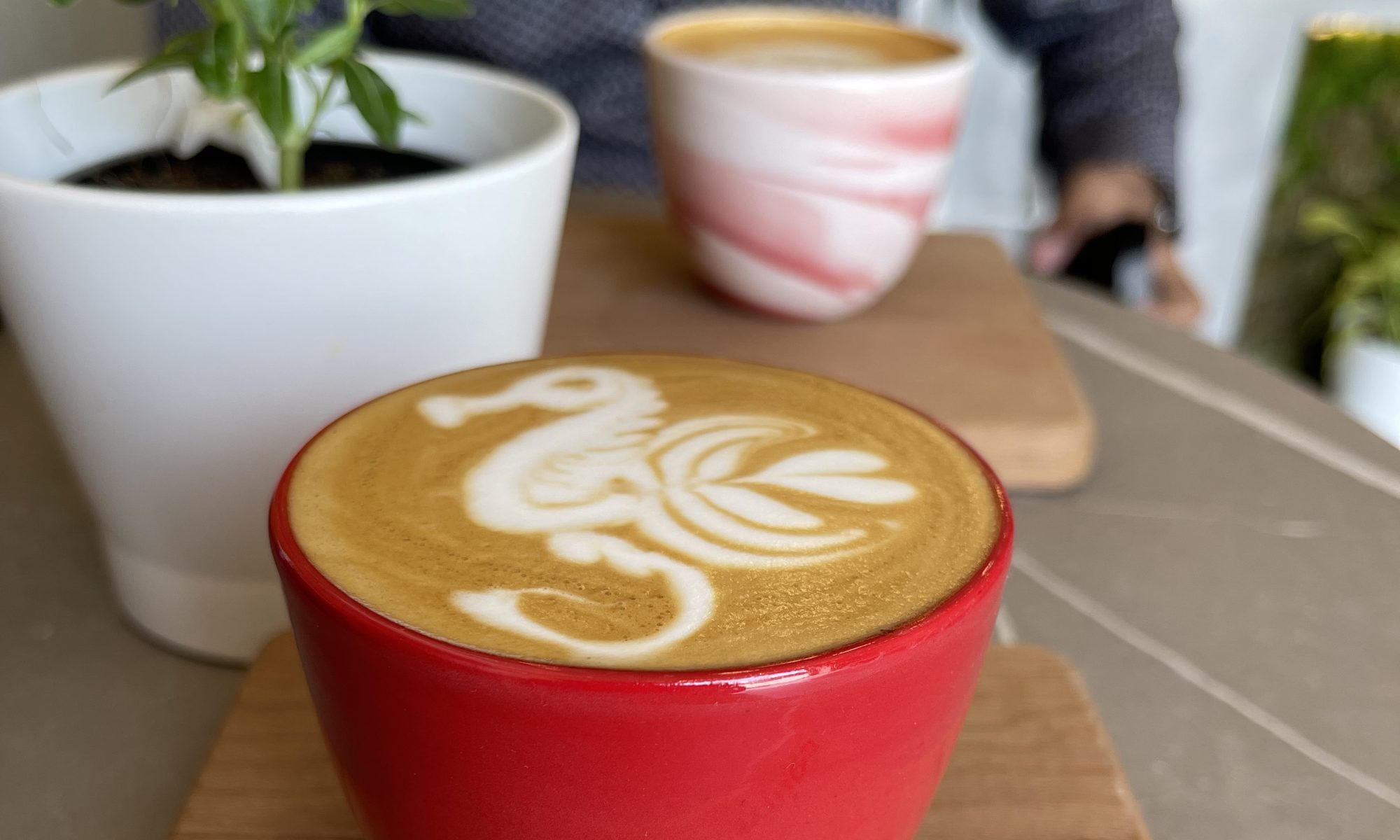
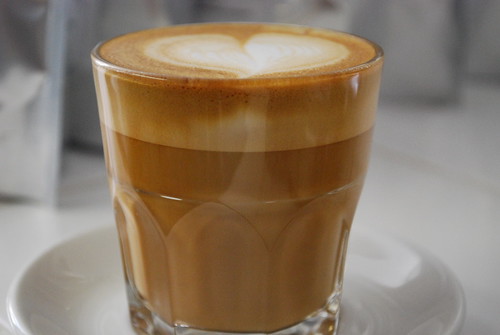
Since I was served this Spanish version of an espresso milk based drink at Espresso Lab (Cape Town) in October 2009, it has become my favourite morning brew. In summary, it is half espresso and half milk/froth, almost like a smaller brother of a cappuccino but packs more punch because there’s more espresso in it, which means you get to taste the coffee more. So, to get a little technical, you’re looking at a 50-60ml double espresso extraction (depending on how many grammes you use) topped with about the same amount of liquid (frothed and steamed milk). It’s much easier if you have a 100-120 ml cup of course, but just play around with it, so that the coffee punches well through the milk. You should also be able to detect some different taste notes coming out such as milk chocolate and hazelnut, which appear to reveal themselves more distinctly when milk is added to the coffee/espresso equation. I’d strongly recommend it for espresso lovers, who don’t want as much milk and froth as you find in a cappuccino nor in a Flat White, but who nevertheless want to taste their espresso blended nicely with hot milk.
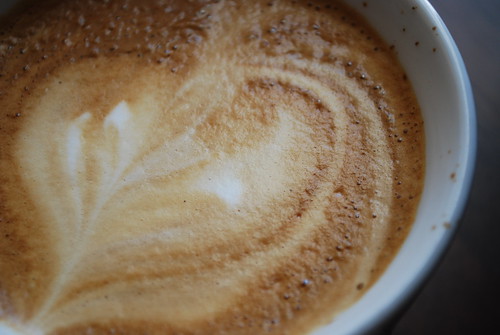
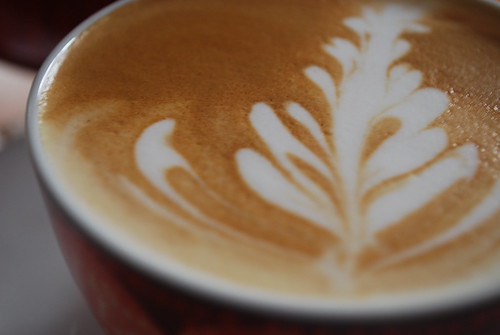
The other reason why I like a Cortado, is that I find it much easier to do latte art in a smaller cup – Well ! how else would I be able to share these nice pics with you because if I just talked and didn’t share these tasty pics to inspire you to try it at home, you’d skip my blog. Coffee is about art and science – a wonderful blend of the subjects of our age – OK ! enough of this philosophical dribble, just try this at home. Ciao ! or perhaps on this occasion I should say Adios (for those who don’t know, this is the Spanish way of saying bye bye). Adios Cortado ! until tomorrow morning.
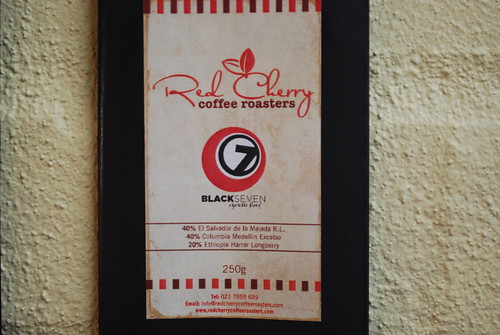
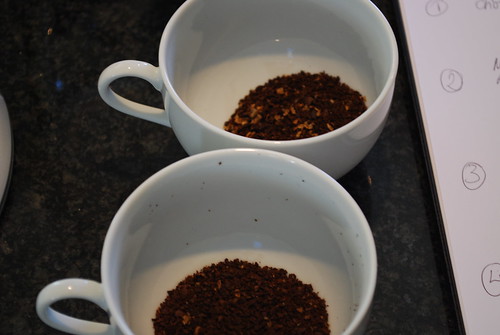
It’s not very often that you meet someone who can talk to you about a coffee bean for hours and just amaze you with their knowledge on stuff you didn’t even know about coffee – but lucky me, because I met Audrey, the coffee roasting genius and one half of Red Cherry Coffee Roasters. Audrey and her husband, John have set up an amazing coffee roasting facility, albeit part of their garage in Cape Town environs, located up in the hills at a place called Noordhoek. I was lucky enough to be tracked down by them and more so to be invited over to check their operation out. Audrey is really “mad about coffee” and I often describe her as “someone who can talk to you about a coffee bean for hours” and I’m not joking. She may be relatively new to roasting (a few years already) but she’s travelled to London to meet with Square Mile Coffee Roasters (James Hoffman & Anette Moldvaer) to get tips, constantly studies everything there is to know about a bean before she roasts and doesn’t compromise on quality. In summary, they’ve got a coffee roaster in their garage alongside highly prized green arabica beans, ready for the “roasting”. Once roasted, after a lot of research by Audrey, where farms, altitude, varietal (i.e. type of bean) and many more variables have been checked, the coffee is usually “rested” for several days as it goes through a rapid de-gassing process. In this way through cupping, this will ensure that the correct profile for that specific origin will be determined. For the cupping, done in their well equipped kitchen, the coffees are weighed, ground and placed into specialist coffee tasting cups to ascertain flavour profile and characteristics, which helps to decide which coffees would go well in blends or just sold off as single estate origin coffees.
In addition, John, a trained barista and chief taster, pulls different types of shots on their very advanced ExpoBar Espresso Machine (where you can adjust the temperature easily per shot) to try and test at different temperatures, which coffees have brighter notes and which ones have lower tones. For example, higher notes generally bring out chocolate, caramel and nutty tastes, which go well with milk based espresso drinks or just as pure espresso.
I was lucky enough to join them at one of these sessions, where I learned the following:
The sharp taste you get when you slurp coffee is usually the mark of high acidity in a coffee, typical of African coffees, usually roasted by Red Cherry to preserve the bright fruity tones.
African coffees are usually quite complex, whilst Indonesian coffees tend to display more earthy tones – OK ! what’s that ? By earthy we mean spices that grow in the earth like vanilla, cardamon and cocoa.
Central American coffees are lovely when roasted lighter as you get brighter notes like mandarin, peaces and apricots, but when roasted a bit darker, you get higher notes like chocolate, caramel and toffee.
Kenyan coffees have dark fruit characteristics like blackberries and Tanzanian coffees can display citrus hints like lemon, dark fruits, dark chocolate and honey. Wow ! all this in a cup of coffee – better believe, BUT, only if it is properly roasted by an artisan roaster.
Light roasted coffees are usually best extracted at a temperature of around 92-94 C, where the emphasis would be on tasting the “brighter notes” of the coffee. However, these type of lighter roasted coffees can be intense and may be better enjoyed without milk. You see, I need a home machine like the ExpoBar – anyone feeling generous ?
Medium roasted coffees are usually best extracted at a temperature of around 94-95 C, where the emphasis would be to get the chocolate and nutty tastes like almonds, hazelnut, coupled with toffee and honey like tastes – probably best for milk based espressos.
Good coffee should still taste nice even when drank at lower temperatures, but more so when extracted using a French Press or Plunger.
There were some other lessons, but I was overwhelmed by the information and was probably cutting them in conversation as I tongue couldn’t stop as I fired away with questions out of pure excitement and delight at this incredible coffee experience.
I’ve already been to seen them thrice, making sure that I save myself for some exquisite coffee before I go. Even my wife, who doesn’t drink coffee (OK ! perhaps 8 times a year) has always asked for a cup whenever she goes.
My favourite is a flat white, because Red Cherry are really into perfecting the ultimate milk-based espresso blend, which I think they are close to as the current rumoured number one cafe in South Africa, is supposed to be Double Shot of Plettenberg Bay and they buy coffee from Red Cherry.
Red Cherry Flattie
Furthermore and hot of the press, Audrey has been selected to be an international juror at the prestigious “cup of excellence” in El Salvador, where she will mingle with the World’s top roasters and tasters to determine the cup of excellence winners for 2010 – need I say more ?
OK ! So, how do you get this coffee ? Well ! at the moment, you can contact them by visiting their website, www.redcherrycoffeeroasters.com, selecting a coffee or some coffees you would like to try and give them a call for a good old chat about coffee but watch your phone bill and place an order – they’ll ship within South Africa. They plan on launching a webshop very soon and are working on selling their coffee through some retail outlets, so watch this space for that memorable day.
Just wanted to let you know that Red Cherry provided some inputs to the editing of this blog as it was easy for me to misunderstand some of the finer elements of the complicated and wonderful world of coffee.
Yes ! A Grand Reserve coffee – a speciality from top coffee grower, Aida Battle, supposed to be a special blend of coffees from her farm in El Salvador. Fruity and intense, yet complex and medium balanced on the acidity. Have I lost you ? If you’re an expert, then you probably want more, but I’ll just keep it simple for now. This particular batch was roasted by top roasters, Square Mile Coffee Roasters (SMCR) no less and if you have been an avid reader of my blog, you’ll know that I used to be a regular customer of SMCR -that is until I moved to Cape Town. So, how did I get my hands on this special coffee ? Only God could have made this possible but here’s the story behind it. I walk into one of my favourite cafes in Cape Town, Espresso Lab in Woodstock, get chatting to owner/roaster, Renato and spot the famous label bag on the shelf and asked how he managed to get a bag down here in Cape Town – “ordered through the internet of course”. But having read about the coffee on SMCR website a few weeks bag, I knew that it was really special with a real special price too, at about £22 (or $33 or 242 Rands) per 350g bag. Probably spotting the delight in my eye, Renato offered me a precious 40g free of charge, enough to make one French Press and one double espresso portions – thank you God.
You can’t imagine the excitement when I got home – I read about this coffee, grown by one of the top coffee growers in the World, roasted by one of the best coffee roasters in the World, unable to order it all the way from London because of the costs and here it was in my kitchen, ready to be prepared the way I love coffee, French Press and double espresso. OK ! Let’s get to work but be warned, as this is so special, I was inspired to focus on trying to capture the coffee as best as I could on photo, so that I could share the experience with you. I’ve already described the taste profile at the top of this blog, so don’t expect too much emphasis on taste profile, just enjoy the pics and dream.
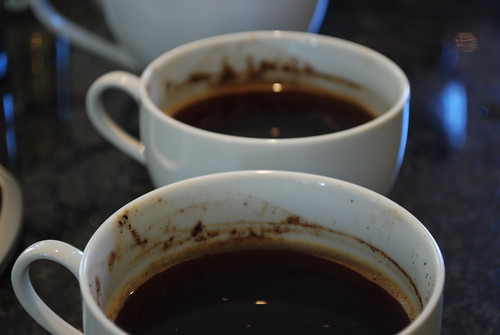
First up, Le French Press. OK ! with this type of preparation, the fruity elements tend to dominate – very balanced as an afternoon cup after a light lunch, going down smoothly.
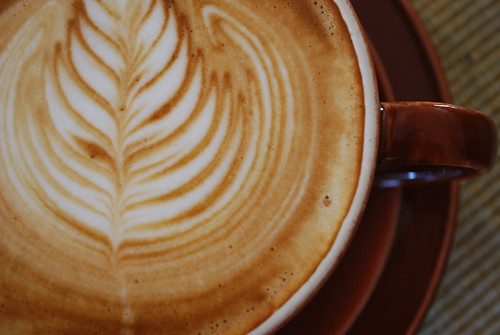
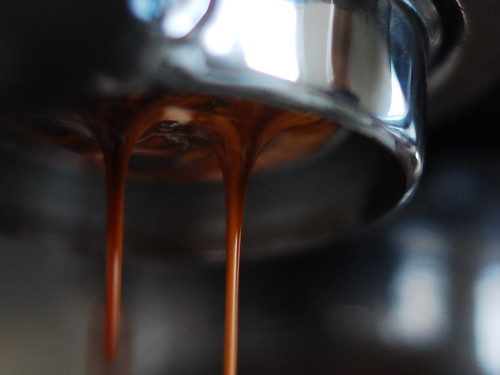
I was tempted to just drink the coffee as a double espresso to really experience it as a concentrate but there was a part of me saying “what would it be like with milk?” So, I went for a Cortado – a what ? It’s currently my favourite milk based drink, a Spanish version of a cappuccino, but with less milk, so you use about the same portions of milk as espresso, using a 150ml cup – so strictly speaking, a double shot espresso at about 50-55ml with 50ml frothed milk, which would have a foam of about 20%.
Doesn’t it look yummy and inspirational ? with this type of extraction and preparation, I found the Grand Reserve not too acidic with a soft touch of milk chocolate coming through the milk. I wish I had done this blog sooner when the coffee was readily available and then I could have said buy it now from Square Mile Coffee Roasters but I just googled it and I think Sweet Maria’s in the USA roast it too, so if you are reading this in the US, try and get it before it runs out. Until then, dream and if it’s out again, I’ll try and let you know somehow.
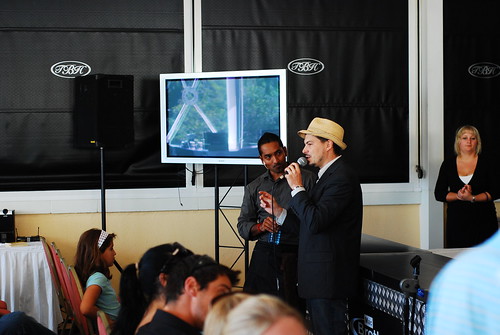
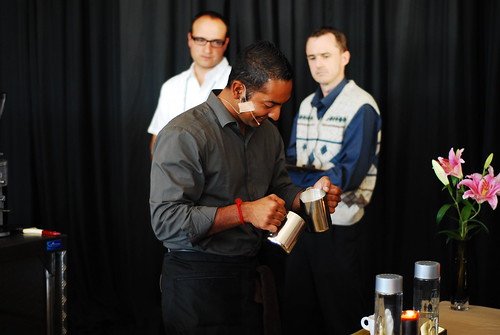
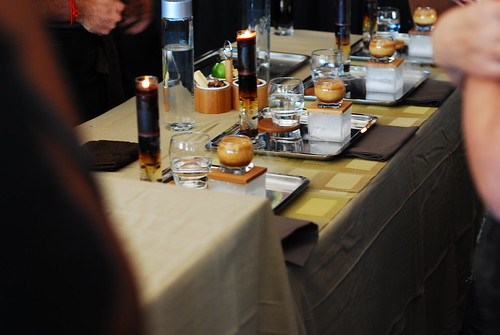
Wow ! what a weekend. I’m really loving being here in Cape Town. Just last week, some new friends of mine invited me to the South African National Barista Championships, which incidentally were taking place in Cape Town from 26-28 March at the luxurious Table Bay Hotel on the Victoria & Alfred Waterfront. I’ve never been to one before and sadly I’ll be missing the World Barista Championships (WBC) this year, which will be taking place in London – typical eh ! just when I leave Europe, they finally have it on my doorstep. So how was the South African version ? It seemed a bit low key to me on the promo side, although I found out there were some important “coffee” VIPS in the room, but nevertheless the baristas and their fans/families were very committed, cheering the competitors all the ways, with loud screams of support everytime they extracted an espresso or poured some latte art. In summary, each barista has to make 4 espressos, 4 cappuccinos and 4 signature drinks for the 4 tasting judges and they are tested by another 2 judges for preparation, checking many things such as wastage in coffee preparation. I also managed to get a free 1kg bag of freshly roasted coffee from one of the speciality roasters attending the event.
This years winner was Ishan Natalie, who also won the competition last year. Ishan works for Woolworths – which should not be confused with the same name shops in UK or USA. Woolworths is an upmarket supermarket store so committed to coffee that they purchased La Marzocco GB5s for their standard espresso machines. They’re supposed to have a really good coffee roaster called Tribeca, which supplies them with coffee, sourced primarily from Africa but also from Brazil and other places. So here are some pics of the event; First up, the winner pouring some latte art
And second the winning drink, a signature coffee drink made primarily with espresso, cream and whipped eggs – almost like an eggnog latte without the alcohol – cups were pretty cool and the presentation tops, especially as Ishan didn’t compromise on effects by mixing some concoction to create a smoking ice glass placed underneath the winning signature drinks.
So, Ishan will be representing South Africa at the WBC in London, scheduled to take place in the latter half of June 2010. I think it may be held during the Caffe Culture event, but I’ll try and keep you posted.
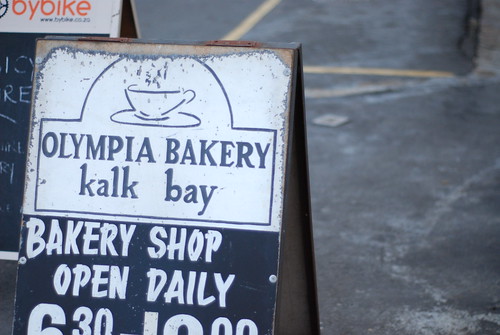
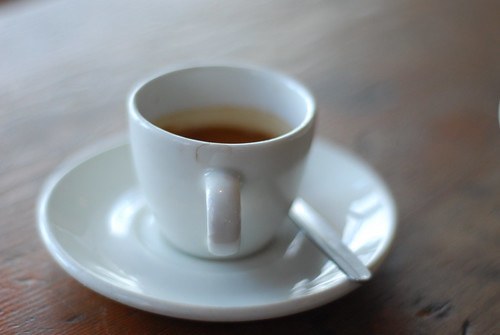
Last weekend on our “discover Cape Town” trip, we decided to check out the coastal fishing village of Kalk Bay. I had two main intentions, eating fish and chips at Kalkies and checking out the infamous (at least on this side of the World) the Olympia Bakery & Cafe. So after my fish and chips, it was down to the main road in Kalk Bay to look for this cafe, which was quite easy to find and almost a strong stone throw away from the fishing port. Olympia is very popular with the locals are supposed to be famous for breakfast and apparently on Saturday mornings, it can be near impossible to get a seat inside if you are a late bird. Lucky for us, we popped in during the late afternoon, where the mood was lively and very down to earth. True to form, I ordered a double espresso – what else in the afternoon ?
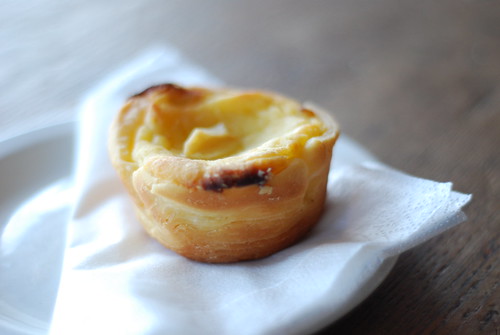
Being a bit of a sweet tooth, I noticed that most of the pastries and cakes were gone – good for Olympia as they got to sell their stuff, but spotting the no-serious-cafe-in cape town-cannot stock pasties de nata phenomenon, I went for one Pasties de Nata to accompany my order of a double espresso. I must admit the pasties was more cake than pasties & custard, but fine for me.
My daughter was with me and so not to be left out, we ordered a hot chocolate too, which she took away, enjoyed and spilt in the car, hmmm. The coffee at Olympia is supplied by Origin Coffee Roasting, based in de Waterkant, which you can find more about on my blog roll and if you do visit Cape Town and rent a car, (you will need to for this trip), then I recommend the 30 minute drive from the centre of Cape Town to this village, which apparently is very busy during the high tourist season between mid-December and mid-January, because of its quaint appeal and warm beaches, not to mention Seal watching, fish restaurants and of course Olympia Bakery.
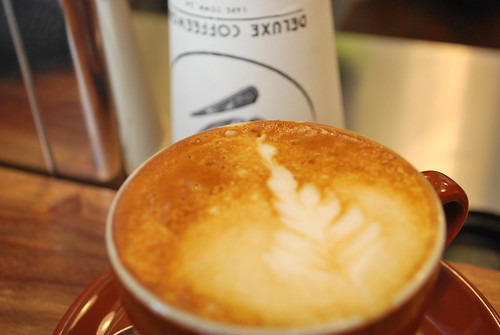
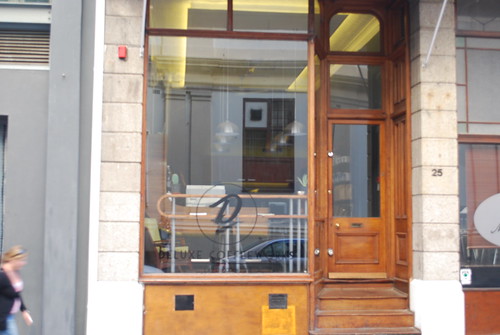
I’ve decided to add a new category as I launch myself into the Cape Town and South Africa coffee scene, to be called “Coffee Roasters”. I was thinking, if you are new to a new city and are really craving not only good coffee, but somewhere to buy good coffee, it can be stomach wrenching – I am speaking from experience in my new home city of Cape Town. So, imagine my joy in late December, when the bags of coffee I carried over from Europe had run out and I stumbled across a shop, wreaking with the smell of freshly roasted coffee. Of course I walked in, spotting a coffee roaster tucked into the back and someone behind a coffee bar offering me free coffee to taste, “God relieved me of my distress”. Where was I ? Deluxe Coffeeworks. Well ! actually I have been thinking, but I have never asked, where did that name come from and I thought about breaking the name into a phrase ” Deluxe coffee works” Get it ? Well ! Good coffee works, but bad doesn’t. OK, I’m digressing. So, who are they ? Currently there’s Carl, Nick and Judd. Judd, originally from New Zealand, was also trained there at Cafe Supreme and from what he is doing in this new establishment, he obviously learnt well. They’ve only been up and running since 2009 and already have a following and a growing client base amongst some top cafes and restaurants in Cape Town. Their plan is to focus entirely on wholesale coffee sales but lucky for us, you can pop into their roastery cum shop on Church Street, which is very centrally located and they would gladly serve you any espresso based drink at a fantastic price.
The other bonus of course, is that you can also buy freshly roasted arabica beans to take home with you, packed in organic looking brown bags by the kilo or shiny 250g bags. They can also grind it for you if you prefer and they sell little gadgets like milk frothing jugs and Bialetti’s version of the French Press. The guys at Deluxe Coffeeworks are really easy to talk to and if you’ve got some time to spare, drop in and chat about coffee, Cape Town and life. Naturally, I’ve tried their coffees, which I tend to find is very aromatic. My current favourite is their organic espresso blend,
but their espresso blend is also very nice, blending well with milk and displaying chooclate and nutty tastes.
I’ve currently got one of their experimental blends at home, which is a mixture of Kenyan and Ecuadorian arabic coffee beans. I find it a bit spicy, bordering on licorice in taste and very distinctive as an espresso.
I was also lucky enough to be invited to an espresso tasting session of single origin coffees a few weeks back, which ranged from a very strong Kenyan espresso to easy-to-drink and very mass appealing Guatemalan arabica. So, definitely worth a visit before they completely close their doors to the walking public, but if you’ve got a cafe or restaurant in the Cape Town area, check them out as a possible supplier and they ain’t paying me to say that.
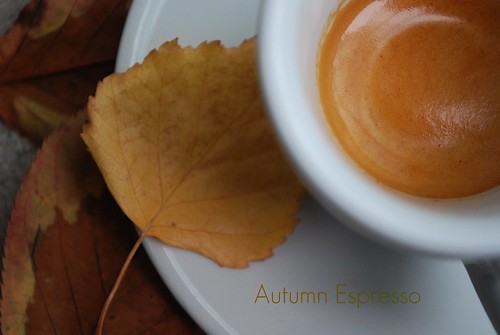
This is absolutely disgraceful – 8 weeks without blogging – I hold my head in shame but I do have a great excuse… I’ve moved to Cape Town, one of my favourite foodie city to open a coffee (but of course) and cake/sandwich shop. It’s been challenging trying to settle in without easy access to communication like internet. In any case I’ve been really busy with checking out the coffee and cafe scene and it is quite exciting. However more on that next time, as this is supposed to be about Autumn Espresso.
Yes ! It is a bit strange to talk about autumn, as it’s mid-winter in the northern hemisphere and mid-summer in the southern hemisphere – it’s like 25C outside as I write. So, I guess to compromise for my readers in both hemispheres so that no one gets left out, it is apt that I should talk about a coffee that was roasted and blended to typify the season in between, Autumn of course. OK ! I got this bag of Autumn Espresso during the northern hemisphere season, back in late October/early November but didn’t get the chance to share my experience.
It’s roasted by Square Mile Coffee in London and reminds you of the Autumn mainly because of the roasted hazlenut and caramel and toffee tastes that dominate. There is a hint of chocolate of course, but this comes out more when you make it as an espresso milk based drink like a Cappuccino or Caffe Latte.
Just love the pics of these coffees as I was really getting into studying my digital SLR and playing around with different concepts like Aperture, so that I could use the camera to bring out the best of the coffee, especially as these were taken on wet, windy and cloudy Autumn days. I must confess I cannot remember where the coffees were sourced from, but being a fan of Square Mile since they started in 2008 I can almost say for certain that there was some Central American arabica thrown in, probably from Guatemala and/or Ecuador. You’ll have to wait another 9 months for this to be available again on the market and if you can get your hands on some, go for it.
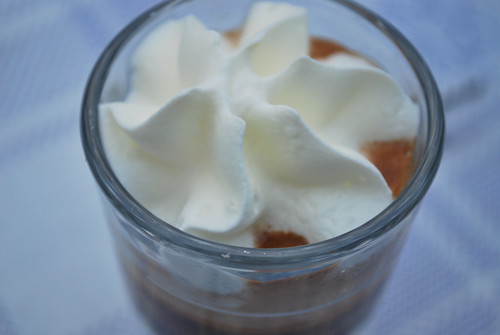
Doesn’t it look lovely ? Yes ! It’s another simple espresso recipe, for which you need to extract a good espresso, following all the rules of course and just top it with freshly whipped cream. I’ve got one of those flashy ISI Whippers, which basically makes fresh cream in an instant by placing single cream into a siphon and adding some gas through a specially made canister for the ISI Siphon (made famous by World renowned chefs like Ferren Adria – you’ll only know of him if you are a mad foodie). In any case, most cafes now have ISI Siphons, even Starbucks, as it is so easy to use when making coffee that requires whipped cream. You may also wish to know that ISI is actually an Austrian company and that the first place to serve coffee with cream was in….. Vienna, capital of Austria.
You can also top it with chocolate sprinkles. Espresso Tazza D’Oro of course is a very Italian name, which has something to do with gold (oro), but this drink has another more famous name, Espresso Con Panna. It’s just that I like the way its not so famous name sounds, very flashy and Italian indeed, so one more time ESPRESSO TAZZA D ORO, Ciao bellissima caffe.
That’s the way I’d like to describe the coffees I got from Espresso Lab, Cape Town, when I visited a few weeks ago. Of course I drank them a while back, but these are just my notes on my experience. Actually, Espresso Lab describe their espresso blend as “a complex blend bringing out blackcurrant licorice and chocolate flavours with a snappy finish”, so I’m just agreeing with them. There’s no doubt it had a complex taste and I really got to taste the chocolate flavours with a snappy finish, but I can’t vouch for the blackcurrant one.
In any case, the espresso blend consists of arabic beans from Brazil, Costa Rica and Ethiopia, so it really is a blend, mixing three different regions. Yes ! Costa Rica is not in South America, but in Central America. For me, it still confirms that I really enjoy an espresso blend when it has Brazilian arabica beans added, so I was pleased with the espresso, when I got it right. And on that last note, I want to go back to the word “complex”. Using all the techniques of making espresso including timing the pour, this coffee rarely followed the rules. Yes ! out of a 250g bag, which equates to about 16 cups of coffee for me (I only drink double espressos and that happens twice a day and I am assuming 15g of coffee per double cup – complex isn’t it ?), and after adjusting for the 30ml of espresso in 25-28 seconds, I only got about 7 good espressos. Of course everytime the pour wasn’t consistent with the rules, I adjusted the settings, then it will work in the morning and not in the afternoon and vice versa, hmmmm ! I guess better luck next time and perhaps a bigger bag of 500g to do lots of tweaking until I get a pour right every other time. So enough of the rambling and on to the other coffee.
Sometimes it is said “after struggle comes ease” and so it was with their Rwandan blend. Initially, I bought this to satisfy my daily thirst for “real” coffee when I was in Cape Town, extracting it for French Press in the mornings and evenings, however, without proper scales to measure the exact dosage, I just thought “OK ! not bad”, however, on return to Vienna, I got the scales out and made it in my lovely Bodum Colombia and Wow ! what a difference. Who said tools don’t work ? It definitely did on this occasion because it was such a lovely brew and the one word that instantly came to mind was… “REFRESHING”. On tastes, I got the red berries and fruity flavours, which I think really make French press coffee wonderful for the palate.
I had the opportunity last week to spend time with, David Donde, formerly of Origins Coffee Roasting and he showed me a new cafe, Espresso Lab Microroasters, located in “becoming trendy” Woodstock. Espresso Lab is located at the Old Biscuit Mill, 375 Albert Road, which seems quiet during the weekday but on Saturday mornings becomes a bustling market place, with Cape Town’s middle class jostling to buy organic fare, art and delicious food. OK ! back to the coffee. Espresso Labs has a really unique concept, living to its name by appearing like a lab, with coffee signs displayed like ES for espresso and AM for Americano, but the bags have longer names like ESP for espresso
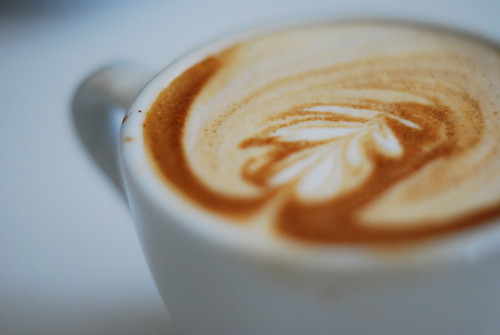
Espresso Lab is run by Portuguese origin Capetonian, Renato. They’ve got a La Marzocco GB5 and their coffee roaster is located at the back in a clean looking space. On my second visit, yes ! I went twice, I decided to try what seems like their signature drink, a CO or a Cortado, made using a double espresso with about equal portions of frothed milk – check out the beautifully poured rosetta heart.
So it is really for those who want to taste their coffee with just a topping of frothed milk, as is a bit obvious from the pic below, where you can see the clear separation/layers from coffee, through milk and froth at the top.
It was really nice, especially for someone like me who ideally prefers a really strong cappuccino as opposed to the usual espresso, third milk and third froth – the official description of a cappuccino. Before I left I got a couple of bags of coffee to sample but of course, but more on that next time. So, when in Cape Town, check out Espresso Lab Microroasters and check out their website too, http://espressolabmicroroasters.com/.





 From Coffee With Love