About a month ago, on my way back from holiday, I stopped over in London and naturally went over to my favourite bean bazaar or specialist coffee roaster – HR Higgins, Duke Street, London and stocked up on more coffee.
I was lucky enough to be offered one of their new beans, El Salvador Pacamara. Trusting the salesman on this occasion, I took two 250g bags, as they do two types of roasts, medium dark, which I usually find goes well with milk-based espresso drinks and very dark roasted, which is lovely for espresso (shhh ! don’t share the secret).

On return to Vienna, I was pleasantly surprised by the versatility of the 2 roasts. Sure enough, my predictions matched my expectation in that the medium-to-dark version was lovely as a cappuccino and the very dark version was nice as an espresso, but more importantly for my coffee grinder, I didn’t really have to fiddle about with the grind switch for both types of coffee. Am I making sense ? If not, I’m going to have to get a little bit tekky (technical) here. In short, I’ve discovered that you cannot use the same grind setting for a medium dark roast and a very dark roast coffee to get the ideal espresso shot (i.e 23-27 seconds depending on what book you read). The secret is…… well ! perhaps not a secret for pros, is that you need a finer setting for very dark roasts. So for example, if you usually grind your coffee on say dial 7 for a medium dark coffee, with dial 1 being the finest (like powder and usually for Turkish style coffee) and dial 10 or above being like clumps (usually for French Press), then when you come to grind a dark roast coffee, you need to use a shorter dial, like 6 or 5 to get the same grind. For me, on my previous coffee grinder, it was easy, but my new coffee grinder is a bit of a pain as there are no dial settings – you just turn the knob, after wasting about 30 grammes of coffee until you get the right grind, but I’ll save more of that headache for another post God willing.

Anyway back to El Salvador Pacamara. For espresso, I found it light and sweetish. I could taste the sweetness at the tip of my tongue – perhaps my palate is getting more sophisticated to all the speciality roasted Arabica coffee I keep throwing down my mouth 3 times a day. Excuse the pic below – I was still playing with my new digital SLR camera and the flash was a bit too bright. The richness of the colour can be seen in the pic above during extraction.

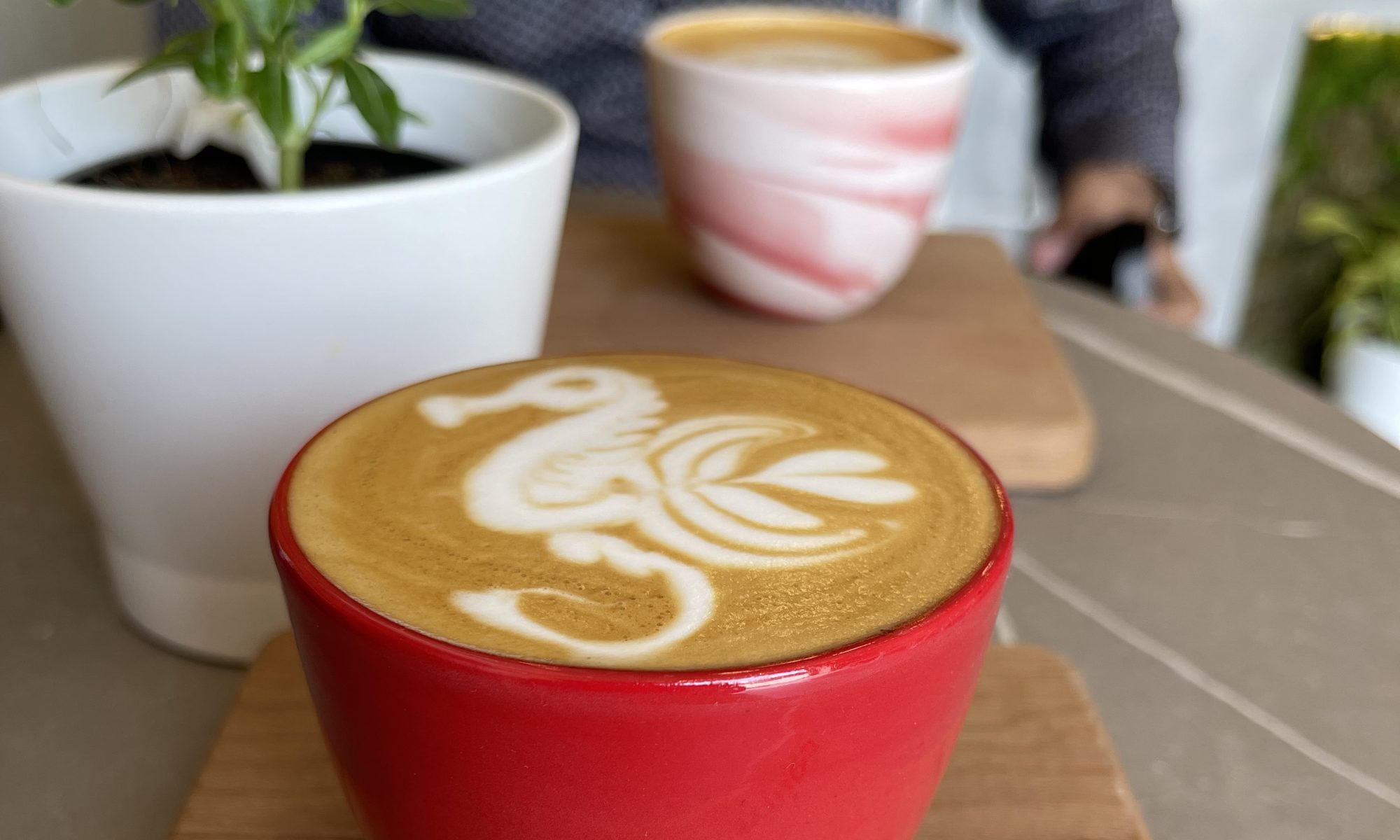
Naturally, I kept the medium-to-dark roasted coffee for my morning fixes of cappuccinos and the sweetish taste contrasted well with the smooth silky sweetish frothed milk that accompanied it. Excuse my latte art, still trying to get there….

In summary, I thought that the bean was well rounded and very versatile, easily adaptable for both types of espresso drinks (with and without milk). The taste is not over powering and “bold” and reminds me of the typical Central American coffee (just in case you were wondering where El Salvador is, it is in Central America). It is not as acidic as the champions of Central America – Costa Rica and Guatemala, but still worth a buy and I’m sure your non-coffee mad friends will find it pleasant to drink too. So get out there and try some coffee from El Salvador.


 Again, the short answer is that you cannot just tell by looking at it – see above. You will have to wait until you get home and try and pull an espresso or use another brewing method. In any case, I recently fell victim to this scenario and really the warning bells should have been ringing when I asked the roaster at
  I also noticed that once extracted, the coffee was lightish in colour despite the right time for extraction;
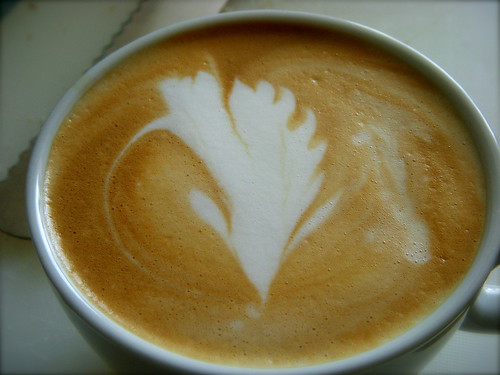
  The final straw was of course the taste test – the coffee was sour around the middle part of your tongue. Now, as you know, really fresh coffee that has been taken care of should not taste bitter or sour, so that got nme thinking – what’s wrong ? I tried stuff like leaving the beans out all night in a big metallic bowl so that they could let off steam, but that didn’t work. I tried another brewing method, French Press, but still the taste was sour. Then I thought, based on stuff that I had read, to leave the beans in their bag for about a week. I was bordering on being mad, because to compensate for my ever increasing coffee appetite, I decided to buy a 500g bag for the first time. In trying to apply my general culinary skills to the situation, I thought, if the bean could talk, perhaps it would say “hey ! I’ve just been exposed to 450 F, let me cool down a bit before you get the best out of me”. It’s almost like trying to toast freshly baked bread – it’s going to burn a lot quicker. In any case, not being a chemist, I thought there’s some sort of proper chemical explanation for this. Anyway, I’m glad to report that after leaving the beans for a week in their original bag, well sealed, with no exposure to air, there was a big difference. Firstly, although the coffee may not have smelt as nice as earlier, it was now easier to find the right grind setting for a 23-25 second pull for an espresso and the colour was back to dark reddish crema – see below;
  Also, good for latte art and impressing your friends (OK ! I’m joking about the last).
  So next time your coffee roaster tells you the coffee is really fresh, ask them how fresh. A few days can be good, say 3 days, but I have learnt that the mistake made by the roaster was putting the fresh beans into a sealed vacuum bag immediately after roasting as opposed to letting them de-gas by their own. If it is freshly roasted, it should be left alone and not bagged up. I can even say now, as I am drinking this coffee (Organic Bolivian)that after about 10 days the coffee is even better, especially for espresso – the sweetish taste is back. Ciao


 It is near the Hofburg Palace, situated on Kohlmarkt, which now resembles Saks Fifth Avenue (New York) or New Bond Street (London, UK), next to shops like Armani, Chanel, Louis Vitton and Tiffanys. Cafe Demel is famous because it was often visited by royalty and in keeping with tradition, even today, whenever dignitaries visit Vienna, a lot of them get taken to Demel to have a coffee or at least to buy a famous Viennese cake. For example, when the former United Nations Secretary General, Kofi Annan visited, Cafe Demel made a cake that looked just like him, at least from shoulder up.As you enter the shop, there’s a display of souvenir cakes on your left and on the right and in front of you, an impressive display of very traditional Viennese cakes and pastries. As you make your way to the back, the traditional atrium has been converted into an open display area, separating you from pastry chefs decorating cakes – you are allowed to take pictures as long as he flash is off. I made my way upstairs as the lunchtime crowd had already taken up all the best seats downstairs. The interior looks like it hasn’t been touched since the turn of the last century, but that adds to the character. The regular customers I spotted in there were all into the typical Viennese tradition of ordering a coffee and reading a newspaper. as you know, if you have been through my website under “did you know”, you will know that cafes in Vienna were the first ones to introduce newspapers on sticks.Anyway Cafe Demel is now a must-stop on the Vienna tourist trail, so I was not surprised to hear lots of American and British accents. I am also happy to report that the waitresses spoke English and more importantly, where very polite, contrary to the infamous Viennese reputation of unpleasant waitresses. I had a very traditional Viennese coffee, called an Einspanner, which s basically like an Austrian version of an espresso topped with lots of thickly whipped cream.
 To accompany my very Viennese Coffee House experience, I ordered another traditional Viennese dessert, a cherry and apple strudel. All in all it was a good experience, something to be done at least once if and when you visit Vienna and I must confess, this is my first visit to a traditional Viennese coffee shop since I moved to Vienna almost 6 years ago.
 Wow ! an arena, where you will probably be served the best coffee in London and probably the UK over two days and the best part, it’s all free, as top baristi and espresso machine suppliers and coffee roasters vie against one another to try and sell you their coffee. Caffe Culture basically brings together all the major suppliers and players of the UK coffee shop scene covering all the supply chains – so if you were thinking of setting up a coffee shop, you will in summary meet everyone that can help you provide all the essentials (coffee, coffee equipment, non-coffee products, smoothie machines, tea, chocolate, cakes, biscuits, paper cups, porcelain cups, graphic design, cafe furniture, publications, software, etc) including consultants that will train your staff and teach you how to draw up a business plan. As I mentioned in my previous post announcing the event, this was my third year attending. This year, the event was even better and bigger, spreading over two floors for the first time in the Kensington Olympia Hall. The bottom floor was predominantly dominated by equipment, auxiliary items and coffee suppliers including two stages, one focusing on food preparation and the other on lectures on the coffee business. The second floor had a few other suppliers but was dominated by the Speciality Coffee Association of Europe (SCAE) events, where there were workshops and most excitingly of all, the UK Latte Art Championships and some coffee tasting sessions. Sadly, I missed some of the competitions – there was just too much going on, as I busied myself with exploring some business ideas and attending 3 lectures; (i) Why a great barista will make a difference ? (ii) planning and designing a cafe including drawing up a business plan and most excitedly of all, for me anyway (iii) Latte Art – improving your technique. For the last one, I was coached by Stephen Morrissey – Irish National Barista Champion and Soren Stiller Marcussen – Danish National Barista Champion (a favourite for the WBC 2008). In summary, there was about 30 minutes of theory and an hour of practice. Stephen guided my hand to help me pour my first rosetta (below).
  I also got to use a
  Still with
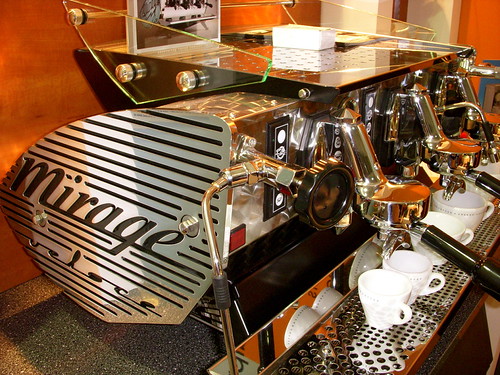
  Wandering along the foyer, I got to spot a really beautiful looking machine, the Mistral. It’s actually built by La Marzocco, but the body design is done by a designer and sold by a company called Andronicas World of Coffee who now have a coffee shop in the famous London department store, Harrods. Of course, as soon as I saw it, I stopped and took some pictures.
  For more, check
  For training and further planning, I met briefly with Gayle Reed of the London School of Coffee (
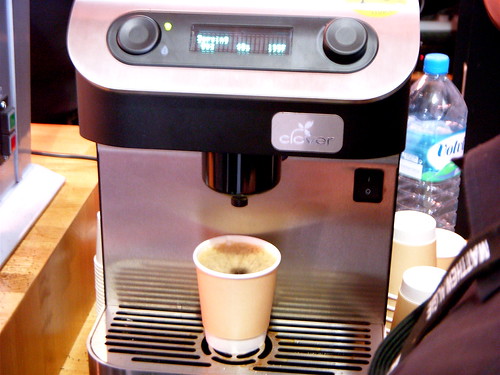 The Clover is getting quite popular in the USA, particularly with top independent cafes, where the rave is about selling coffees like wine, with $8 for a cup of coffee, sourced from a special farm. However, the Clover company has just been bought by… wait for it… Starbucks. Apparently, one of the first pioneers of Clover in America is so disgusted by the sale, that they will stop using the Clover machine. I wonder if they are willing to sell their Clover machine to me then for a few $$$. Next to the Clover, I also spotted this machine, made by Neuhaus Neotec.
  It’s a smaller roaster designed to handle small batches of green coffee and has over 200 programmes that can be pre-programmed fo
 You can view more pictures from Caffe Culture 2008 under my flickr account,
