I’ve been promising to visit a traditional Viennese Coffee House so that I can report about it on my blog for a while and if you live in Europe, you will know that the European Football Championships (soccer to North Americans) are being hosted by Austria together with Switzerland and I thought that if any of my readers where in Vienna, they could visit some traditional Viennese coffee houses. To help you, I chose a very authentic cafe, famous for cakes, the Cafe Demel.  It is near the Hofburg Palace, situated on Kohlmarkt, which now resembles Saks Fifth Avenue (New York) or New Bond Street (London, UK), next to shops like Armani, Chanel, Louis Vitton and Tiffanys. Cafe Demel is famous because it was often visited by royalty and in keeping with tradition, even today, whenever dignitaries visit Vienna, a lot of them get taken to Demel to have a coffee or at least to buy a famous Viennese cake. For example, when the former United Nations Secretary General, Kofi Annan visited, Cafe Demel made a cake that looked just like him, at least from shoulder up.As you enter the shop, there’s a display of souvenir cakes on your left and on the right and in front of you, an impressive display of very traditional Viennese cakes and pastries. As you make your way to the back, the traditional atrium has been converted into an open display area, separating you from pastry chefs decorating cakes – you are allowed to take pictures as long as he flash is off. I made my way upstairs as the lunchtime crowd had already taken up all the best seats downstairs. The interior looks like it hasn’t been touched since the turn of the last century, but that adds to the character. The regular customers I spotted in there were all into the typical Viennese tradition of ordering a coffee and reading a newspaper. as you know, if you have been through my website under “did you know”, you will know that cafes in Vienna were the first ones to introduce newspapers on sticks.Anyway Cafe Demel is now a must-stop on the Vienna tourist trail, so I was not surprised to hear lots of American and British accents. I am also happy to report that the waitresses spoke English and more importantly, where very polite, contrary to the infamous Viennese reputation of unpleasant waitresses. I had a very traditional Viennese coffee, called an Einspanner, which s basically like an Austrian version of an espresso topped with lots of thickly whipped cream.
 To accompany my very Viennese Coffee House experience, I ordered another traditional Viennese dessert, a cherry and apple strudel. All in all it was a good experience, something to be done at least once if and when you visit Vienna and I must confess, this is my first visit to a traditional Viennese coffee shop since I moved to Vienna almost 6 years ago.
Thanks La Marzocco

In the process of trying to experiment, I logged onto La Marzocco’s website and was pleased to see that they now have an online shop, where you can order lots of stuff including what I was looking for, a bottomless La Marzocco porta-filter holder (more of that to follow in my next post God willing). In any case, I was happy to learn that they now have a dealer in Vienna, Austria – where I live, and so got in touch with the dealer. In the meantime, I managed to exchange a few e-mails with La Marzocco, informing them about my website naturally, and I am pleased to say that they were impressed with my website and encouraged me to keep up the good work – OK ! now I’m feeling a bit water eyed (i.e. tearful) because, for a company like La Marzocco – makers of probably the best espresso coffee machine in the World, who of course know a lot about coffee -to say something like that, I was really touched. In any case, I am pleased to report that I managed to get my La Marzocco bottomless porta-filter and it fitted perfectly into my Isomac Venus, in fact it fitted much better than the original, so naturally I am very pleased.
The Austrian dealer tried to encourage me to get the one and only La Marzocco machine made for the home – the GS3 (the rest are for professional or commercial purposes only), but when I gasped at his special price for me only of €2,500 (a cool equivalent of about $3,500) – Now on this occasion, I am happy to say that the price of this machine is cheaper than in the US, which I just saw was retailing for about $7,000. It’s worth a coffee fanatic coming over to Austria and buying the machine and taking it back home and still saving money. In any case for more about this machine read the very extensive review on Home Barista http://www.home-barista.com/pros-perspective-gs3.html.
Anyway I digress somewhat.
Visit www.lamarzocco.com for more about La Marzocco.
Report on Caffe Culture 2008
 Wow ! an arena, where you will probably be served the best coffee in London and probably the UK over two days and the best part, it’s all free, as top baristi and espresso machine suppliers and coffee roasters vie against one another to try and sell you their coffee. Caffe Culture basically brings together all the major suppliers and players of the UK coffee shop scene covering all the supply chains – so if you were thinking of setting up a coffee shop, you will in summary meet everyone that can help you provide all the essentials (coffee, coffee equipment, non-coffee products, smoothie machines, tea, chocolate, cakes, biscuits, paper cups, porcelain cups, graphic design, cafe furniture, publications, software, etc) including consultants that will train your staff and teach you how to draw up a business plan. As I mentioned in my previous post announcing the event, this was my third year attending. This year, the event was even better and bigger, spreading over two floors for the first time in the Kensington Olympia Hall. The bottom floor was predominantly dominated by equipment, auxiliary items and coffee suppliers including two stages, one focusing on food preparation and the other on lectures on the coffee business. The second floor had a few other suppliers but was dominated by the Speciality Coffee Association of Europe (SCAE) events, where there were workshops and most excitingly of all, the UK Latte Art Championships and some coffee tasting sessions. Sadly, I missed some of the competitions – there was just too much going on, as I busied myself with exploring some business ideas and attending 3 lectures; (i) Why a great barista will make a difference ? (ii) planning and designing a cafe including drawing up a business plan and most excitedly of all, for me anyway (iii) Latte Art – improving your technique. For the last one, I was coached by Stephen Morrissey – Irish National Barista Champion and Soren Stiller Marcussen – Danish National Barista Champion (a favourite for the WBC 2008). In summary, there was about 30 minutes of theory and an hour of practice. Stephen guided my hand to help me pour my first rosetta (below).
  I also got to use a Mahl Konig coffee grinder to grind espresso and prepare espresso using a commercial machine for the first time, on the La Spaziale, who seem to be making a big impression on the commercial espresso coffee machine scene by sponsoring the event, as their machines were predominant all over the event.
  Still with La Spaziale, they followed their trend from the past two years by always getting the UK National Barista Champion to offer free coffees using their machines. This year, it was Hugo Hernod, owner of Relish Deli in Cornwall, UK, current national champion, who I bothered daily with my regular dose of cappuccinos in the morning and espresso in the afternoon. After all, if you can be served by the best for free, why not go ahead, especially as Hugo was always willing and he seemed like a nice guy – very modest too. Here’s a pic of one of the coffees I got to drink prepared by him.
  Wandering along the foyer, I got to spot a really beautiful looking machine, the Mistral. It’s actually built by La Marzocco, but the body design is done by a designer and sold by a company called Andronicas World of Coffee who now have a coffee shop in the famous London department store, Harrods. Of course, as soon as I saw it, I stopped and took some pictures.
 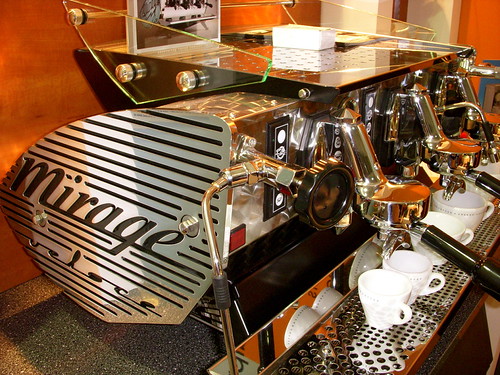 For more, check http://www.andronicasworldofcoffee.com/ On the coffee beans side, I got to sample some nice espresso from Union Hand-Roasted, whose account manager. Keith Love, was really pleasant as he took a lot of time to explain their philosophy. I already have them down on my main website as a valuable link for setting up a coffee shop. In any case, Union have gone through a major image change with nice bright exciting colours like purple. They have now started supplying supermarket chains, but I was assured that the freshness of the roasted coffee on the supermarket shelves were keenly monitored
  For training and further planning, I met briefly with Gayle Reed of the London School of Coffee (www.londonschoolofcoffee.com), whom I was pleasantly surprised to learn, offer all types of coffee and barista training, including planning and more importantly of course, for me in any case, are willing to come to your premises abroad to teach you all about coffee. For me, this was a bonus as I am currently exploring options for places like Dubai. Also on the training side, the Coffee Community, whose managing director, Paul Meikle-Janney, gave the really insightful lecture on design and planning that I attended, are also a good bet for providing all sorts of training and advice from idea, concept to implementation. Check them out on www.coffeecommunity.co.uk On more equipment, I finally got to see for the first time, the famous Clover machine, which boast a very unique method for brewing coffee. At present it retails for about the equivalent of $10,000 in the UK. There’s been a lot of noise about the Clover, not just about it’s price, but because the method manages to bring out some delicate flavours from coffee. I must admit, I sampled a Rwandan blend from the Clover and it was really easy on the stomach – it went down really smoothly and the brewing time was just a minute.
 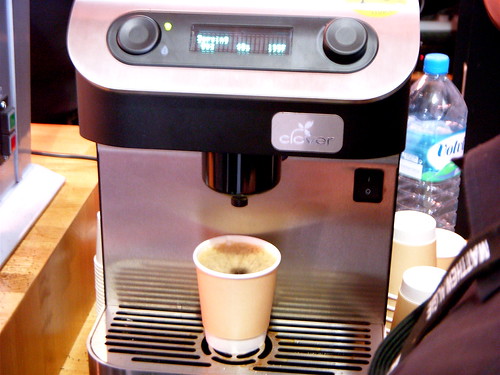 The Clover is getting quite popular in the USA, particularly with top independent cafes, where the rave is about selling coffees like wine, with $8 for a cup of coffee, sourced from a special farm. However, the Clover company has just been bought by… wait for it… Starbucks. Apparently, one of the first pioneers of Clover in America is so disgusted by the sale, that they will stop using the Clover machine. I wonder if they are willing to sell their Clover machine to me then for a few $$$. Next to the Clover, I also spotted this machine, made by Neuhaus Neotec.
  It’s a smaller roaster designed to handle small batches of green coffee and has over 200 programmes that can be pre-programmed fo
r different types of coffee. Its appeal, promoted by the saleswoman is that it can impressive customers in a local cafe, where your customers can see coffee being roasted freshly before their very eyes. In any case, some expert roasters will let you know that you need to know what you are doing with roasting beans before popping them into an automatic roaster and pressing a button. As I’m now very conscious of this post getting very long (it’s my longest to date)- I’m trying to make up for not blogging for 2 weeks, I think I’ll stop here, but just wanted to “sign” off with…  You can view more pictures from Caffe Culture 2008 under my flickr account, http://www.flickr.com/photos/lameen/
Caffe Culture 2008 (London, 21-22 May)
I’m not sure how you are connected to coffee, but for those who live in the UK and are thinking of setting up a coffee shop anytime soon, then this year’s must visit event is definitely “Caffe Culture” 2008 from 21-22 May at Kensington Olympia, London. Caffe Culture is basically the only UK and probably Europe event dedicated to the coffee shop business, which will feature over 200 suppliers from coffee beans and coffee machines to cups, tea, food, shop outfitters/architects,etc. In short, if you wanted to open up a modern cafe, then all you want will be there, in terms of suppliers and know-how, plus you get to drink lots of free coffee made by professionals. The first one was in 2006 and ever since then I’ve been visiting. Initially I was planning a move back to London to open a cafe in central London – what a dream – but things didn’t work out – long story. So in 2006, I went to visit potential suppliers. In 2007, I was planning on opening a cafe in Vienna (Austria), where I live – I got the suppliers, which helped a lot to get realistic figures for my business plan, but again that’s been put on hold. I did get to meet Jim Hoffmann, World Barista Champion for 2007 and got some valuable advice from him. In any case, all the stuff I learnt from talking to lots of people has helped me gain a lot of knowledge on coffee and if I do ever open up a store one day God willing, I would we a bit more wiser as to what to do and what not to do or serve. In 2008, I’m just going as “coffee enthusiast and art photographer” and hope to get some contacts for my pictures, so wish me luck. 2008 plans to be even bigger with stuff like the SCAE-UK Latte Competition and seminars for baristas, managers and potential cafe owners. I plan to report back with pictures.
For now, click on www.caffeculture.com
Re-Inventing Starbucks
When I started getting into all things coffee – part of my research to open a coffee shop – I picked up a copy of “Pour Your Heart Into It” the story about how Starbucks started and written with Howard Schultz, the person who made Starbucks what it is. However, after reading about all the good ideas, like selling Italian style coffee to a largely un-educated American population about good coffee, which funnily enough Mr Schultz had a lot of problems trying to convince his management about – I was puzzled when I walked into a Starbucks in Atlanta (I was on holiday at the time) and found a huge disparity between what I had read and what I was being served. Just a few pointers: (i) in the book, it mentions that espresso has to served in a porcelain cup to preserve the heat and the taste, but when I went to a local Starbucks and ordered an espresso, I got the espresso served in a small paper cup – they still serve espresso in porcelain cups in Austria (see the pic)

(ii) the idea of preparing espresso style coffee is mentioned a lot in the book where the baristi are trained for many hours on dosing, tamping etc, but in your local Starbucks, the barista just pushes a button – OK ! what’s going on here ? There were a few other discrepancies but I soon found out that the book I was reading was written about the beginning of Starbucks from early 1980’s until the mid 1990’s and that back then, I was reading the book in January 2006 – a 10 year gap.
So what happened to the passion of coffee that Starbucks re-invented for North America and parts of the World ? In summary, a lot but as they expanded, the passion suffered. OK ! there was huge success from a financial point of view – yes ! their stocks went way of the scale as well as profits, shop openings and brand recognition, BUT there was a price – quality and romance – the very first ideas that made Starbucks what is was. Anyway, I’m not going to write a whole blog about dissecting what went wrong or right depending from your point of view, but all I can say is that things are expected to change, with the re-appointment of Howard Schultz as CEO of Starbucks (he was previously Chairman of the Board). There’s been a lot of media coverage since mid-2007 when a memo was leaked from Starbucks about the “wrong” sort of changes. In addition, there was a drop in the share price and the first ever fall in sales, culminating with the sacking of their CEO, replaced by Schultz.
Now ! Starbucks are trying to “re-invent” themselves again – trying to go back to the original quality ways but trying to take into account the change in environment – I mean now, there are so many Starbucks imitations, as well as cafes that have sub-consciously and blatantly modelled themselves on Starbucks with dim light, brown and green interiors, carpets, etc, who attract customers that want that “away from home but home environment feel”. However, although an estimated 45 million people buy something from Starbucks every week (now, that’s a lot of people) – they have lost a lot of customers, firstly the ones who grew to love coffee from Starbucks and then felt betrayed and started their own cafes or bought their own coffee machines and don’t even dream of drinking coffee outside anymore (sounds like me) and those who just went with the culture thing but once they have found something that tasted like Starbucks and was a lot cheaper, they left for other chains. Regarding the last point, it still shocks me how much Starbucks charge for coffee outside USA – it ain’t cheap in Europe and especially in London.
Anway back to what they plan to do. For me, I am looking forward to what they intend to re-launch, especially with (i) grinding beans fresh in the store, and my most anticipated move (ii) preparing coffee the manual way. The whole idea is to bring back the “romance” of coffee – the smell, the preparation and the serving. They’ve also launched an interactive “ideas” forum website on www.mystarbucksidea.com. I wish them luck. For further reading, goggle Starbucks and check the Newsweek article of 21 April 2008.
My First Cup of Excellence Coffee
I just wanted to introduce you, to those of us who do not know to the Cup of Excellence group. Scanning through their website on www.cupofexcellence.org the idea began 1999 when a group of coffee connoisseurs believed that Brazil had some really special coffees that kept on being unnoticed or disregarded, probably because although Brazil grows the most coffee in the World, their coffees are primarily used for instant coffee or if of good quality, blended with other coffees.
In any case this group got together “cuppers” (expert coffee tasters) and they went through a few coffees and the best ones were selected, giving the Cup of Excellence stamp and auctioned through the internet. This practice continues today and now has 9 country programmes, mainly from Central and South America but with one exception, Rwanda in Africa. The coffees are very special, each with their own distinctive flavours, aromas, etc and are practically handcrafted by their grower and eventually auctioned off through the internet.
The Cup of Excellence is now what may be known as the Oscars of the Coffee World. The coffees are bought by coffee connoisseurs all over the World, roasted by top specialists who want to give their customers the best highest quality coffee. Furthermore, the people who really benefit from this scheme are the growers themselves, who are recognised and financially rewarded, enabling them to plough back the profits into their business, leading to better education for their loved ones and impacting positively on their communities – Well done !
So, naturally, you can imagine that I was very excited when I got my hand on a Cup of Excellence Bag of coffee from the Costa Rica Libano coffee farm, roasted by a specialist in Austria.

I checked out the coffee on the Cup of Excellence website, where it was described by the professional cuppers as “bright, honey, syrupy and dry fruit”. I was advised to use it for espresso, which I found sweetish, reminding me of the espresso I had at Flat White, Soho (London). It had a nice golden colour too, having not been dark roasted.

However, as far as I am concerned Central American coffees are excellent for espresso based milk drinks and I as soon as I used this coffee for a double espresso macchiato, it was FANTASTICO – Heavenly, Wow ! What a feeling. Naturally ! I only drank this wonderful coffee in the mornings when I tend to drink milk based espresso drinks such as Cappuccinos or Lattes. I think the price I paid, about 7 Euros for a 250g bag of beans was worth it, considering that I have spent more and it hasn’t been a Cup of Excellence coffee. So, next time you visit your specialist roaster, try and ask if they can get you a Cup of Excellence coffee, but not one that will break the bank.
Latte Love – My Latte Art Heart
I just wanted to share another one of my favourite pics with you, taken in a LOVE coffee mug bought by my wife pour moi.

As you can see, I’ve been practising my “latte art” and although I haven’t progressed to rosettas and big hearts, this is my second success with a little heart, so wish me luck every mornings when I practise my latte art and end up rushing to work and getting in just in time. Wishing you a latte love morning, ciao.
Another Visit to Origins Coffee Roasting, Cape Town
This is another long overdue post, as I was in Cape Town in February 2008. Again, any visit there has to include a trip to my favourite coffee shop in the Southern Hemisphere, Origins Coffee Roasting, 28 Hudson Street, de Waterkant, Cape Town.  It’s one of those places that when I visit, it feels like home, as the staff now recognise me as that keen coffee drinker with a camera always talking about coffee machines and coffee beans. I was glad to see that Origins have expanded their horizons and are taking their self-imposed goal of educating South Africa about quality coffee seriously. For one, they now have a barista school at the back of their shop, where I was able to witness upcoming baristi (plural for barista in Italian) practising their latte art. I also met briefly again with Joel Singer, co-owner of Origins. Secondly, Origins now organise roadshows and they planned to have one in Johannesburg in late February. They now sell their blends to other cafes (Manna Epicure – see post on Cape Town Coffee Scene of 2008 below) and are now beginning to get a reputation. When I first discovered the place, I used to go around Cape Town mentioning Origins and everyone used to look at me like, “what and where is that ?”, but on this visit, they were like “yes, I’ve heard of it….” . In addition, one of their baristi won the South African National Barista Championships – the second year in a row that one of Origins home grown has won.

So, I’m glad that Origins reputation is spreading as the “Artisan Roasters of Africa” in SA.
In the shop, they’ve changed their main coffee grinder to the Spanish made Compak, which is fast becoming the expert choice of the baristi world as Compak coffee grinders are now used at the World Barista Championships. In any case, I went for my double espresso and was tempted to try 2 Portugese custard tarts or pasties de nata and shot a video of a two heart latte art, which you can view on my YouTube page ( http://www.youtube.com/Lameen71) They still serve their coffees using a naked filter on their Synesso espresso coffee machine, which I was determined not to miss. This gives their espresso and edge.

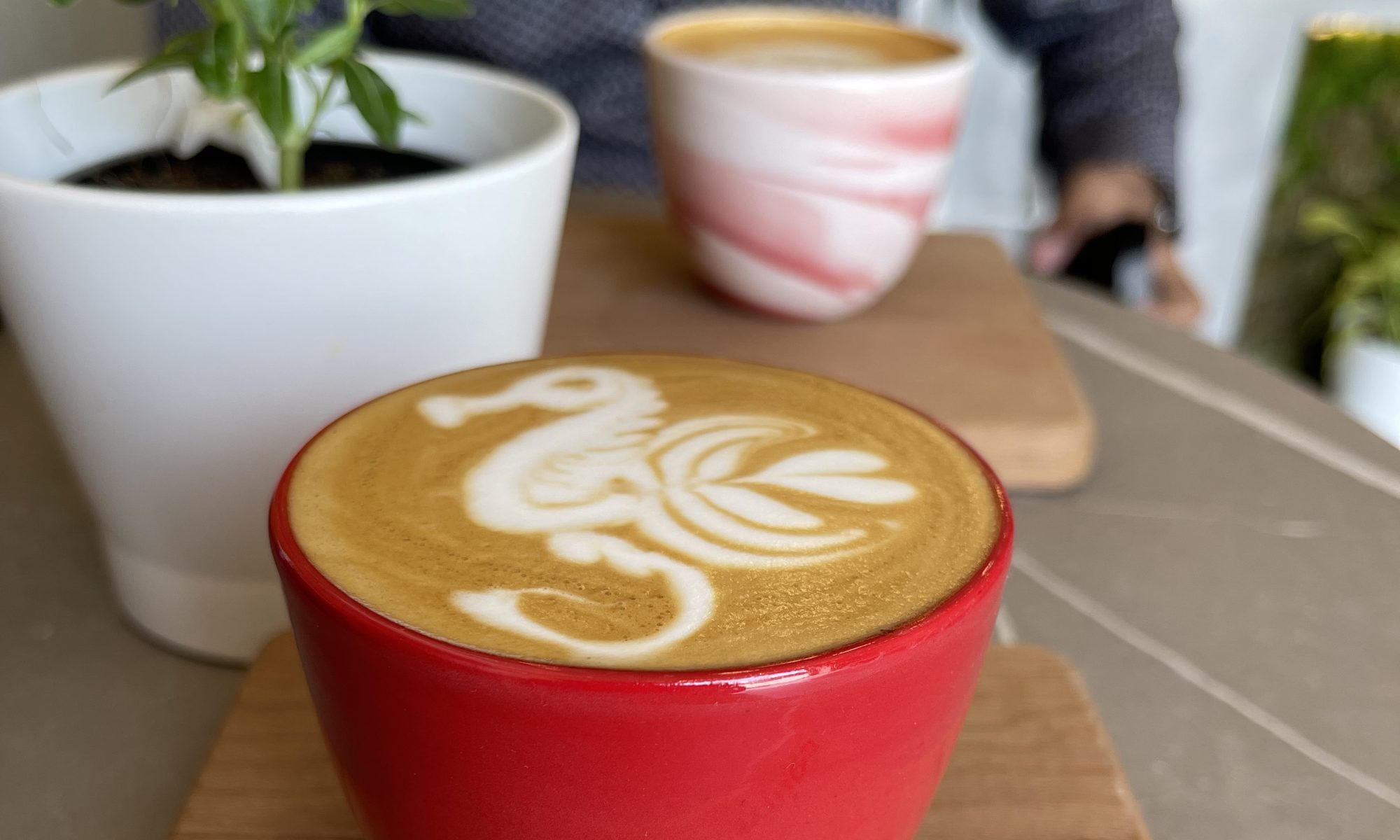
I also got to snap this unusual latte art piece – dragonfly of heart ?

I bought some freshly roasted coffee and was glad to see other people in the queue enquiring and splashing out (an English slang for spending lots of money) on coffee.

I continue to wish Origins the best of luck in their ventures and if you go to Cape Town, please do yourself a favour and visit – your taste buds would love the experience. Check out their website on http://www.originroasting.co.za/
I’ve Been Drinking… lots of Coffee

I’ve been a bit lazy with this category, where I share my latest coffee bean experience with you – so I’m going to give you a snapshot of what I’ve been drinking over the last 2 months and promise to keep you up to date with my latest taste adventures.
First up is a Rwandan Musasa, which I bought from Origins Coffee Roasting, Cape Town, back in February 2008.

It was quite nice as an espresso, rich, dark and …. handsome (to the taste buds that is). I found it earthy/chocolatey and a smell of it, reminded me of Africa. So it was quite true to its name. I also got on that trip an Ethiopian Yirgacheffe as they didn’t have my favourite Ethiopian Sidamo. The Yirgacheffe was what I call typical African – bold and earthy, nice for Cafetiere and I couldn’t resist the temptation to make a portion in my bodum Cafetiere and shoot it in a newly bought “African” coffee cup, which I bought in Zimbabwe.

On my way back from that trip to Africa, I got to stop over in London and rushed on over to my favourite roaster, HR Higgins, where sadly enough they didn’t have Indian Malabar Monsooned but I was tempted to try their Brazilian Bourbon, which I can tell you has been added to my favourite list for espresso. Delightful ! It’s quite smooth as an espresso and has that Italian feel – I seem to recall reading somewhere that Italians use a lot of Brazilian arabica coffee beans in their espresso blends. As I usually drink espresso at night and wasn’t able to get a good shot of a rich and smooth espresso due to bad lighting, I can only share with you, a snapshot of the coffee bag below.

In any case that basically summarizes the main highlights of my taste adventures for now. Of course I’ve also been drinking lots of other coffee but I just wanted to focus on the main discoveries.
My Coffee Videos on You Tube
My First Video, shot at Origins Coffee Roasting, Cape Town, where the barista poured two hearts into a latte. Check it out; Two Hearts Latte Art.mov
Or if your browser doesn’t like this, click below for more videos;
 From Coffee With Love