I’m drinking espressolab coffees

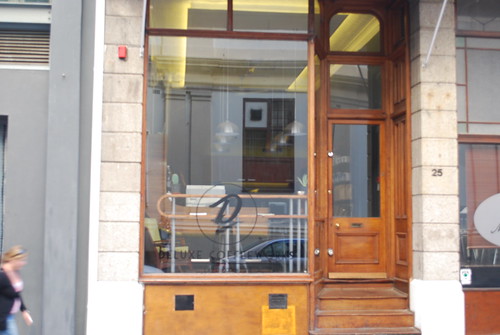
They are only 1 year old but their popularity is growing, Espresso Lab that is, situated in Woodstock, Cape Town. If you’ve been reading my blog, you’ll know that I discovered way back in October 2009 – well, they were 5 months old. OK ! So it’s one of my prime stops for coffee in Cape Town and lucky for me, my familiarity with Renato, the roaster, has helped increase my coffee knowledge. Usually sourced from high quality coffee farms when in season, Renato prefers to roast in a manner that brings out the fruity and spicy elements in a coffee, almost like coffee for the sophisticated, so if brewed correctly, you should get soft chocolate, apricots, lime, honey and caramel notes. In this manner and I may be generalizing, the coffee is roasted lighter than most. To compliment this style of roasting, you also need to set your brew temperature (if you’ve got one) to between 91-93 C. Lucky for us, Renato places a variety of information on each coffee bag, ranging from roast date, blend composition, tasting notes and brew parametres.

Just a note; as I don’t have a brew temperature control, I usually run the machine for a few seconds to cool it down a bit, before I extract my espresso shot.

OK ! So what have I been having. Lots and the main ones I can remember are Panama Mama Cata, Organic Espresso (Brazil and Ethiopia), Espresso 004 Version (panama  mama cata, costa rica puente tarrazu and ethiopia hama) and just finished Espresso blend 008 version (brazil serra do bone, costa rican puente ecologico tarrazu and ethiopian guji). I should mention that Renato likes African coffees too. So first up,the Panamanian coffees, santa teresa and mama cata, which I will never forget, tend to have very distinctive tastes, such as lime, grapefruit and chocolate, wow ! I recall tasting them at espresso lab when they were having an in-house tasting session and the mama cata was really different.
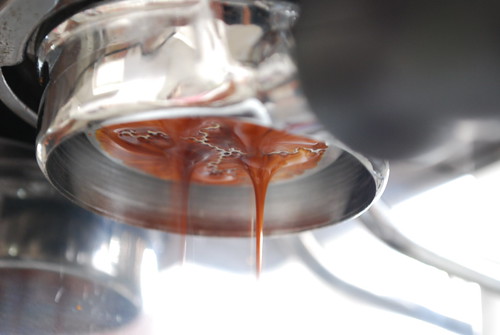
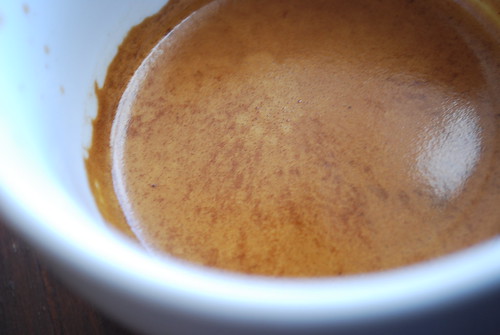
Look at that golden trickle, like honey.

Second up and very in-tune with espressolab coffees are the high notes of fruit, complimented with soft cocoa tones and a hint of honey and sometimes caramel, encapsulated in the ESP004 blend, which featured a 40% composition of mama cata. Nice – was my first impression. However, as I’ve lost some of my pics due to my hard drive crashing a few weeks ago, I can’t share a pic with you, unless the pics are retrieved. Wish me luck.

However, my favourite to date (just finished last week) has to be their latest blend, the ESP008 (I’m guessing that every time Renato develops an espresso blend, it gets a new 00 number, so this is version 8). On this occasion I just went for a 500g bag, and seeing that about 10 days before I got it, it was ready for the extracting. As an espresso, it was one of the sweetest I’ve ever had and so after dinner, there was always a pleasant delight to complete my meal awaiting for me, with a double espresso but of course;
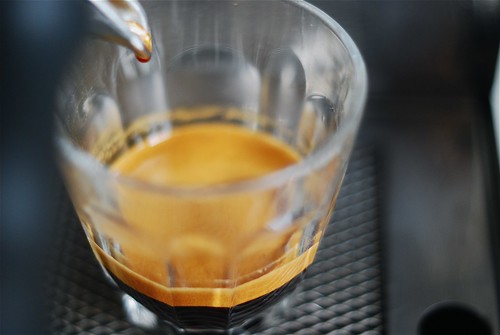
I looked forward to the mornings, as when blended with milk, the chocolate and caramel tones pulled through the milk for quite a pleasant brew. As the first people that served me a cortado, I usually made a cortado to compliment this delicious espresso blend from espressolab, which I think is their best to date, well done espressolab.

I hope Renato doesn’t tamper with this blend for a while as I know he prefers to source seasonal coffees and I’ve got an exciting package of more coffee to taste coming soon to share with you. If you can, grab a bag quick, when you are near Woodstock or visiting the Old Biscuit Mill on Saturday morning, Ciao !
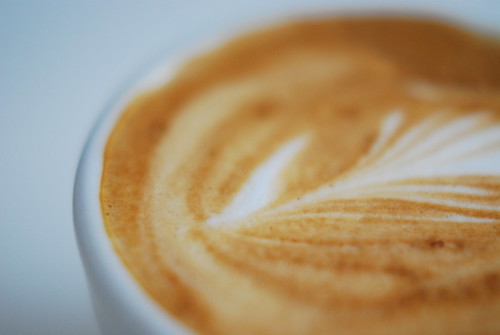
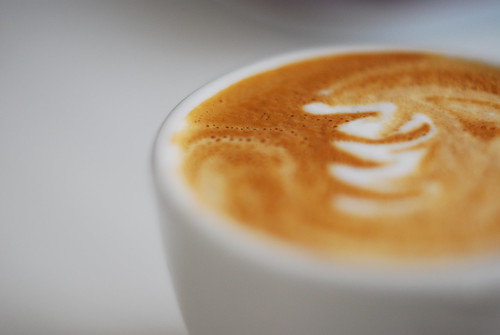
Cortado, Cortado…

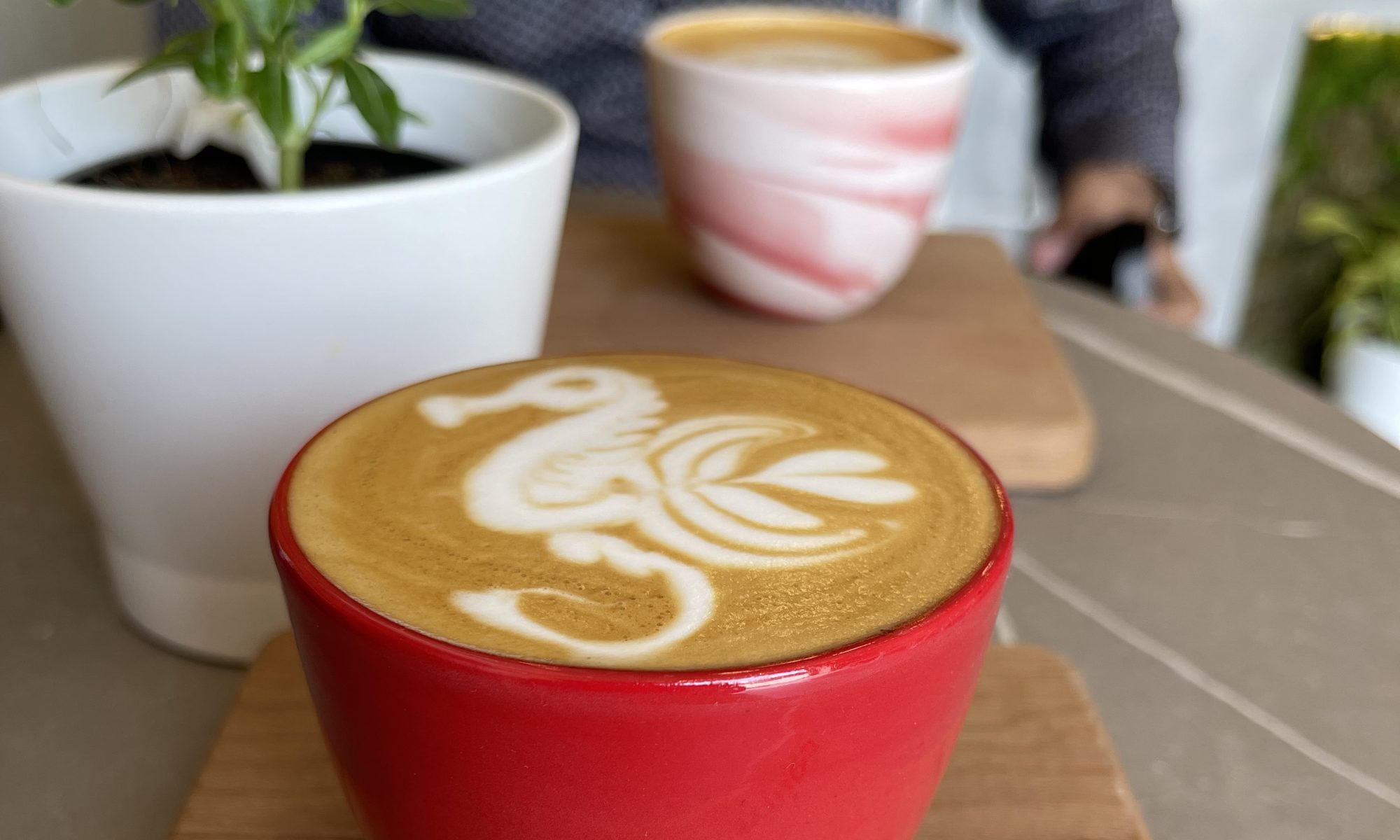
Since I was served this Spanish version of an espresso milk based drink at Espresso Lab (Cape Town) in October 2009, it has become my favourite morning brew. In summary, it is half espresso and half milk/froth, almost like a smaller brother of a cappuccino but packs more punch because there’s more espresso in it, which means you get to taste the coffee more. So, to get a little technical, you’re looking at a 50-60ml double espresso extraction (depending on how many grammes you use) topped with about the same amount of liquid (frothed and steamed milk). It’s much easier if you have a 100-120 ml cup of course, but just play around with it, so that the coffee punches well through the milk. You should also be able to detect some different taste notes coming out such as milk chocolate and hazelnut, which appear to reveal themselves more distinctly when milk is added to the coffee/espresso equation. I’d strongly recommend it for espresso lovers, who don’t want as much milk and froth as you find in a cappuccino nor in a Flat White, but who nevertheless want to taste their espresso blended nicely with hot milk.

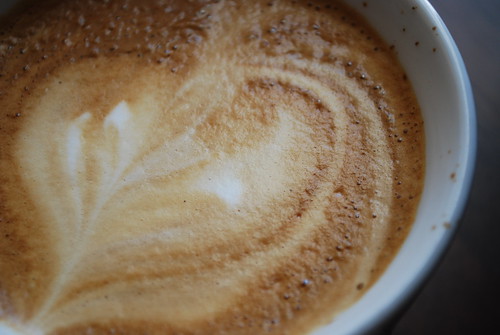
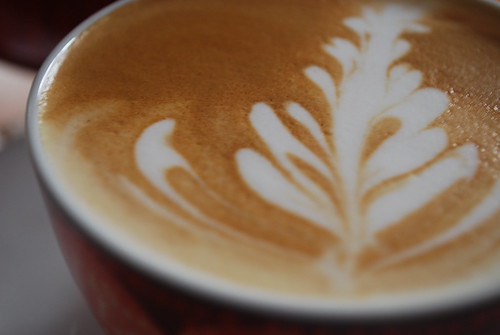
The other reason why I like a Cortado, is that I find it much easier to do latte art in a smaller cup – Well ! how else would I be able to share these nice pics with you because if I just talked and didn’t share these tasty pics to inspire you to try it at home, you’d skip my blog. Coffee is about art and science – a wonderful blend of the subjects of our age – OK ! enough of this philosophical dribble, just try this at home. Ciao ! or perhaps on this occasion I should say Adios (for those who don’t know, this is the Spanish way of saying bye bye). Adios Cortado ! until tomorrow morning.

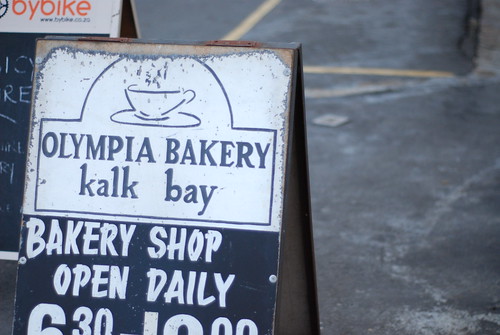
Bean There: Olympia Bakery & Cafe, Kalk Bay

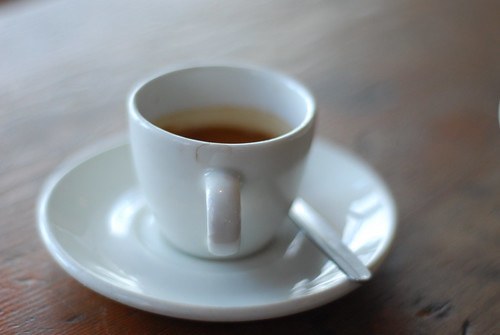
Last weekend on our “discover Cape Town” trip, we decided to check out the coastal fishing village of Kalk Bay. I had two main intentions, eating fish and chips at Kalkies and checking out the infamous (at least on this side of the World) the Olympia Bakery & Cafe. So after my fish and chips, it was down to the main road in Kalk Bay to look for this cafe, which was quite easy to find and almost a strong stone throw away from the fishing port. Olympia is very popular with the locals are supposed to be famous for breakfast and apparently on Saturday mornings, it can be near impossible to get a seat inside if you are a late bird. Lucky for us, we popped in during the late afternoon, where the mood was lively and very down to earth. True to form, I ordered a double espresso – what else in the afternoon ?

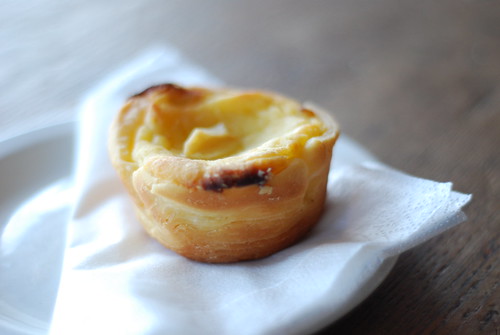
Being a bit of a sweet tooth, I noticed that most of the pastries and cakes were gone – good for Olympia as they got to sell their stuff, but spotting the no-serious-cafe-in cape town-cannot stock pasties de nata phenomenon, I went for one Pasties de Nata to accompany my order of a double espresso. I must admit the pasties was more cake than pasties & custard, but fine for me.

My daughter was with me and so not to be left out, we ordered a hot chocolate too, which she took away, enjoyed and spilt in the car, hmmm. The coffee at Olympia is supplied by Origin Coffee Roasting, based in de Waterkant, which you can find more about on my blog roll and if you do visit Cape Town and rent a car, (you will need to for this trip), then I recommend the 30 minute drive from the centre of Cape Town to this village, which apparently is very busy during the high tourist season between mid-December and mid-January, because of its quaint appeal and warm beaches, not to mention Seal watching, fish restaurants and of course Olympia Bakery.

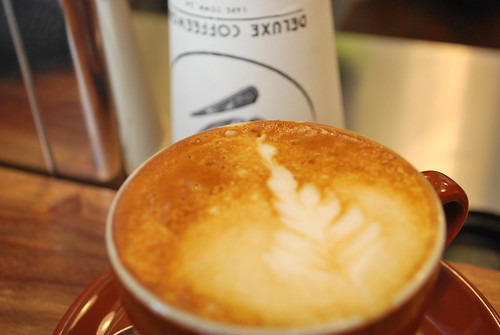
Coffee Roasters: Deluxe Coffeeworks, Cape Town

I’ve decided to add a new category as I launch myself into the Cape Town and South Africa coffee scene, to be called “Coffee Roasters”. I was thinking, if you are new to a new city and are really craving not only good coffee, but somewhere to buy good coffee, it can be stomach wrenching – I am speaking from experience in my new home city of Cape Town. So, imagine my joy in late December, when the bags of coffee I carried over from Europe had run out and I stumbled across a shop, wreaking with the smell of freshly roasted coffee. Of course I walked in, spotting a coffee roaster tucked into the back and someone behind a coffee bar offering me free coffee to taste, “God relieved me of my distress”. Where was I ? Deluxe Coffeeworks. Well ! actually I have been thinking, but I have never asked, where did that name come from and I thought about breaking the name into a phrase ” Deluxe coffee works” Get it ? Well ! Good coffee works, but bad doesn’t. OK, I’m digressing. So, who are they ? Currently there’s Carl, Nick and Judd. Judd, originally from New Zealand, was also trained there at Cafe Supreme and from what he is doing in this new establishment, he obviously learnt well. They’ve only been up and running since 2009 and already have a following and a growing client base amongst some top cafes and restaurants in Cape Town. Their plan is to focus entirely on wholesale coffee sales but lucky for us, you can pop into their roastery cum shop on Church Street, which is very centrally located and they would gladly serve you any espresso based drink at a fantastic price.

The other bonus of course, is that you can also buy freshly roasted arabica beans to take home with you, packed in organic looking brown bags by the kilo or shiny 250g bags. They can also grind it for you if you prefer and they sell little gadgets like milk frothing jugs and Bialetti’s version of the French Press. The guys at Deluxe Coffeeworks are really easy to talk to and if you’ve got some time to spare, drop in and chat about coffee, Cape Town and life. Naturally, I’ve tried their coffees, which I tend to find is very aromatic. My current favourite is their organic espresso blend,

but their espresso blend is also very nice, blending well with milk and displaying chooclate and nutty tastes.

I’ve currently got one of their experimental blends at home, which is a mixture of Kenyan and Ecuadorian arabic coffee beans. I find it a bit spicy, bordering on licorice in taste and very distinctive as an espresso.

I was also lucky enough to be invited to an espresso tasting session of single origin coffees a few weeks back, which ranged from a very strong Kenyan espresso to easy-to-drink and very mass appealing Guatemalan arabica. So, definitely worth a visit before they completely close their doors to the walking public, but if you’ve got a cafe or restaurant in the Cape Town area, check them out as a possible supplier and they ain’t paying me to say that.

Autumn Espresso… What Now !

This is absolutely disgraceful – 8 weeks without blogging – I hold my head in shame but I do have a great excuse… I’ve moved to Cape Town, one of my favourite foodie city to open a coffee (but of course) and cake/sandwich shop. It’s been challenging trying to settle in without easy access to communication like internet. In any case I’ve been really busy with checking out the coffee and cafe scene and it is quite exciting. However more on that next time, as this is supposed to be about Autumn Espresso.

Yes ! It is a bit strange to talk about autumn, as it’s mid-winter in the northern hemisphere and mid-summer in the southern hemisphere – it’s like 25C outside as I write. So, I guess to compromise for my readers in both hemispheres so that no one gets left out, it is apt that I should talk about a coffee that was roasted and blended to typify the season in between, Autumn of course. OK ! I got this bag of Autumn Espresso during the northern hemisphere season, back in late October/early November but didn’t get the chance to share my experience.

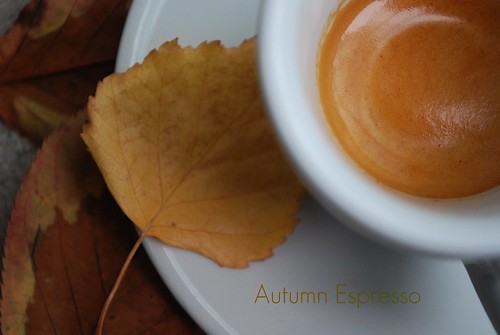
It’s roasted by Square Mile Coffee in London and reminds you of the Autumn mainly because of the roasted hazlenut and caramel and toffee tastes that dominate. There is a hint of chocolate of course, but this comes out more when you make it as an espresso milk based drink like a Cappuccino or Caffe Latte.

Just love the pics of these coffees as I was really getting into studying my digital SLR and playing around with different concepts like Aperture, so that I could use the camera to bring out the best of the coffee, especially as these were taken on wet, windy and cloudy Autumn days. I must confess I cannot remember where the coffees were sourced from, but being a fan of Square Mile since they started in 2008 I can almost say for certain that there was some Central American arabica thrown in, probably from Guatemala and/or Ecuador. You’ll have to wait another 9 months for this to be available again on the market and if you can get your hands on some, go for it.

Espresso Tazza D’Oro

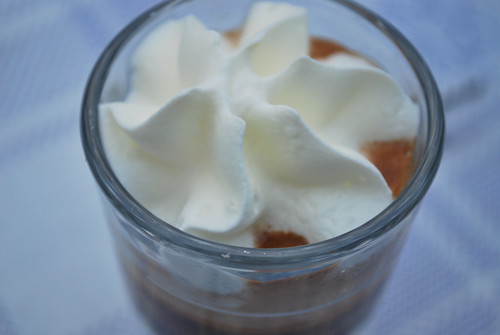
Doesn’t it look lovely ? Yes ! It’s another simple espresso recipe, for which you need to extract a good espresso, following all the rules of course and just top it with freshly whipped cream. I’ve got one of those flashy ISI Whippers, which basically makes fresh cream in an instant by placing single cream into a siphon and adding some gas through a specially made canister for the ISI Siphon (made famous by World renowned chefs like Ferren Adria – you’ll only know of him if you are a mad foodie). In any case, most cafes now have ISI Siphons, even Starbucks, as it is so easy to use when making coffee that requires whipped cream. You may also wish to know that ISI is actually an Austrian company and that the first place to serve coffee with cream was in….. Vienna, capital of Austria.

You can also top it with chocolate sprinkles. Espresso Tazza D’Oro of course is a very Italian name, which has something to do with gold (oro), but this drink has another more famous name, Espresso Con Panna. It’s just that I like the way its not so famous name sounds, very flashy and Italian indeed, so one more time ESPRESSO TAZZA D ORO, Ciao bellissima caffe.

Bean There… Espresso Lab, Cape Town

I had the opportunity last week to spend time with, David Donde, formerly of Origins Coffee Roasting and he showed me a new cafe, Espresso Lab Microroasters, located in “becoming trendy” Woodstock. Espresso Lab is located at the Old Biscuit Mill, 375 Albert Road, which seems quiet during the weekday but on Saturday mornings becomes a bustling market place, with Cape Town’s middle class jostling to buy organic fare, art and delicious food. OK ! back to the coffee. Espresso Labs has a really unique concept, living to its name by appearing like a lab, with coffee signs displayed like ES for espresso and AM for Americano, but the bags have longer names like ESP for espresso

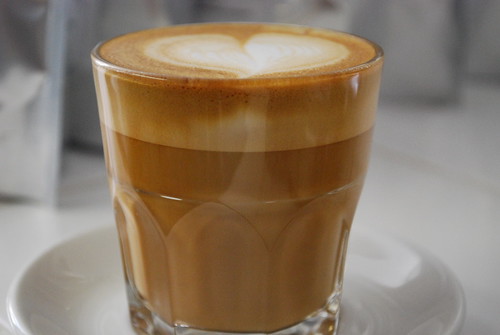
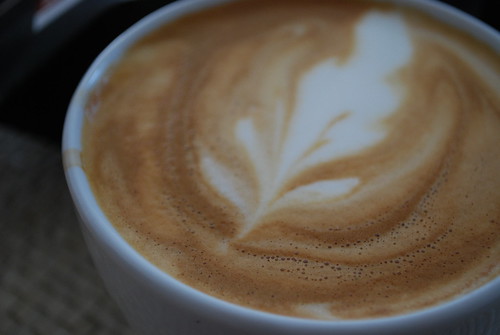
Espresso Lab is run by Portuguese origin Capetonian, Renato. They’ve got a La Marzocco GB5 and their coffee roaster is located at the back in a clean looking space. On my second visit, yes ! I went twice, I decided to try what seems like their signature drink, a CO or a Cortado, made using a double espresso with about equal portions of frothed milk – check out the beautifully poured rosetta heart.

So it is really for those who want to taste their coffee with just a topping of frothed milk, as is a bit obvious from the pic below, where you can see the clear separation/layers from coffee, through milk and froth at the top.

It was really nice, especially for someone like me who ideally prefers a really strong cappuccino as opposed to the usual espresso, third milk and third froth – the official description of a cappuccino. Before I left I got a couple of bags of coffee to sample but of course, but more on that next time. So, when in Cape Town, check out Espresso Lab Microroasters and check out their website too, http://espressolabmicroroasters.com/.

Espresso Cream

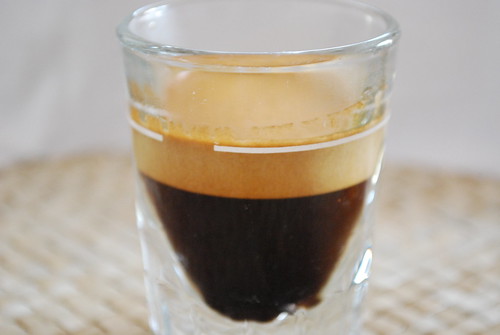
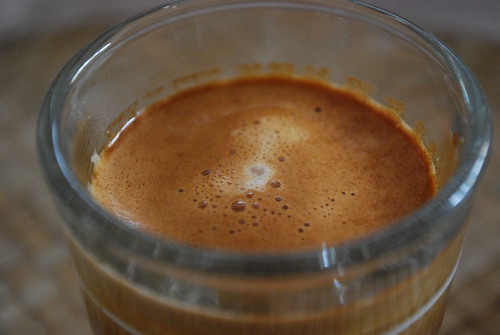
No ! that isn’t spelt wrong… it is cream this time and not crema, but you need crema first. Confusing ! I thought so, so let me explain. I was drinking Square Mile Coffee Roasters latest addition “Progresso” I love the way it sounds. It’s like a new espresso drink should be created with that name. In any case, Progresso is advertised as a cremay cup, with lingering sweetness, if brewed properly of course. So, looking into my fridge, I noticed a carton of full cream inside and thought “I’ve never tried espresso with cream before, well there’s always a first time”. The main reason for this of course, is that I thought “how can someone destroy an espresso by putting cream inside” and the very thought cold easily make me scream, BUT on this occasion, my culinary curiosity got the better of me, because I thought cream added to sweet things usually enhances it. So first up, extract a beautiful espresso with a good dose of crema visible on top like below;

Then of course, just pour a little bit of cream on top, but it should be enough to make the drink rise just a little bit – say about 2 teaspoons worth.

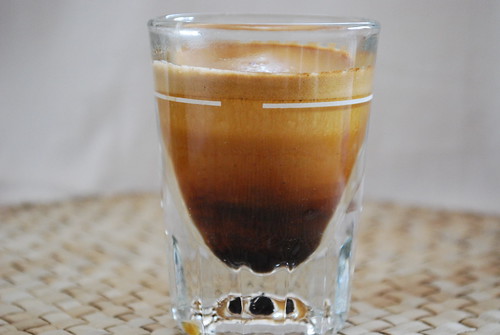
In the picture below, this is more evident, as I used an espresso shot glass, which when extracting a single espresso should rise to the line, but there was enough cream to just push it above the line.

This adventure just wasn’t about the taste, but about the art of coffee, because I really wanted to see how the colours would display with a shot of cream poured inside an espresso crema – would the crema disappear, or would it rise to the top like real cream is supposed to, and so there was a bit of the scientific too. Just look at all those colours.

On taste, I was correct, the sweetness in the espresso was enhanced, making it a truly tasty experience. So next time, break with the conventional and try something different. Is this progress with drinking espresso ? I don’t know but just one more time, say PROGRESSO like an Italian would.

Ciao, Espresso Cream Crema……

I’m Drinking …. Summer Espresso

Hmmm ! Courtesy of Square Mile Coffee Roasters (London), who produce a blend for each season. The summer version is made using 80% Finca Las Nubes from Guatemala and 20% La Carol from Colombia. Incidentally, as far as I can remember, the Finca Las Nubes arabica bean was roasted by Square Mile Coffee and used by Gwilm Davies to win the World Barista Championship this year. So this is really a special bean and if I was a crass advertising agent for Square Mile Coffee, I would say “buy your special championship bean from us, used only by champions, so be a champion and buy this bean…now !” But, I’m not, so just buy it anyway, but oops, too late, summer is over. Until next year then, God willing, but honestly visit their website (link on my blogroll to the left) and they may have some more left. In any case, what I like about Square Mile Coffee Roasters (SMCR) is that they actually tell you what their blend consists off – this is unusual trust me, as I’ve asked many a roaster what their special in-store blend consists off and they give me that, like I’m going to tell you my secret smirk. Even more props to SMCR, they give you an indication of what the coffee should taste like if you’ve got the right tools of course and know what you’re doing. So, for the Summer Espresso, it should be…

An amalgamation (i.e. lots of) of taste, however the prominent ones I detected were caramel and the berry juice finish. The berry juice finish is really freaky, because what happens is that you’re drinking the coffee, tasting the nutty and caramel taste and then as you finish each gulp, a berry tastes whirls through to the back of your throat…BERRY FINISH. almost scary, but fun for the taste buds. With milk based espresso drinks, I found the toffee more prominent with “honey sweet”

Anyway, I was so impressed with this blend that not only did I tell SMCR about it, I’ve just ordered 2 more bags before summer runs out and if you know me, you’ll know that I hardly order the same thing twice, especially in one pack. Watch this space for the Autumn blend

Making Affogato

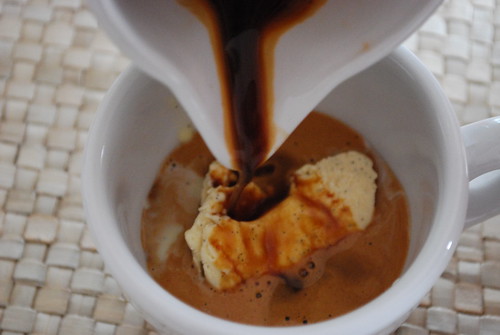
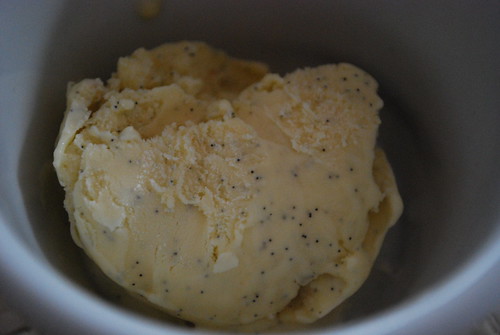
I’m not sure where you are, but in Vienna, it’s been quite hot. Not one for compromising on my afternoon fix of a double espresso, when I’m at home, I thought I’d re-visit another one of my favourite coffee recipes, Espresso Affogato in full, but for those who know, just Affogato. It’s quite popular in Italy, especially in the summer. In short, it’s ice cream and espresso together….simple, isn’t it. First up, get a cup that’s wide enough to handle a double espresso shot. Wide is important here, because with both ice cream and espresso in one cup, you don’t want the mixture spilling out at the top, as would happen if you used a normal espresso cup. Second, prepare your espresso and extract it preferably into a milk jug. Third, scoop one portion of vanilla ice cream into the cup and you are ready to complete your affogato.

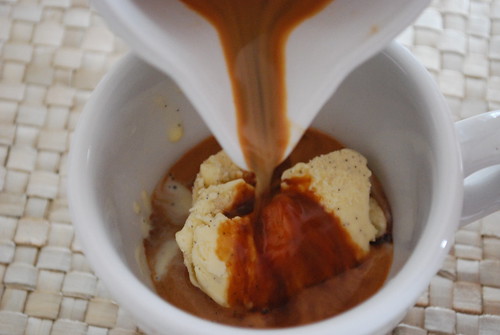
Simply pour the double espresso on top of the ice cream scoop in the cup and there you have it, Espresso Affogato.

You won’t have much time to enjoy this, especially if you have used freshly homemade ice cream, like me (recipe here), and it is really hot outside, which it was, when I made this, as the hot espresso will begin to melt away the ice cream, almost creating an espresso style float, whereby the float is warm ice cream rising to the top of the double espresso, creating a vanilla ice cream crema…. hmmmm !

One tip; to make this experience longer, adapt the pre-warmed cup technique for making espresso, for this cold/warm drink, but of course this time, you will pre-freeze the cup. So, place the cup you intend to use into the freezer or fridge for at least 30 minutes before you make the affogato, so that you don’t suffer what I went through. If you really want to be trendy with this, you can also serve it as a dessert on a warm evening in trendy cups with teaspoons to scoop the ice cream out, which some restaurants now do during the summer months, so share this experience as much as you can during the late summer months.